
My sister sat across from her ex-partner in a small room above a solicitor’s office for two Saturdays in a row, trying to sort out arrangements for her kids. On the third session, he simply stopped showing up. She called me afterwards, half relieved it was over and half terrified, asking, “So what actually happens now? Do I just… go to court?”
That question sent both of us digging through forms, deadlines, and phrases like FHDRA that meant absolutely nothing to either of us a month earlier. If you’re in the same spot right now, here’s the actual sequence of what happens if mediation fails in the UK — not the vague version, the one with real forms and real numbers.
Table of Contents
- What Comes After Unsuccessful Mediation?
- Step 1: Get Your MIAM Certificate
- Step 2: Filing the Right Court Application
- Can I Skip Mediation and Go Straight to Court?
- Step 3: Full and Frank Financial Disclosure
- Step 4: Your First Court Hearing (FHDRA)
- Does Refusing Mediation Hurt Your Case?
- What Happens If a Mediation Agreement Is Broken?
- Mistakes to Avoid
- Frequently Asked Questions
- Related Searches
What Comes After Unsuccessful Mediation?
Here’s the first thing worth knowing: mediation is voluntary, and it genuinely doesn’t work out for a lot of families. Maybe one side is being unreasonable, maybe the issues are just too tangled to resolve in a room without a judge. None of that means you’re stuck. It just means the next stage of the process kicks in, and it’s more structured than people expect.
What happens when mediation fails to reach a settlement is essentially this: you get a certificate proving you tried, then you take your case to Family Court so a judge can make the decision you and your ex couldn’t reach on your own.
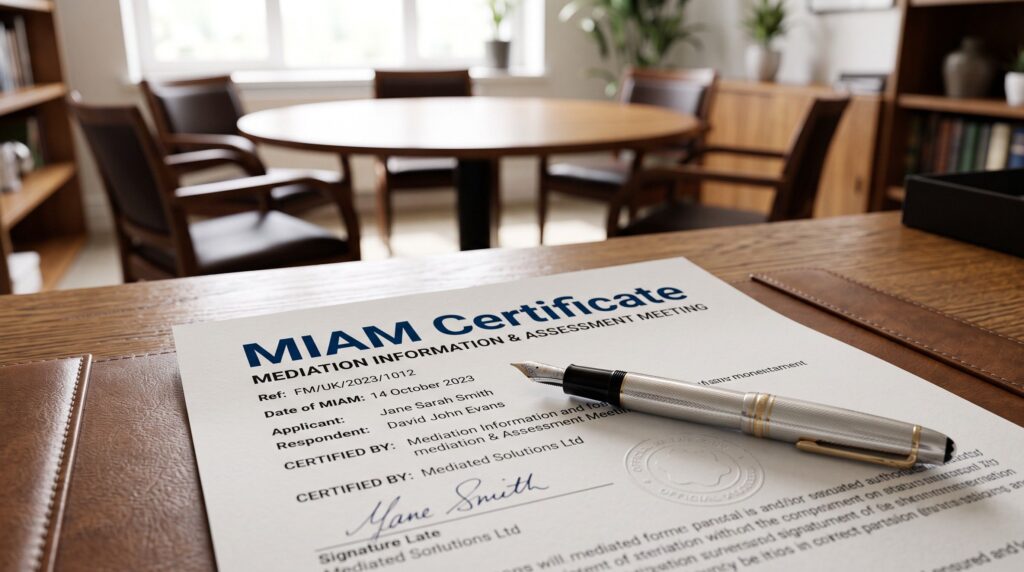
Step 1: Get Your MIAM Certificate
The single most important document you’ll need is the MIAM Certificate (form FM1). This is the formal proof that you attempted mediation and it genuinely didn’t resolve things.
Only an accredited mediator can sign this. Without it, the court will almost always reject your application outright — unless you qualify for a domestic abuse exemption.
One detail that catches people out: the certificate expires. As of 2026, it’s only valid for four months. If you don’t get your court application submitted within that window, you’ll have to go back, sit through another MIAM session, and pay for it all over again. My sister nearly missed this because she assumed she had all the time in the world.
Step 2: Filing the Right Court Application
Once the certificate is in hand, you or your solicitor file the appropriate application with the Family Court.
- Child arrangements — you’ll use a C100 form.
- Financial settlements — you’ll use a Form A.
As of 2026, the court fee sits around £255, though there’s a discount available if you’re on a low income. It’s not a huge amount compared to legal fees down the line, but it does need to be paid upfront when you file.
Can I Skip Mediation and Go Straight to Court?
Generally, no — not unless you fall into an exemption category, most commonly domestic abuse, urgency (like a child at risk), or certain situations where mediation genuinely isn’t appropriate. For most people, the court expects to see that MIAM certificate before it’ll even look at your application. Trying to skip straight to court without one usually just means your case gets bounced back and you lose time rather than save it.
Step 3: Full and Frank Financial Disclosure
Even after mediation has fallen apart, honesty doesn’t stop being required — if anything, it gets more formal. For financial cases, this stage is called “Full and Frank Disclosure,” done through Form E. You’re required to list every asset, debt, and source of income you have.
If you held back documents during mediation sessions, this is where that stops being an option. Hiding assets at this stage isn’t just risky, it can lead to real penalties once discovered.
Step 4: Your First Court Hearing (FHDRA)
Your first hearing usually goes by the name FHDRA — First Hearing Dispute Resolution Appointment.
The point of this hearing isn’t to settle everything in one go. The judge reviews what’s still genuinely in dispute and checks whether there’s still room to resolve things without a full trial. If an agreement still isn’t possible, the judge sets what’s called “Directions” — this could mean ordering Cafcass to write a report on the children’s welfare, or arranging a formal valuation of a shared property.

Does Refusing Mediation Hurt Your Case?
If mediation collapsed because your ex simply refused to show up at all, that gets reflected on your MIAM certificate, and judges do take note of it. A judge can’t force anyone to reach an agreement, but they do have tools available. In 2026, they can order the person who refused to mediate to pay part of your legal costs, or adjourn the case and strongly push both sides to give mediation one more genuine attempt before proceeding.
What Happens If a Mediation Agreement Is Broken?
This is a slightly different scenario — sometimes people do reach an agreement in mediation, but then one side doesn’t stick to it. On its own, a mediated agreement usually isn’t legally binding until it’s been turned into a formal court order (a Consent Order for finances, for example). If that formal step was skipped and the agreement gets broken, your options usually involve going back to court to have the arrangement made legally enforceable, rather than trying to fight it out informally.
Mistakes to Avoid
- Letting the MIAM certificate expire because the four-month window felt like plenty of time.
- Assuming you can skip mediation entirely without checking if you actually qualify for an exemption.
- Holding back documents at the Full and Frank Disclosure stage, assuming nobody will notice.
- Refusing mediation outright without realising it could affect costs later in court.
- Not turning a mediated agreement into a formal court order, then being stuck when it gets ignored.
Frequently Asked Questions
What comes after unsuccessful mediation?
You get a MIAM certificate confirming you tried mediation, then file the relevant court application (C100 for children, Form A for finances) so a judge can make a binding decision.
What happens when a mediation fails to reach a settlement?
The case moves to Family Court. You’ll need your MIAM certificate, complete full financial disclosure if relevant, and attend a first hearing (FHDRA) where a judge decides next steps.
Can I skip mediation and go straight to court?
Only if you qualify for an exemption, such as domestic abuse or urgent safety concerns. Otherwise, courts expect a valid MIAM certificate before accepting your application.
What happens if a mediation agreement is broken?
If the agreement was never turned into a formal court order, it likely isn’t legally binding. You’d generally need to go back to court to get it formalised and enforceable.
How long after mediation can you go to court?
You should file within four months of your MIAM certificate being issued, since it expires after that period and you’d need a new one.
Going to court after mediation — what should I expect?
Expect a court fee (around £255 in 2026), a first hearing called an FHDRA, and potentially a wait of several months before a final hearing due to court backlogs.
If I refuse mediation, will it go against me in court?
It can. Judges see on your certificate whether mediation was attempted and by whom, and can order the refusing party to contribute to legal costs or push for another mediation attempt.
What happens when custody mediation fails?
The same general process applies — you’d get a MIAM certificate, file a C100 form for child arrangements, and the case proceeds to an FHDRA hearing where a judge decides on next steps or orders further reports.
Related Searches
- How long after mediation can you go to court
- What happens when mediation fails to reach a settlement
- Going to court after mediation
- What happens if mediation fails in divorce
- No settlement at mediation
- If I refuse mediation will it go against me in court
- What happens when custody mediation fails
- When mediation doesn’t work in the workplace
Further reading: GOV.UK – Family mediation | GOV.UK – Making a child arrangements application
Disclaimer: This article is for general information only and isn’t legal advice. Moving from mediation to court involves complex procedures, deadlines, and costs. We strongly recommend speaking with a qualified family solicitor before filing any court application.

Sarah Mitchell is a family law specialist with a strong background in child arrangements, custody disputes, and family mediation. She joined LegalFacts.uk to help parents across the UK understand their legal rights and make informed decisions for their children’s future.