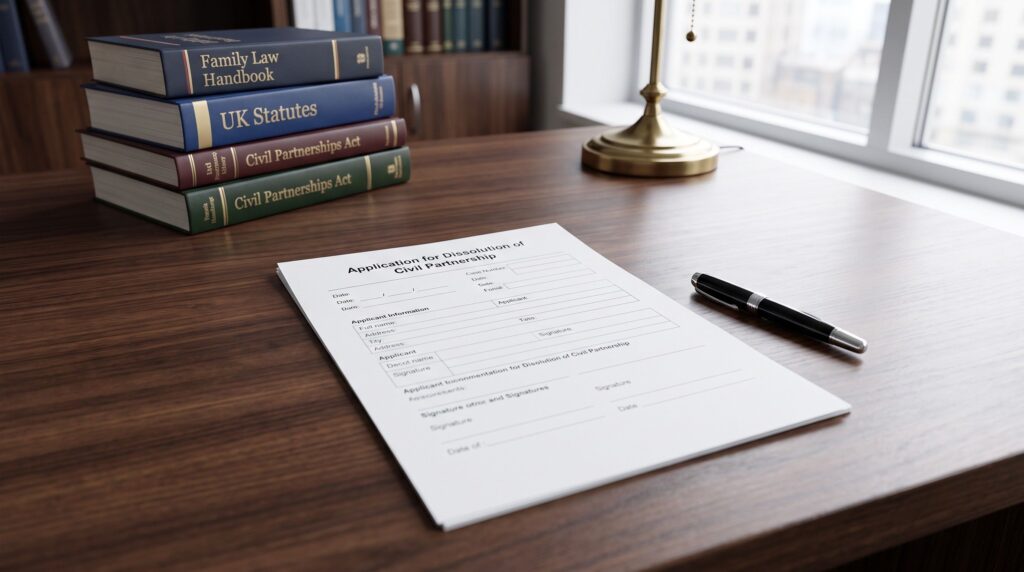
A friend of mine called me the night she and her partner finally agreed things were over. Not a messy split, no big fight — just two people who’d quietly grown apart. Her first question wasn’t about feelings, it was practical: “Okay, so how do we actually end this legally? Is it the same as divorce?”
Turns out, it’s not quite divorce — it’s called “dissolution” — but the process is built to be about as painless as ending a legal relationship can be. I sat with her through most of the paperwork, so here’s the actual step-by-step on how to end a civil partnership in the UK, without the legal jargon overload.
Table of Contents
- What Does “Dissolution” Actually Mean?
- What Are the Grounds for Dissolution?
- Step 1: Are You Even Eligible Yet?
- Step 2: Making the Application
- Step 3: The 20-Week Reflection Period
- Step 4: The Conditional Order
- Step 5: The Final Order
- Sorting Out Finances and Children
- What Is a Deed of Dissolution?
- Frequently Asked Questions
- Related Searches
- Final Thoughts
What Does “Dissolution” Actually Mean?
If you’re in a civil partnership rather than a marriage, the legal term for ending it isn’t divorce — it’s dissolution. As of 2026, the whole process runs on a no-fault principle, which means neither of you has to point fingers or prove the other person caused the breakdown. You just need to confirm the relationship genuinely can’t be saved, and the system takes it from there. A dissolved civil partnership simply means the union has been legally and permanently ended, and both people are free to remarry or enter a new partnership.

What Are the Grounds for Dissolution?
This surprised my friend, because she assumed she’d need to prove something specific went wrong. Under the current no-fault system, the only ground you need is that the relationship has broken down irretrievably — meaning it genuinely can’t be saved. You don’t need to cite adultery, unreasonable behaviour, or blame either person specifically. You simply confirm, formally, that things are over for good. This is one of the biggest practical differences from how the old system used to work, and it’s a big part of why the process feels less combative now.
Step 1: Are You Even Eligible Yet?
Before anything else, there are two basic boxes to tick:
- The one-year rule. You must have been in the civil partnership for at least a year. Courts won’t accept a dissolution application before that point, no exceptions.
- Irretrievable breakdown. You need to formally state that the relationship has broken down permanently and there’s no realistic path back.
If both of those apply, you’re clear to start.
Step 2: Making the Application
The process kicks off with a court application, and in 2026 this is mostly handled through the government’s digital portal rather than paper forms.
You’ve got two routes here. A sole application works if your partner isn’t on board with ending things — you can start the process alone regardless. A joint application works if you’re both in agreement, and honestly, it tends to set a more cooperative tone for everything that follows, since you’re already on the same page from step one.
Step 3: The 20-Week Reflection Period
Once the court accepts your application, a mandatory 20-week waiting period kicks in — often called the “period of reflection.” This isn’t just bureaucratic delay for its own sake. It’s meant to give both of you genuine time to think things through, and more practically, to start sorting out finances and any arrangements involving children before things move further along.
My friend actually found this window useful in a way she didn’t expect — it gave her breathing room to figure out the practical stuff without the pressure of an immediate deadline.
Step 4: The Conditional Order
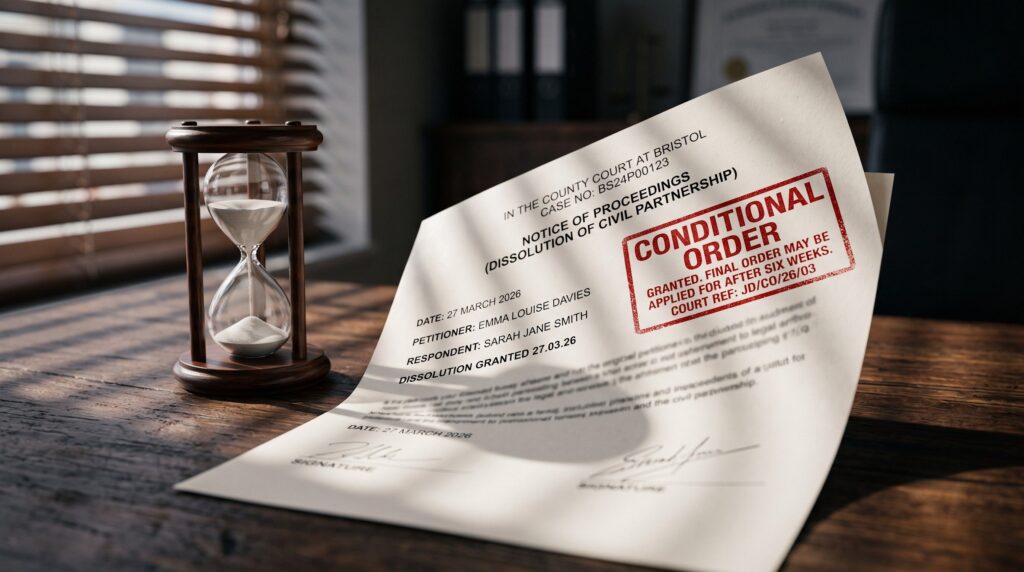
Once the 20 weeks are up, you can apply for a Conditional Order. This is the court confirming there’s no legal reason stopping you from ending the partnership. It’s important to understand this isn’t the finish line — you’re technically still legally partnered at this stage, but it’s the clear signal that the end is close.
Step 5: The Final Order
After receiving the Conditional Order, there’s a further wait of 6 weeks and 1 day before you can apply for the Final Order. Once the court grants that, your civil partnership is officially, legally dissolved, and you’ll receive a dissolution certificate confirming it. At that point you’re legally single again, free to marry or enter a new civil partnership if you choose to.
Sorting Out Finances and Children
Here’s the part people underestimate the most: dissolution only ends the legal union itself. It does not automatically sort out money, property, or arrangements for children.
For the civil partnership dissolution financial settlement, most solicitors strongly recommend getting a Consent Order from the court. This makes your financial agreement legally binding and stops an ex-partner from coming back to make a claim on your money years down the line, even after everything else feels settled. Without it, your finances technically remain open to a future claim, no matter how much time has passed.
For children, ideally you agree between yourselves where they’ll live and how time is split. If that’s not possible amicably, a separate Child Arrangements Order may be needed to formalise things.
What Is a Deed of Dissolution?
This term trips people up because it sounds like it belongs to civil partnerships specifically, but it’s actually a separate concept used mainly for business partnerships, not personal civil partnerships. A deed of dissolution of a partnership is a legal document that formally winds up a business partnership between two or more people — outlining how assets, debts, and responsibilities are divided when the business relationship ends. If you’re ending a personal civil partnership, the correct document is the Final Order from the court, not a deed of dissolution.
Frequently Asked Questions
What are the grounds for dissolution of a partnership?
For a personal civil partnership in the UK, the only ground needed under the current no-fault system is that the relationship has broken down irretrievably. For a business partnership, grounds usually relate to the terms set out in the partnership agreement, such as mutual consent, breach of terms, or the partnership no longer being viable.
How much does it cost to dissolve a civil partnership in the UK?
As of 2026, the standard court fee for a dissolution application is £593, whether you apply alone or jointly. If you’re on a low income or receiving certain benefits, you may qualify for Help with Fees to reduce or waive the cost.
What are the grounds for dissolution?
In the context of a civil partnership, it’s simply that the relationship has broken down permanently and can’t be saved. There’s no requirement to prove fault or provide specific reasons under the no-fault system.
What is the deed of dissolution of a partnership?
It’s a legal document used to formally end a business partnership, setting out how assets, liabilities, and responsibilities are divided between partners. It’s distinct from ending a personal civil partnership, which is handled through the court’s dissolution process instead.
How long does it take to end a civil partnership?
Because of the mandatory waiting periods, a standard dissolution typically takes around 6 to 8 months from start to finish. It can take longer if there are complicated financial matters to resolve alongside it.
How to dissolve a civil partnership in the UK?
You apply through the court (usually via the government’s digital portal), wait through the mandatory 20-week reflection period, apply for a Conditional Order, then wait a further 6 weeks and 1 day before applying for the Final Order that officially ends the partnership.
Is a civil partnership the same as marriage?
Legally, they carry almost identical rights around tax, pensions, and inheritance, but they’re formed and ended differently — a civil partnership is dissolved rather than divorced, and it began as a secular-only process, though the two remain distinct legal statuses.
Can you convert a civil partnership to marriage instead of ending it?
Yes, if you’d rather stay together but change your legal status, you can convert a civil partnership into a marriage in England and Wales, and you keep your original partnership date rather than starting over.
Related Searches
- Civil partnership dissolution financial settlement
- How long does it take to end a civil partnership
- How to dissolve a civil partnership UK
- Civil partnership dissolution certificate
- Civil partnership dissolved meaning
- Convert civil partnership to marriage
- Surviving civil partnership meaning
- Is civil partnership same as marriage
Final Thoughts
Moving to a no-fault system in 2026 has taken a lot of the bitterness out of this process compared to how it used to work. Following the timeline properly, understanding the grounds you actually need, and getting your finances sorted with a proper court order rather than a verbal agreement, makes the whole thing far less stressful for everyone involved — including any kids caught in the middle. It’s not a quick process, but it’s a predictable one, and that predictability is honestly worth a lot when you’re going through something this personal.
Further reading: GOV.UK – End a civil partnership | GOV.UK – Financial settlements after divorce or dissolution
Disclaimer: This article is for general information only and isn’t legal advice. Dissolving a civil partnership involves significant financial and practical implications. We strongly recommend consulting a qualified family solicitor to protect your assets and your rights.

David Hargreaves is a legal content writer specialising in wills, inheritance, and cohabitation rights. He is passionate about helping UK residents understand what happens to their assets and loved ones, and writes in-depth guides to make the law easy to understand for everyone.