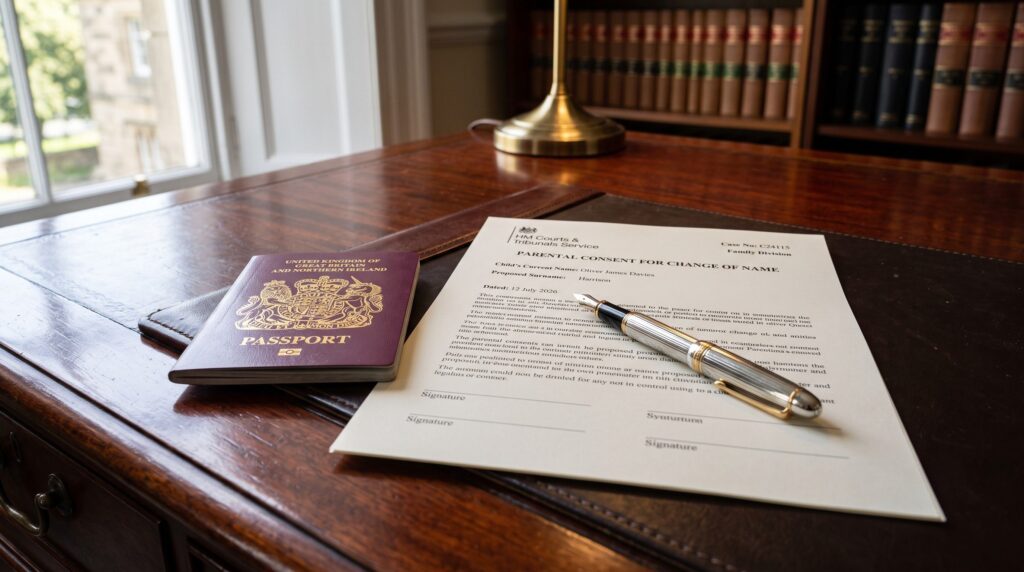
My sister-in-law went back to her maiden name after her divorce finalised and just assumed her son would automatically follow along with it, like changing an address. When she rang HM Passport Office to update his passport, she got turned away — because her ex-husband hadn’t agreed to it, and legally, that mattered a lot more than she’d expected.
That call sent her down a legal rabbit hole she wasn’t prepared for. So if you’re wondering how to change your child’s surname after divorce in the UK, here’s what actually happens, step by step, including the part that catches most parents completely off guard.
Table of Contents
- Why You Can’t Just Change It on a Whim
- The Golden Rule: Parental Responsibility
- Can an Ex-Wife Change a Child’s Surname in the UK?
- Can I Change My Son’s Surname Without Dad’s Permission?
- Step 1: Try to Reach Mutual Agreement
- Step 2: Mediation (MIAM)
- Step 3: Applying for a Specific Issue Order
- How to Legally Change Your Child’s Surname in the UK
- Mistakes to Avoid
- Frequently Asked Questions
- Related Searches
Why You Can’t Just Change It on a Whim
In the UK, a child’s surname is treated as a genuine part of their identity, not just paperwork. Because of that, you can’t simply change it because you feel like a fresh start is in order, even after a difficult divorce. There are real legal hurdles built specifically to protect a child’s link to both parents, regardless of how the adults’ relationship has ended.
The Golden Rule: Parental Responsibility
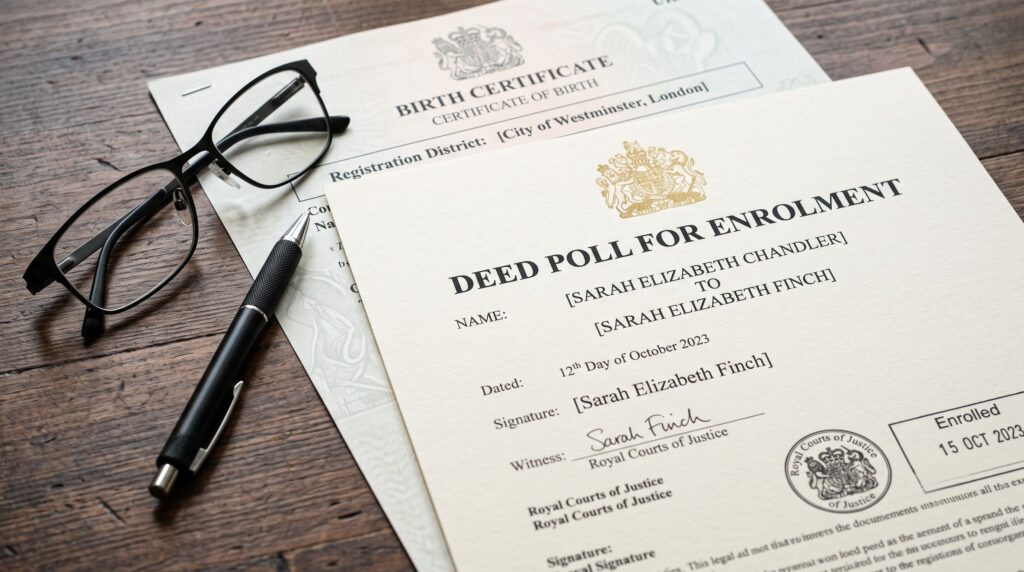
Everything here hinges on one concept: Parental Responsibility, usually shortened to PR. If the other parent holds PR, you cannot legally change your child’s surname without their written consent or a court order giving you permission.
- Mothers automatically have PR from birth, no extra steps needed.
- Fathers have PR if they were married to the mother when the child was born, or if they’re named on the birth certificate (for births registered after December 2003 in England and Wales).
If you try to push a name change through via Deed Poll without the right consent in place, agencies like HM Passport Office will typically reject it outright — which is exactly what caught my sister-in-law out.
Can an Ex-Wife Change a Child’s Surname in the UK?
Yes, but only under the right conditions. If the father holds Parental Responsibility, an ex-wife can’t unilaterally change the child’s surname without his written agreement or a court order permitting it — regardless of who has day-to-day care of the child. If she’s the sole holder of Parental Responsibility (for example, the father isn’t named on the birth certificate and they weren’t married), she can generally make the change without needing his consent, though it’s still worth informing him to avoid future disputes.
Can I Change My Son’s Surname Without Dad’s Permission?
This is the question that comes up constantly, and the honest answer is: it depends entirely on whether dad holds Parental Responsibility. If he does, no — you’d need either his written consent or a court order (a Specific Issue Order) authorising the change. If he doesn’t hold PR, you can typically proceed via Deed Poll on your own, though many parents still choose to tell the other parent as a matter of fairness and to head off arguments down the line.
Step 1: Try to Reach Mutual Agreement
The least stressful path, by far, is talking to the other parent directly. If you both agree, the process is genuinely simple:
- Draft and sign a consent letter, agreed by everyone holding Parental Responsibility.
- Apply for an Enrolled Deed Poll, which is the most cost-effective and straightforward route, and avoids any courtroom involvement at all.
Step 2: Mediation (MIAM)
If the other parent won’t agree, you can’t just go around them. Under current UK legal protocols, you’re generally required to attend a Mediation Information and Assessment Meeting (MIAM) before applying to court. A mediator works with both of you to focus on the child’s best interests rather than either parent’s frustration. Sometimes a compromise — like a double-barrelled surname — satisfies both sides without needing to escalate further.
Step 3: Applying for a Specific Issue Order
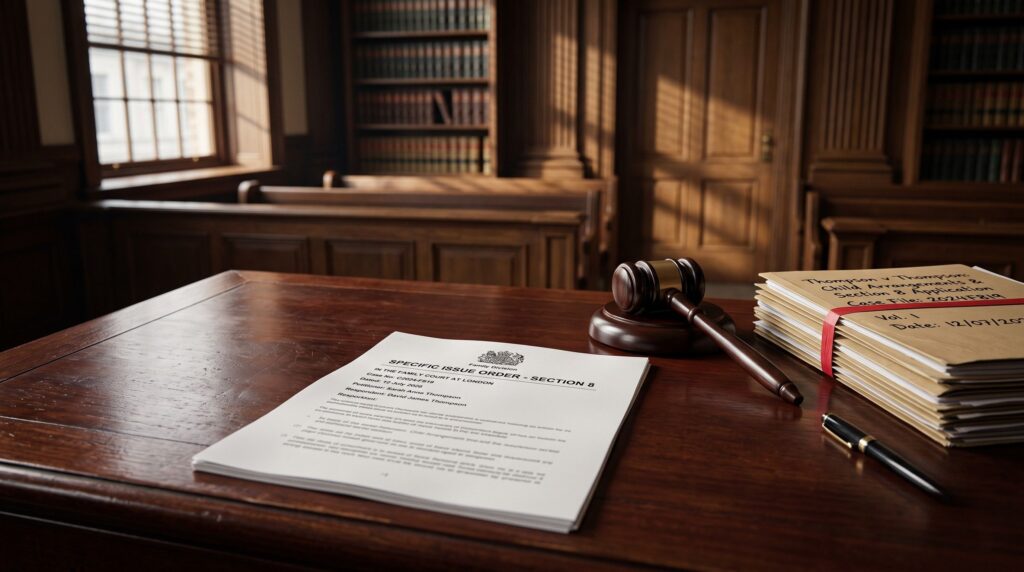
If mediation doesn’t resolve things, the next step is applying to the Family Court for a Specific Issue Order under Section 8 of the Children Act 1989.
Here’s the part that surprises a lot of parents: the judge isn’t weighing up “parental rights” at all. Their entire focus is what’s best for the child. They’ll look at:
- The child’s emotional connection to their current name
- The genuine reason behind the requested change (versus, say, wanting to spite an ex-partner)
- How the change might affect the child’s relationship with the other parent
- The child’s own wishes, depending on their age and maturity
How to Legally Change Your Child’s Surname in the UK
Pulling the whole process together: check who holds Parental Responsibility first, try for mutual written agreement and an Enrolled Deed Poll if possible, attend a MIAM if the other parent won’t consent, and apply for a Specific Issue Order through the Family Court as a last resort if mediation doesn’t resolve things. Skipping straight to a Deed Poll without the right consent in place is the single most common mistake, and it’s usually what leads to rejected applications at agencies like the Passport Office.
Mistakes to Avoid
- Assuming a name change after divorce automatically applies to the children too, without checking Parental Responsibility first.
- Trying to file a Deed Poll without proper consent, only to have it rejected by government agencies.
- Skipping mediation and going straight to court, which most judges expect you to have attempted first.
- Changing the name informally at school (“known as” name) and assuming that counts as a legal change — it doesn’t.
- Not being able to show evidence of genuine efforts to reach an absent parent, which the court will expect if they can’t be found.
Frequently Asked Questions
Can an ex-wife change children’s surname in the UK?
Only with the other parent’s written consent if he holds Parental Responsibility, or through a court order if he doesn’t agree. If she’s the sole holder of Parental Responsibility, she can generally proceed without his consent.
Can I change my son’s surname without dad’s permission in the UK?
If dad holds Parental Responsibility, no — you’d need his written consent or a Specific Issue Order from the court. If he doesn’t hold Parental Responsibility, you can typically make the change without his permission.
How to legally change your child’s surname in the UK?
Check who holds Parental Responsibility, seek mutual written agreement and apply for an Enrolled Deed Poll if possible, attend mediation (MIAM) if consent is refused, and apply to the Family Court for a Specific Issue Order if mediation doesn’t resolve the disagreement.
How to change surname after divorce in the UK?
For yourself, you can usually revert to a previous name via Deed Poll fairly simply. For your children, the process is more involved and depends on whether the other parent has Parental Responsibility and agrees to the change.
How to change a child’s surname without the father’s consent?
This is only straightforward if the father doesn’t hold Parental Responsibility. If he does, you’d need to go through mediation and, if necessary, apply for a Specific Issue Order from the Family Court.
What age can a child change their surname without a father’s consent?
Once a child turns 16, they can apply to change their own surname via Deed Poll without needing parental consent from either parent.
Can I change my child’s surname on the birth certificate?
Changing a birth certificate itself is a separate, more limited process from a Deed Poll name change, and generally requires specific legal grounds, such as a re-registration following a change in parentage recognised by law.
How much does it cost to legally change your name?
An Enrolled Deed Poll typically costs more than an unenrolled one, since it’s officially recorded with the court, but it’s generally far less expensive than pursuing a contested Specific Issue Order through the Family Court.
Related Searches
- How to change a child’s surname without father’s consent
- What age can a child change their surname without father’s consent
- Can I change my child’s surname on the birth certificate
- Statutory declaration online UK
- Name change after divorce
- UK deed poll unenrolled
- How much does it cost to legally change your name
- Are deed polls public record
Further reading: GOV.UK – Change your child’s name | GOV.UK – Parental rights and responsibilities
Disclaimer: This article is for general information only and isn’t legal advice. Changing a child’s surname involves complex Parental Responsibility laws. We strongly recommend consulting a family law specialist before applying for a Specific Issue Order or an Enrolled Deed Poll.

Sarah Mitchell is a family law specialist with a strong background in child arrangements, custody disputes, and family mediation. She joined LegalFacts.uk to help parents across the UK understand their legal rights and make informed decisions for their children’s future.