
I still remember sitting in my car outside a mediation office in Manchester, hands actually shaking a bit, thirty minutes before my first session with my ex. We’d been together twelve years, had two kids, and somehow it all came down to sitting across a table from a stranger who was supposed to help us figure out who gets the kids on Christmas morning. I’d read a dozen articles beforehand and none of them told me what the room would actually feel like, or that the mediator would ask me to make tea in the waiting area while my ex was still finishing their intake call.
That’s the thing about family mediation — everyone explains the theory, almost nobody tells you what it’s like to actually go through it. So that’s what I want to do here. I went through the full process for child arrangements, and I’ve since talked to a handful of friends who did the financial side too, so I’ll cover both, plus every question people keep typing into Google when they’re staring down this exact situation.
So What Actually Is Family Mediation, In Plain English
Forget the textbook definition for a second. Family mediation is basically a series of conversations, run by a trained neutral person (the mediator), where you and your ex try to sort out arrangements for your kids, your money, or your house — without going anywhere near a courtroom. The mediator doesn’t take sides, doesn’t tell you what to do, and definitely doesn’t make decisions for you. Their whole job is to keep the conversation from derailing and help you both actually hear each other, which sounds simple until you’re the one in the room.
How Does Family Mediation Work In The UK?
In England and Wales, there’s actually a legal step most people don’t know about until their solicitor mentions it: before you can apply to court for most family matters, you’re expected to attend something called a MIAM — a Mediation Information and Assessment Meeting. It’s not optional in most cases (there are exemptions for things like domestic abuse or urgency), and courts genuinely do check whether you’ve been.
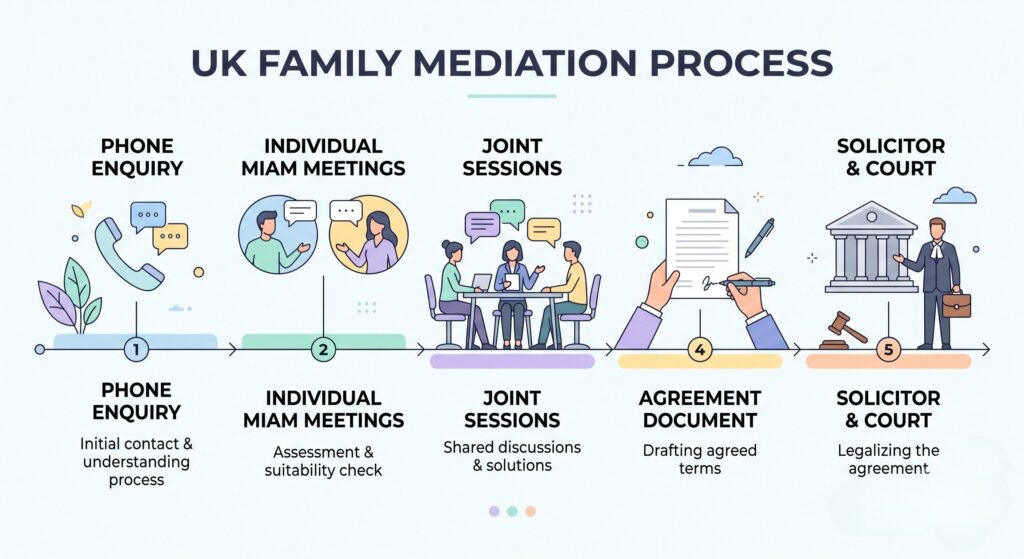
Here’s roughly how the whole thing unfolds from start to finish.
What Are The 7 Steps Of Mediation?
Step 1: You Contact a Mediator and Book Your MIAM
You (or your ex, or both of you separately) contact a family mediation service. Most places let you book online or over the phone. You’ll each attend a MIAM separately at first — this isn’t the two of you in a room together yet, it’s just you and the mediator, who explains how mediation works and checks whether it’s actually appropriate for your situation.
Step 2: The Mediator Screens For Safety Issues
This bit surprised me. Before anything else happens, the mediator asks a lot of questions — some of them quite direct — about safety, power imbalances, and whether there’s been any abuse. This isn’t box-ticking. If mediation isn’t safe or appropriate, the mediator will say so and point you toward court or a different route instead.
Step 3: Both Parties Agree To Take Part
Assuming both MIAMs go fine, the mediator contacts your ex (or vice versa) to see if they’re willing to join. Sometimes people refuse. That’s allowed — mediation only works if both sides agree to it — and if your ex won’t engage, the mediator signs a form (a C100 form for court, if it comes to that) confirming you tried.
Step 4: The Joint Sessions Begin
This is the part people picture. You and your ex sit down together (or in separate rooms with the mediator going between you, which is called “shuttle mediation,” if being in the same room isn’t workable) and start actually talking through the issues — who the kids live with, how holidays get split, school choices, or if it’s financial mediation, how the house and pensions get divided.
Sessions usually run about an hour to ninety minutes. Most people need somewhere between three and five sessions, though I’ve heard of straightforward cases wrapping in two and messier ones dragging past eight.
Step 5: You Work Through The Issues One At A Time
A decent mediator doesn’t let you try to solve everything in one go. They’ll break it down — child arrangements first, maybe, then finances — and keep steering you back when the conversation drifts into old arguments that have nothing to do with the actual decision at hand.
Step 6: You Reach (Or Don’t Reach) Agreements
If things go well, you’ll land on agreements together. The mediator writes these up in a document called a Memorandum of Understanding, plus a summary of your finances if that was part of it (called an Open Financial Statement). These documents aren’t legally binding on their own.
Step 7: You Get It Made Legally Binding
This is the step people forget about. Once you’ve got your Memorandum of Understanding, you take it to a solicitor who turns it into a Consent Order, which then goes to the court to be approved. Only once a judge signs off is it actually enforceable. A lot of people assume the mediation agreement itself is binding — it isn’t, and that catches people out.

What Not To Say In Family Mediation
I made a couple of mistakes here myself, so take this from someone who learned the hard way.
- Don’t bring up who cheated, who was lazy, who ruined the marriage. It’s not relevant to child arrangements and it just derails the session.
- Don’t threaten. Even something like “if you don’t agree to this I’ll take you to court and make it ugly” tends to shut the whole process down.
- Don’t speak in absolutes about the other person’s parenting unless there’s a genuine safety concern — “you’re a bad father” gets nowhere, but “I’m worried about bedtime routines on your nights” can actually go somewhere.
- Don’t agree to something just to end an uncomfortable session. I did this once with a holiday schedule and regretted it within a month.
- Don’t bring the kids into the room as messengers or bargaining chips, even indirectly.
What Is The Most Difficult Part Of Mediation?
Honestly? For me it was the silence. There’s a moment in most sessions where the mediator asks a direct question and just… waits. No rescuing you, no filling the gap. You have to sit with the discomfort and actually answer honestly, in front of the person you’re separating from. The second hardest part was accepting that “fair” doesn’t mean “what I originally wanted.” A good outcome in mediation is usually one where both people are a bit unhappy, not one where either person completely wins.

How Long Does Mediation Take To Start?
From first phone call to your first MIAM, you’re usually looking at one to three weeks, depending on how busy the local service is. Getting your ex booked in for their own MIAM can add another couple of weeks if they’re dragging their feet. In total, from initial enquiry to your first joint session, four to six weeks is a realistic average.
How Long Does Mediation Take For Child Custody (Child Arrangements)?
Once joint sessions start, most child arrangement cases wrap up within two to three months, spread across three to five sessions roughly two to three weeks apart. Financial cases tend to run a bit longer because there’s more paperwork to gather — think three to six months in total.
How Much Is Mediation For Child Access?
Private mediation in the UK typically runs somewhere between £100 and £160 per person, per session, though it varies by provider and region — London tends to sit at the higher end. Your MIAM alone usually costs somewhere in the £80–£150 range per person.
The good news: there’s a government-backed Family Mediation Voucher Scheme that currently offers up to £500 per family toward the cost of child-related mediation. It’s not means-tested, so it doesn’t matter what you earn — your mediator applies it on your behalf, so you don’t need to fill out a separate application. It’s been extended multiple times since it launched in 2021, so it’s worth just asking your mediator directly whether it’s still running when you book, since funding gets reviewed periodically.

Free Family Mediation Near Me
If your income is low enough, you may qualify for legal aid, which can cover your MIAM and mediation sessions completely, and sometimes your ex’s MIAM too even if they don’t personally qualify. It’s genuinely worth checking even if you assume you won’t be eligible — thresholds are more generous than people expect. Search “legal aid family mediation” plus your area, or ask any local mediator to check your eligibility; they usually do this for free in about five minutes.
Family Mediation Association and Family Mediation Council
These two get mixed up a lot. The Family Mediation Council (FMC) is the umbrella regulatory body — it accredits mediators, sets standards, and runs a “Find a Mediator” search tool on its website that’s genuinely useful for finding someone local and properly qualified. The Family Mediation Association is one of several member organisations under that wider umbrella, alongside groups like National Family Mediation and Resolution. When you’re choosing a mediator, checking FMC accreditation is the important bit — it means they’re insured, trained, and held to a code of conduct.
What Is Mediation For Children?
This one confuses people. It doesn’t mean mediating with young children in the room arguing about arrangements. It refers to “child-inclusive mediation,” where, with both parents’ consent, a specially trained mediator has a separate, age-appropriate conversation with the child to hear their views, which then gets fed back into the adult sessions (with the child’s permission on what gets shared). It’s not standard in every case and it’s generally only used for children old enough to express clear views, but in my experience it can genuinely shift how parents see the situation.

Family Mediation London
If you’re based in London specifically, expect session costs at the higher end of the national range, but also a much bigger pool of FMC-accredited mediators to choose from, plus more providers offering online sessions if getting across the city for in-person appointments isn’t realistic. The voucher scheme applies the same way regardless of location.
Common Mistakes People Make Going Into Mediation
- Going in expecting the mediator to “decide” — they won’t, and if you’re waiting for them to rule in your favour, you’ll leave frustrated.
- Not preparing your finances properly before financial mediation — vague numbers slow everything down.
- Treating the first joint session like a courtroom, with prepared speeches instead of honest conversation.
- Skipping legal advice entirely. Mediation isn’t a replacement for a solicitor — it works best alongside one, especially before you sign anything final.
- Assuming one refusal from your ex means it’s over. Sometimes a second approach a few weeks later, or a different mediator, gets a different answer.
Frequently Asked Questions
What are the 7 steps of mediation?
Broadly: initial enquiry, individual MIAMs, safety screening, agreement to proceed, joint sessions working through issues one by one, reaching a Memorandum of Understanding, and finally converting that into a legally binding Consent Order through a solicitor and the court.
Is family mediation legally required in the UK?
Attending a MIAM is generally required before applying to court for most child arrangement or financial disputes, though there are exemptions, including cases involving domestic abuse.
Can mediation happen if my ex refuses to attend?
Yes, mediation simply won’t proceed on a joint basis. The mediator will confirm this to the court if you later apply, which satisfies the requirement that you attempted it.
Does the mediator make the final decision? No. The mediator facilitates the conversation but has no authority to impose a decision. Any agreement has to come from both of you.
Is what I say in mediation confidential?
Generally yes — it’s protected as “without prejudice,” meaning it usually can’t be quoted in court later, with some exceptions around safeguarding concerns.
Do I need a solicitor as well as a mediator?
It’s strongly recommended, especially before signing off on financial agreements or converting arrangements into a Consent Order. Mediators can’t give legal advice, only legal information.
What happens if we can’t agree on everything?
You can still get partial agreements formalised, and take the remaining unresolved issues to court if needed. It’s not all-or-nothing.
How much does a MIAM cost?
Usually somewhere between £80 and £150 per person, though this can sometimes be covered by legal aid or included as part of the voucher scheme process.
Can I do family mediation online?
Yes, most FMC-accredited mediators now offer sessions over video call, which is often easier logistically and just as effective for many cases.
Final Thoughts
Looking back, the process took my ex and me about ten weeks from that shaky first phone call to a signed Memorandum of Understanding, and honestly the version of the arrangement we ended up with looks nothing like what either of us walked in wanting. That’s not a failure — that’s kind of the point. If you’re about to start this, go in expecting some uncomfortable silences, bring your actual finances instead of guesses, and don’t treat the first session as the one that has to fix everything. It rarely is, and that’s fine.

Sarah Mitchell is a family law specialist with a strong background in child arrangements, custody disputes, and family mediation. She joined LegalFacts.uk to help parents across the UK understand their legal rights and make informed decisions for their children’s future.