Here’s a scene I’ve watched play out more times than I can count, working alongside family law offices for the better part of a decade: a client walks in convinced there are exactly two options — “we sort it out ourselves” or “we go to court.” That’s it. Binary. Nobody ever told them there’s a whole spectrum sitting between those two extremes, and that spectrum is usually cheaper, faster, and considerably less brutal on everyone involved, especially the kids.
So let’s actually map that spectrum out properly, because most people going through separation genuinely don’t know these options exist until someone spells them out.
Family Dispute Meaning: What Actually Counts?
Quick grounding before we get into the options. A family dispute isn’t limited to divorce. It covers any unresolved disagreement between family members over things like:
- Where children live and how contact time is split
- Child support or spousal maintenance amounts
- Division of property or assets after separation
- Decision-making authority over a child’s education, health, or upbringing
- Disagreements between adult family members over care of an elderly relative or inheritance matters
Basically, if two or more family members can’t agree on something with real consequences, and it’s serious enough that you’re considering formal intervention, you’re looking at a family dispute in the legal sense.
Family Dispute Examples
To make that concrete, here’s what these actually look like in practice:
- Two separated parents disagreeing on whether a child should switch schools
- A disagreement over whether one parent can relocate to another city with the children
- Siblings disputing how to divide a deceased parent’s estate
- A disagreement about the amount or schedule of child support payments
- Grandparents seeking contact time after a parent restricts access
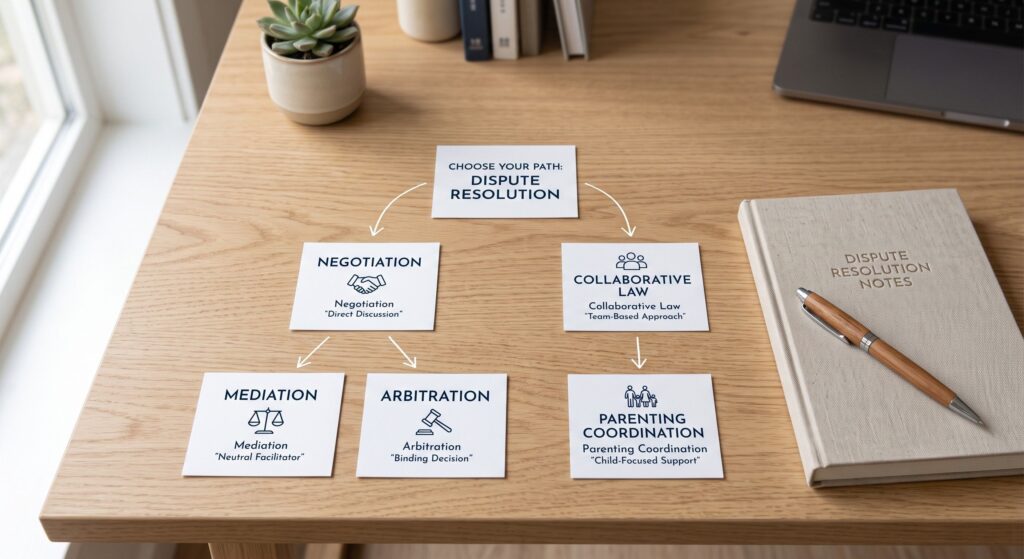
What Are the Five Methods of Dispute Resolution?
Here’s the actual breakdown, roughly in order of how much control you retain versus how much a third party decides for you.
1. Negotiation
Just you and the other party (often through lawyers) working things out directly, with no formal third-party facilitator. Cheapest, fastest when it works, but requires both sides to genuinely engage in good faith.
2. Mediation
A neutral, trained mediator facilitates the conversation but doesn’t make decisions for you. You retain full control over the outcome. This is the most commonly used option for family matters specifically.
3. Collaborative Family Law
Both parties and their respective lawyers commit in writing to resolving things without going to court. If it breaks down and you do end up in litigation, both lawyers typically have to withdraw, which creates a strong incentive to make it work.
4. Parenting Coordination
A trained professional — often a psychologist or social worker — helps implement and manage an existing parenting agreement, particularly useful in ongoing high-conflict situations where small disagreements keep flaring up.
5. Arbitration
A neutral arbitrator hears both sides and makes a binding decision, similar to a judge, but usually faster and more private than court. Unlike mediation, you don’t control the outcome here — you’re handing that decision to the arbitrator.
Some regions also include Judicial Dispute Resolution (JDR), where a judge meets informally with both parties to try resolving outstanding issues before a full trial — technically still court-adjacent, but far less formal than a hearing.
What Are the Different Types of Family Dispute Resolution?
Beyond the five core methods above, it’s worth knowing there are sub-types depending on the format:
- Joint mediation — both parties in the same room (or same video call) together.
- Shuttle mediation — the mediator moves between separate rooms or calls, used when direct contact isn’t appropriate or comfortable.
- Child-inclusive mediation — includes a separate, age-appropriate conversation with the child, facilitated by a trained practitioner.
- Online/virtual mediation — increasingly common, conducted entirely over video call.
What Are the 5 Steps to the Mediation Process?

If you’re wondering what mediation actually looks like from start to finish, here’s the typical flow:
- Intake and screening (MIAM) — an individual meeting with the mediator to assess whether mediation is appropriate for your situation, and to rule out any safeguarding concerns.
- Opening joint session — both parties meet with the mediator, who explains ground rules, confidentiality, and the structure going forward.
- Issue identification — working through exactly what needs resolving: living arrangements, finances, schooling, whatever applies to your case.
- Negotiation and option-generating — this is the bulk of the work, going back and forth on possible solutions, sometimes with the mediator proposing frameworks to consider.
- Agreement and documentation — if things resolve, a written Memorandum of Understanding is drafted, summarizing what’s been agreed, which can later be formalized into a legal document if needed.
Not every case makes it cleanly through all five steps in one pass — some circle back to step 3 a few times before settling. That’s normal, not a sign it’s failing.
How Can Disputes Be Resolved Without Going to Court?
Pulling this together practically, here’s the realistic order most people should consider:
- Try direct negotiation first, ideally with legal advice guiding you, if the relationship allows for civil conversation at all.
- Move to mediation if direct talks stall — this is usually the next and most common step, and in many places it’s a required step (a MIAM) before you can even apply to court.
- Consider collaborative law if you both have lawyers and want a structured, cooperative process with legal backing throughout.
- Bring in a parenting coordinator if the dispute is ongoing and specifically about implementing or adjusting existing parenting arrangements.
- Use arbitration if you want a binding decision without full litigation, particularly useful for narrow, specific disputes rather than the whole separation package.
Court becomes the option when one party won’t engage honestly, there are safety concerns, or the above genuinely can’t produce a resolution.
Family Resolution Service Reviews: What to Actually Check
If you’re vetting a specific provider — whatever it’s called locally, a “Family Resolution Service,” “Family Dispute Resolution Centre,” or similar — here’s what reviews and due diligence should actually tell you:
- Accreditation status. Is the mediator registered with a recognised professional body in your jurisdiction?
- Specialism. Do they handle family and child-related cases specifically, not just general commercial mediation?
- Response time and communication, mentioned repeatedly in reviews, tends to be one of the biggest predictors of a smooth experience.
- Transparency on fees upfront, rather than vague “contact us for pricing” pages.
- Consistency between reviews. One bad review can be an outlier; a repeated pattern about the same issue (rushed sessions, poor communication) is worth taking seriously.
Family Mediation in Alberta and Saskatchewan
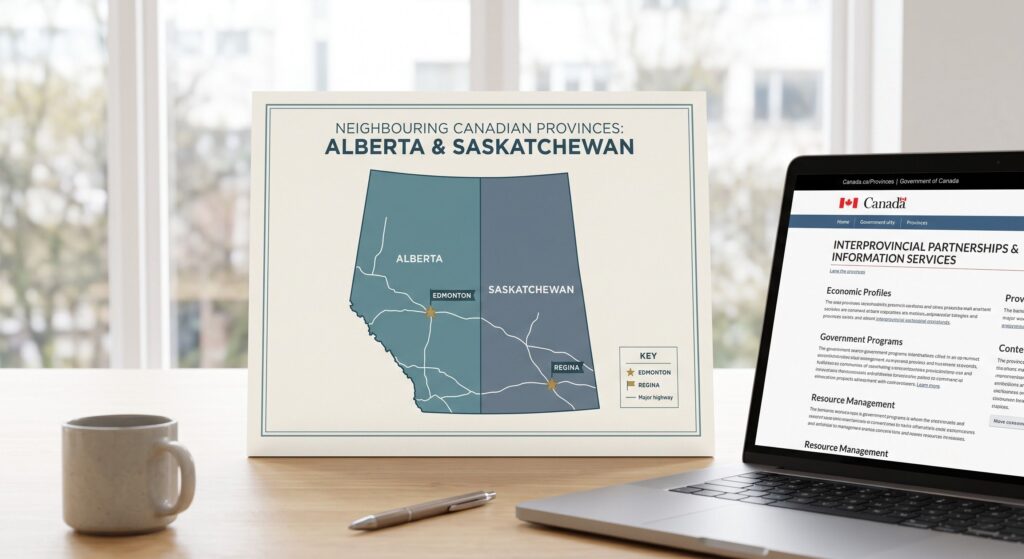
Since these come up often, here’s the regional picture for two Canadian provinces specifically.
Family Mediation Alberta
Alberta offers a free family mediation program through the province and Alberta Courts, available if you meet certain criteria — including having at least one parent with a gross income at or below a set threshold, agreement from both parents to participate, and at least one dependent child involved. If you don’t qualify for the free program, you’ll need a private mediator, and the Alberta Family Mediation Society (AFMS) maintains a directory of qualified professionals who set their own fees. There’s also a Resolution Support Centre in Calgary and Edmonton that can point you toward the right service depending on your situation.
Family Mediation Saskatchewan
Saskatchewan runs a Mandatory Early Family Dispute Resolution (EFDR) program, in effect since July 2022, requiring separating couples to attempt mediation, arbitration, parenting coordination, or collaborative law before applying to court in most cases. The province’s Dispute Resolution Office offers subsidized, sliding-scale mediation based on household income, and there’s a separate Family Matters program offering free, short mediation sessions specifically for urgent parenting and support issues. Private mediators set their own rates on top of these government-backed options.
Family Dispute Resolution PDF Guides: Where to Find Reliable Ones
If you’re after downloadable, official guidance rather than blog explanations (fair enough — this is exactly the kind of thing you want from a primary source), check directly with:
- Your provincial or national Ministry of Justice website, which typically publishes free downloadable guides on family dispute resolution options
- The Family Mediation Council (UK) or equivalent accrediting body in your country
- Legal aid or community legal education organisations in your region, which often produce plain-language PDF guides specifically for people without a lawyer
Avoid downloading legal guidance PDFs from unofficial third-party sites — stick to government or accredited-body sources so you’re working from accurate, current information.
Common Mistakes to Avoid
- Assuming court is the only formal option. Mediation, arbitration, collaborative law, and parenting coordination are all legitimate, often court-recognised paths.
- Picking a method based on what a friend used, rather than what fits your specific dispute and relationship dynamic.
- Skipping the screening step (MIAM or equivalent) and going straight into joint sessions when shuttle mediation might actually be more appropriate.
- Not checking whether a program you qualify for is free or subsidised before assuming private mediation is your only route.
- Confusing mediation with arbitration. One gives you control over the outcome, the other hands that control to a third party — mixing them up leads to real confusion about what you’re agreeing to.
Final Thoughts
Nobody hands you a map when a family relationship starts falling apart. You’re expected to somehow already know that mediation exists, that arbitration is different, that a parenting coordinator isn’t the same as a mediator, that your province might have a free program you’ve never heard of. It’s genuinely disorienting. The point of laying all this out isn’t to make you an expert overnight — it’s just to make sure court isn’t the only door you think is available to you, because for most family disputes, it really isn’t.
FAQ
What are the five methods of dispute resolution?
Negotiation, mediation, collaborative family law, parenting coordination, and arbitration — ranging from full party control to a binding third-party decision.
How can disputes be resolved without going to court?
Through direct negotiation, mediation, collaborative law, parenting coordination, or arbitration, often used in that order depending on how the previous step goes.
What are the 5 steps to the mediation process?
Intake/screening (MIAM), an opening joint session, issue identification, negotiation and option-generating, and finally agreement and documentation.
What are the different types of family dispute resolution?
Beyond the core methods, formats include joint mediation, shuttle mediation, child-inclusive mediation, and online/virtual mediation.

Sarah Mitchell is a family law specialist with a strong background in child arrangements, custody disputes, and family mediation. She joined LegalFacts.uk to help parents across the UK understand their legal rights and make informed decisions for their children’s future.