

When a relationship ends, the prospect of going to court to settle disputes about children or finances can be daunting, highly expensive, and emotionally draining. Family Mediation offers a professional and peaceful alternative. It is a structured process where an independent, professionally trained mediator helps separating couples reach a mutual agreement without a judge making the final decisions for them.
In 2026, the UK legal system strongly encourages mediation as the absolute first port of call. In most family dispute cases, you are now legally required to at least consider this alternative route before a court will even agree to hear your case.
What is Mediation Law?
Mediation law refers to the formal legal framework that governs out-of-court dispute resolution. While an agreement reached in a mediation room is not automatically legally binding on its own, family mediation law ensures the entire process remains strictly regulated, confidential, and impartial. The law also mandates attendance at an initial mediation assessment before a person can apply to the family courts for most matters regarding children or finances.
The 4 C’s of Mediation
Mediation is built upon four fundamental principles, which legal professionals often refer to as the “four Cs”:
- Cost-effectiveness: The cost of traditional family law litigation can quickly become an astronomical financial burden, whereas mediation significantly reduces these heavy legal expenses.
- Confidentiality: Any statements, negotiations, or communications made during mediation sessions are completely private, unlike open and public court records.
- Control: You maintain control over the outcome. Instead of abdicating all decision-making power to a stranger in a courtroom, parties work together to settle disputes on their own practical terms.
- Creativity: Because you control the process, you are free to think up creative, highly unique solutions that respect the specific needs of your children and your individual financial situation, which might not be possible in a rigid court setting.
What are the 4 Types of Mediation?
In family law, mediators may use different distinct approaches depending on the specific complexity of your situation and the current level of conflict between parties. The four main types include:
- Facilitative Mediation: This is the most common and widely used type, where a neutral third party facilitates communication and helps parties explore their deeper interests to reach a voluntary, mutually acceptable solution.
- Evaluative Mediation: The mediator assesses the actual legal merits of each party’s position and may provide an experienced opinion on the likely court outcome if the case were to eventually go to trial.
- Transformative Mediation: This deeper approach focuses on empowering the parties to take control of their dispute resolution, aiming to transform their ongoing relationship and communication dynamics rather than just focusing on immediate, short-term issues.
- Restorative Mediation (or Med-Arb): This focuses on repairing the emotional harm caused by the dispute, or in some hybrid models like Med-Arb, seamlessly transitions into a legally binding arbitration decision if standard mediation fails to produce an agreement.
What are the 7 Stages of Mediation?
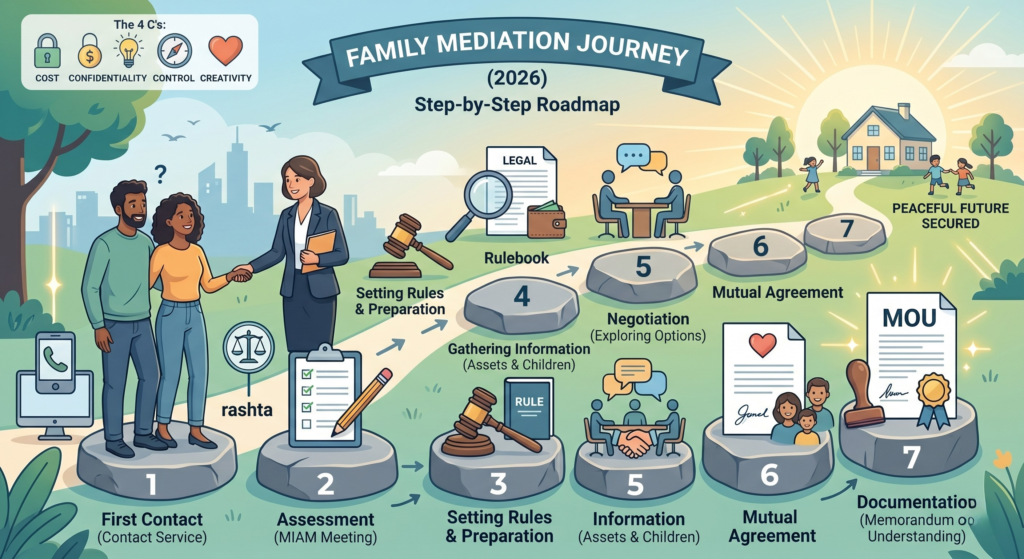
While every individual family’s case is unique, the family mediation process generally follows a highly structured, step-by-step path to ensure fairness. What are the 7 stages of mediation? Here is the standard professional breakdown:
- First Contact: Making initial contact with a certified mediation service to discuss your specific needs and arrange an initial assessment.
- The MIAM: The Mediation Information and Assessment Meeting, where legal suitability is thoroughly checked.
- Preparation and Ground Rules: Setting the stage, deciding on session formats (like shuttle mediation if needed), and outlining expected respectful behavior.
- Information Gathering: Both parties openly share relevant, transparent documents, such as comprehensive financial statements for asset division.
- Negotiation: The mediator actively facilitates productive negotiations to help you safely explore different settlement options.
- Agreement: Formulating practical, workable, and mutual solutions to your ongoing disputes regarding finances, property, or children.
- Documentation: Preparing a formal document called a Memorandum of Understanding (MOU) to permanently record the exact agreement reached.
How Does Family Mediation Work: The MIAM and Sessions

Before you can formally apply to a court for a child arrangements order or a complex financial settlement, you must usually attend a MIAM. During this essential 45 to 60-minute meeting, the mediator explains exactly how family mediation works and carefully assesses whether it is safe and suitable for your specific case. Attending the MIAM is a strict legal requirement unless a specific exemption applies, such as a documented history of domestic abuse or an urgent child safeguarding risk.
If both parties agree to proceed after this meeting, full joint sessions will begin. The mediator operates entirely on neutral ground; they do not take sides, judge, or give personalized legal advice. If you and your ex-partner cannot bear to be in the same room—either physically or virtually—the mediator can perform what is known as “shuttle” mediation. This involves the mediator moving between two separate, private rooms to pass messages and settlement proposals back and forth.
What is Mediation for Children?

What is mediation for children? It is a specialized, highly sensitive focus within the overall process aimed entirely at child arrangement orders, deciding where the children will primarily live and exactly how parenting responsibilities will be shared going forward. In 2026, Child-Inclusive Mediation is widely encouraged by family courts. If your children are over the age of 10, they may be given the unique opportunity to speak privately with a specially trained mediator. This ensures their personal voice is heard without ever forcing them into the middle of their parents’ conflict or making them choose sides.
Costs: How Much Does a Family Mediator Cost in 2026?
Mediation is significantly and undeniably cheaper than a full, drawn-out court battle, which can often cost tens of thousands of pounds and take years. But exactly how much does a family mediator cost? In 2026, an initial MIAM typically costs between £115 and £160 per person (plus VAT). The subsequent joint mediation sessions are generally charged at a standard hourly rate, ranging from £120 to £160 per person per hour (plus VAT).
Who pays for family mediation? Generally speaking, both parties are expected to pay for their own equal share of the ongoing costs. However, when parents are asking how much is mediation for child access, there is substantial financial help available. The UK government’s Family Mediation Voucher Scheme successfully continues in 2026, providing eligible families with a non-repayable voucher worth up to £500 towards the cost of joint sessions that involve child arrangements. Additionally, if you are currently on a low income or receive certain state benefits, you may be fully eligible for Legal Aid, which can completely cover the entire cost of both the MIAM and the subsequent mediation sessions.
Family Mediator Jobs and Salary in 2026
As the UK legal system increasingly relies on alternative dispute resolution to clear court backlogs, family mediator jobs are in incredibly high demand. For those curious about entering the legal profession, the family mediator salary in the UK for 2026 strongly reflects this specialized expertise. A newly qualified, entry-level family mediator earns an average starting salary of £39,010 per year, while the overall national average salary sits around £55,253. Senior mediators who handle highly complex financial cases with extensive experience can easily earn an average of £63,420 or significantly more depending on their private practice.
Frequently Asked Questions (FAQs)
1. How long does family mediation take? Most separating couples are able to reach a full agreement within 3 to 5 dedicated sessions, typically spread over a manageable period of about 3 to 4 months. This is significantly faster, and far less stressful, than resolving a case through the traditional court system, which can easily take anywhere between 6 to 18 months just to get a final hearing.
2. What if my ex-partner outright refuses to come? Mediation is fundamentally a voluntary process. You cannot legally force someone to participate if they do not want to. If they flatly refuse, the mediator will sign your official court form to prove you attempted the process, and you can then ask a family judge to decide the matter. However, the court takes mediation seriously and may strongly question the refusing party to explain exactly why they chose not to mediate, which could potentially impact cost orders.
3. Is the final agreement binding? Unlike a formal court order, an agreement reached in a mediation session is not legally binding on its own. At the end of successful sessions, the mediator carefully drafts a comprehensive Memorandum of Understanding (MOU). To make this written agreement completely legally enforceable, you usually take the finalized MOU to an independent family solicitor, who easily turns it into a formal Consent Order for a judge to officially sign.
Conclusion
Family mediation is ultimately about keeping total control of your own future and your own finances. Instead of letting a complete stranger in a judge’s robe decide how you should raise your children or split your hard-earned bank account, mediation allows you to peacefully craft a bespoke solution that works for your specific family dynamic. In 2026, it undeniably remains the most effective, peaceful, and highly cost-efficient way to move forward and rebuild your life after a separation.
Important Disclaimer: This comprehensive article is for general informational purposes only and is absolutely not a substitute for professional legal advice. While mediators expertly help you reach agreements, they cannot provide specific legal or tax advice. We strongly recommend having any final financial or child arrangement agreement reviewed by a qualified family solicitor before it is officially turned into a binding court order.