

Can a Father Get 50/50 Custody in the UK? (The Legal Reality)
For many fathers navigating the difficult process of separation, there is a persistent, lingering fear that the UK family law system is inherently biased in favour of mothers. The concept of “50/50 custody” is heavily debated across online forums, social media, and support groups. But what is the actual legal reality? Can a father realistically expect an equal split of parenting time in 2026?
The short answer is absolutely yes. However, securing this outcome involves a complex legal reality that goes far beyond simply dividing the week down the middle. In the UK, the courts do not operate on a presumed “right” for parents to have exactly half the time. Instead, the foundation of family law is the child’s fundamental right to enjoy a meaningful, loving relationship with both parents.
In this comprehensive guide, we will explore the common hurdles, dismantle outdated myths, and outline the exact practical steps fathers can take to secure a successful shared care arrangement.
The Myth of “Maternal Preference”
Historically, society held a deeply ingrained belief that young children naturally “belonged” with their mothers. In 2026, this perspective is legally obsolete. The Children Act 1989, alongside numerous modern reforms, makes it explicitly clear that there is absolutely no automatic preference given to either parent based on gender.
When making decisions, the court’s starting point is that the active involvement of both parents is highly beneficial to the child’s well-being, provided there are no proven safeguarding risks. The law fully recognises that a father is equally capable of nurturing, raising, and caring for a child. If you are a father who has consistently been a hands-on, dedicated parent, the court will weigh that heavily in your favour. But is it hard for dads to get 50/50? It requires clear evidence of your capability and commitment, but with the right approach and consistency, it is an entirely achievable goal.
What Does a 50/50 Custody Arrangement Actually Look Like?
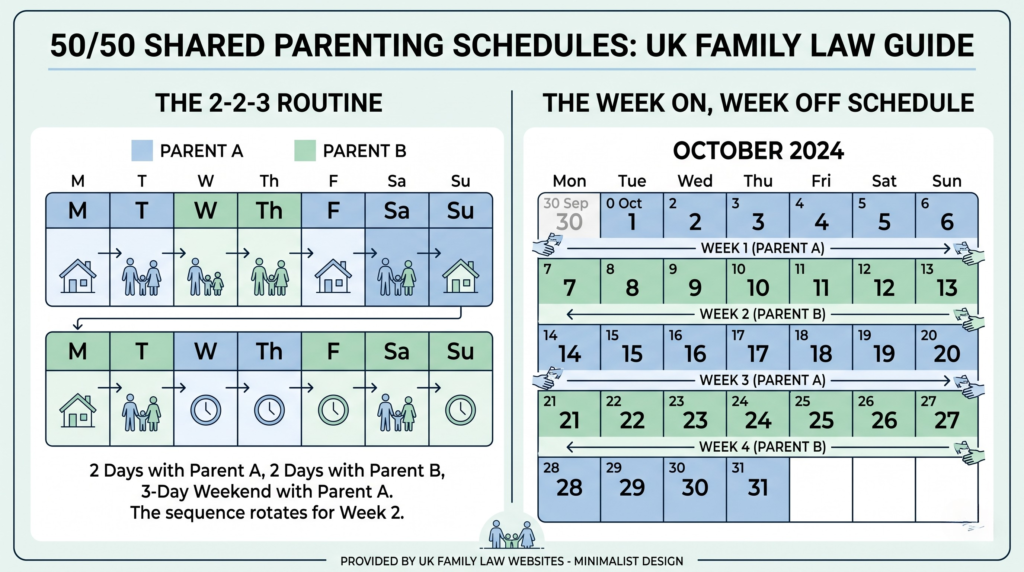
It is vital to understand that a “shared care” arrangement does not strictly mean counting the hours to ensure an exact 3.5 days each per week. How many overnights is 50/50 custody? Generally, it equates to 182 or 183 overnights a year, but the specific 50/50 custody arrangements take various forms depending on the child’s age, schooling, and the parents’ work commitments.
Common routines include:
- The 2-2-3 Routine: The child spends two days with Dad, two days with Mum, and a three-day weekend with Dad. The schedule then flips for the following week.
- Week On, Week Off: One entirely full week is spent with each parent. This arrangement is highly popular for older children and teenagers who prefer stability and less frequent travelling.
- Alternating Split Weeks: Three days with one parent and four days with the other, swapping the longer stretch every single week.
Key Factors That Strengthen a Father’s Case for Equal Care

If you are aiming for equal time, the court wants to see your ability to provide a consistent, stable “home life,” rather than just a “visiting life.” A family judge is significantly more likely to grant a shared care order if you meet the following criteria:
- Geographical Proximity:
- You live relatively close to the child’s school, extracurricular activities, and the other parent’s home. Lengthy commutes are often the biggest barrier to practical shared care.
- Work Flexibility:
- You can clearly demonstrate the ability to manage the school run, attend parents’ evenings, and take time off or work from home when the child falls ill.
- Adequate Space:
- Your home provides a suitable, safe, and comfortable living environment, which ideally includes a dedicated bedroom for your child.
- A Functional Co-Parenting Relationship:
- You can show the court that you are capable of communicating with your ex-partner respectfully and keeping the focus strictly on the children, regardless of personal grievances.
Why Would a Dad Not Get 50/50 Custody?
While the legal framework is entirely neutral, fathers must be prepared for the practical and situational challenges that can derail an equal care application. The court may rule against a 50/50 split under certain circumstances:
- The “Status Quo”: If the children have resided almost exclusively with their mother for an extended period while the father worked demanding hours, the court is often hesitant to abruptly shatter that established routine. Moving towards 50/50 in these cases usually requires a gradual, step-by-step transition plan.
- Logistical Impossibility: If a father lives too far away from the child’s school, the court will always prioritise the child’s daily educational routine over an equal split of overnights.
- Safeguarding Concerns and False Allegations: In high-conflict separations, allegations of domestic abuse or neglect can severely delay proceedings. When this happens, CAFCASS (Children and Family Court Advisory and Support Service) must step in to investigate, which temporarily pauses standard contact progression to ensure the child is safe.
The Effects of 50/50 Custody on the Child
When debating custody, it is crucial to look at the psychological impacts on the children involved.
The Advantages: The primary benefit is that the child maintains a strong, unbroken bond with both parents. They benefit from two distinct support systems, receive diverse life lessons, and importantly, do not feel they have to “choose” sides between the people they love.
The Disadvantages of 50/50 Custody: Shared care only works well if the parents can cooperate. If there is constant hostility, the child simply becomes a battleground. Furthermore, some children struggle with the “suitcase lifestyle,” feeling as though they are constantly moving between two houses and never truly settling into one permanent home. This is why location and routine are so heavily scrutinised by the courts.
Frequently Asked Questions (FAQs)
1. Can a mother refuse 50/50 custody?
A mother can certainly refuse to agree to a 50/50 split during private discussions or mediation. However, she cannot overrule the law. If mediation breaks down, a father can apply to the family court for a Child Arrangements Order. The judge makes the final decision based entirely on the child’s welfare, and a mother’s refusal without any valid safeguarding reason is often viewed as hostile and unreasonable.
2. Do I have to pay child maintenance if we share care equally?
In the UK, the Child Maintenance Service (CMS) calculates payments based on the paying parent’s income and the exact number of overnight stays. If care is shared exactly 50/50, the statutory maintenance liability is often reduced to zero. However, parents still need to come to an agreement on how day-to-day costs, such as school uniforms, winter coats, and school trips, are divided.
3. In a 50/50 custody split, who gets Child Benefit?
Even with a perfect equal split of care, only one parent can claim Child Benefit from HMRC. Parents are encouraged to decide amicably between themselves who receives it. If they cannot agree, HMRC will make the decision for them, usually awarding it to the parent who already has the active claim.
4. Can dads get full custody in the UK?
Yes. While the family courts heavily prefer both parents to be involved, a father can absolutely be granted sole residency (legally known as a sole ‘lives with’ order). This typically happens if the mother is deemed unfit to parent due to severe issues like substance abuse, major mental health crises, or neglect.
5. Why do parents fight over custody?
Disputes often stem from a total breakdown in trust, the deep emotional pain from the separation itself, and the terrifying fear of losing a connection with the children. Financial implications, such as child maintenance obligations and disputes over keeping the family home, also unfortunately fuel many high-conflict court battles.
6. Can I secure equal time if I have a full-time job?
Absolutely. Millions of full-time working parents successfully manage shared care. The court simply expects you to have a realistic childcare plan in place, which might involve breakfast clubs, after-school care programmes, or regular, reliable assistance from grandparents.
7. What is a “lives with” order?
Modern UK family courts no longer use the outdated Americanised terms “custody” or “access.” Instead, they issue a Child Arrangements Order. This legal document can explicitly state that the child “lives with” both parents, formally and officially recognising the 50/50 shared arrangement.
8. How does the court view a father who has been absent for a while?
If there has been a significant gap in contact, the court will not force an immediate 50/50 split, as this would be too disruptive for the child. Instead, they will implement a stepping-stone approach. This starts with supervised or daytime contact and gradually builds up to overnight stays as the father-child bond is naturally re-established.
Conclusion
The legal reality for fathers in the UK is vastly more encouraging than the internet rumours might suggest. The family courts are progressively moving towards shared parenting as the absolute gold standard for a child’s healthy development. A father’s role is essential, not merely optional or secondary.
If you are determined to secure 50/50 care, your best legal strategy is to remain entirely child-focused. Be a consistent presence, live locally if possible, and ensure all communication with your ex-partner remains professional, documented, and cooperative. The law is designed to protect your child’s right to have you actively in their life—not just as a weekend visitor, but as an equal parent.
Important Disclaimer: LegalFacts.uk is an informational blog. We are not solicitors or legal professionals. The content on this website does not constitute formal legal advice. We strongly recommend that fathers seeking shared care seek bespoke advice from a qualified UK family solicitor or a specialist fathers’ rights charity to understand their specific legal position.