
The Step-by-Step Divorce Process: From Petition to Final Order
If you are considering a divorce or civil partnership dissolution in the UK, the most daunting part is often the fear of the unknown. You know you are ready to begin the process, but what actually happens behind the closed doors of the family court? Since the major legal reforms in 2022 introduced “no-fault” divorce, the journey has become far more transparent, digital, and significantly less hostile. However, it still follows a very strict legal sequence.
Understanding what to expect during the legal process for divorce or dissolution is crucial. A clear roadmap helps you manage your expectations, prepare your finances accordingly, and most importantly, minimizes the emotional anxiety that naturally comes with legal uncertainty. Below is the complete journey from your initial application all the way to the final legal decree.
What to Expect: The 4 Stages of Divorce
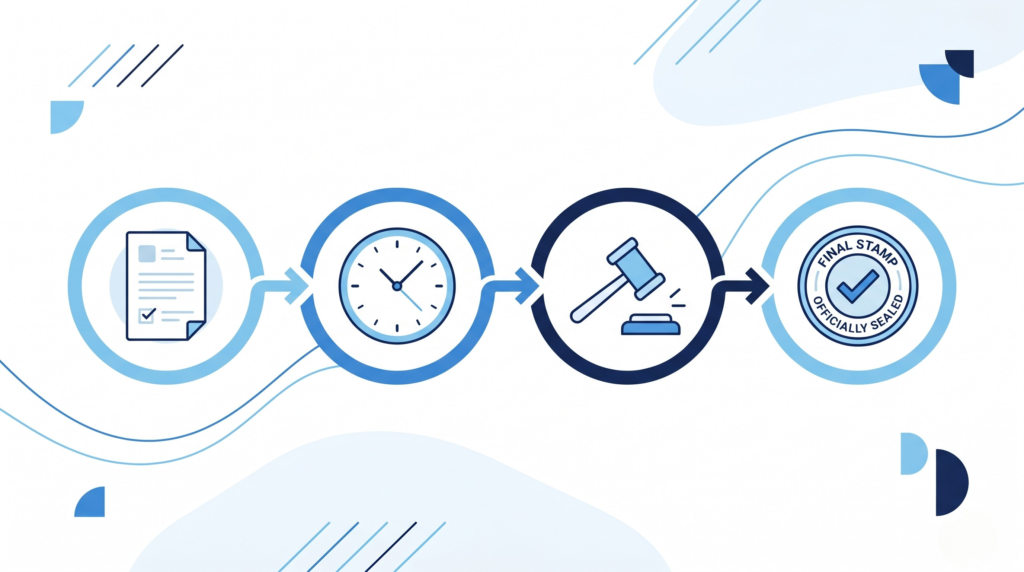
To simplify the legal jargon, the modern UK divorce process can be broken down into four primary stages. First is the initial Application where you formally ask the court to end the marriage. Second is the mandatory 20-week reflection period. Third is the Conditional Order, which is the court’s approval that you are entitled to a divorce. Finally, the fourth stage is the Final Order, which officially dissolves the marriage.
Step 1: The Initial Application (The Petition)
Everything starts with the Divorce Application. Under the current UK system, you no longer need to prove “fault” or cast blame on your partner by citing reasons like adultery or unreasonable behavior. Instead, you simply submit a statement to the court confirming that your marriage has irretrievably broken down.
The Practicalities:
- Where to apply: The vast majority of people now utilize the HMCTS online portal. It is a streamlined system that significantly reduces paperwork errors and speeds up the administrative side.
- The Cost: You are required to pay a court application fee, which is currently set at £612.
- Sole or Joint: You have the choice to apply entirely on your own or submit a joint application together with your spouse.
Step 2: Issuing the Application and Service
Once you submit your application online, court staff will review your documents. Assuming everything is correct and your marriage certificate is accepted, the court will formally “issue” the divorce proceedings.
If you applied as a sole applicant, the court will forward a copy of the application to your spouse, who is legally referred to as the Respondent. They are given 14 days to complete and return an Acknowledgement of Service form to the court. This step is simply to confirm that they have received the legal papers and understand that the process is officially underway.
Step 3: The 20-Week Reflection Period
As soon as the application is issued, a mandatory legal holding period begins. You must wait exactly 20 weeks before you can progress to the next legal stage.
The law introduced this specific timeframe to give couples a period of meaningful reflection. However, in practical terms, this is when the heavy lifting really happens. This 20-week window is the perfect time to negotiate your Financial Settlements, discuss Child Arrangement Orders, and attend mediation. The goal is to reach a solid agreement on how to physically and financially divide your lives before the divorce is finalized.
Step 4: Applying for the Conditional Order
Once your 20-week wait has concluded, you are eligible to apply for a Conditional Order. This represents the halfway milestone of your divorce. A judge will review your application file to verify that all legal requirements and procedures have been followed correctly.
If the judge is satisfied, you will be issued a Certificate of Entitlement, and the court will set a specific date for your Conditional Order to be pronounced. You do not have to attend court for this event; it is handled administratively. This order is the court’s official declaration that it sees no legal reason why you cannot divorce.
Step 5: Divorce Final Steps and the “Cooling Off” Period

After your Conditional Order is pronounced, the law enforces one final waiting period of 6 weeks and 1 day.
This is a critical phase. It is the time for final steps, primarily focusing on filing your marital separation agreement or financial consent order. Legal professionals almost universally advise their clients to hit the pause button here. The reason is simple: once you move forward and obtain the Final Order, you immediately lose vital legal statuses, such as widow or widower rights regarding pensions and life insurance. You should ideally remain at this stage until your financial agreements have been officially sealed and approved by a judge.
Step 6: The Final Order
This is the ultimate finish line. Once the 6-week cooling-off period has expired, and ideally after your finances are securely settled, you can apply for the Final Order.
The court typically processes this final application within a few working days. The moment you receive your Final Order, your marriage contract is legally dissolved. You are officially single in the eyes of the law and free to remarry.
Divorce and the Family Court
A common fear is having to stand in front of a judge in a crowded courtroom. Fortunately, under the current no-fault system, the divorce process itself is almost entirely administrative. Unless there is a severe, unresolved dispute regarding complex financial assets or child custody, you will likely never step foot inside a family court.
The 3 C’s of Divorce
To navigate this difficult transition smoothly, family law experts highly recommend adopting the “3 C’s” approach:
- Communication: Keep dialogues open, respectful, and strictly focused on practical logistics rather than past grievances.
- Cooperation: Working together, rather than treating your spouse as an enemy, drastically reduces stress and legal bills.
- Compromise: Understand that neither party will get everything they want. Finding a middle ground on assets and schedules is the fastest way to move forward.
Frequently Asked Questions (FAQs)
What is the biggest mistake during a divorce?
The most severe mistake is applying for the Final Order before legally finalizing your financial settlement. A divorce only ends the marriage, not your financial ties. If you do not get a legally binding Consent Order, your ex-spouse could potentially make a financial claim against your assets years into the future.
What happens if my spouse ignores the divorce papers?
If your spouse refuses to return the Acknowledgement of Service, the process does not come to a halt. You can employ a Process Server (a professional bailiff) to hand-deliver the documents. Once the court receives proof of this delivery, you are permitted to proceed without your spouse’s cooperation or signature.
Can I apply for a divorce if I lost my marriage certificate?
Yes, but you cannot proceed without it. You will need to order an official, certified copy from the General Register Office (GRO) before starting your application. The family court strictly requires this document to issue a divorce.
Can we still live in the same house during the process?
Absolutely. Given the current cost of living, many couples in the UK choose to live “separately and apart” while remaining under the same roof. This pragmatic choice does not pause or negatively impact the legal timeline of your divorce.
Conclusion
The divorce process is a marathon, not a sprint. From the very first petition all the way to the Final Order, the system is intentionally designed to be methodical, providing couples with the necessary space to make permanent decisions calmly. By understanding these steps and embracing communication, you can take control of your journey rather than feeling like a passenger in a legal machine. Stay organized, prioritize cooperation, and always secure your financial independence before crossing the final finish line.
Important Disclaimer: legalfacts.uk is an informational blog. We are not solicitors or legal professionals. The content on this website does not constitute legal advice. We strongly recommend consulting a qualified solicitor to guide you through the specific steps of your divorce.