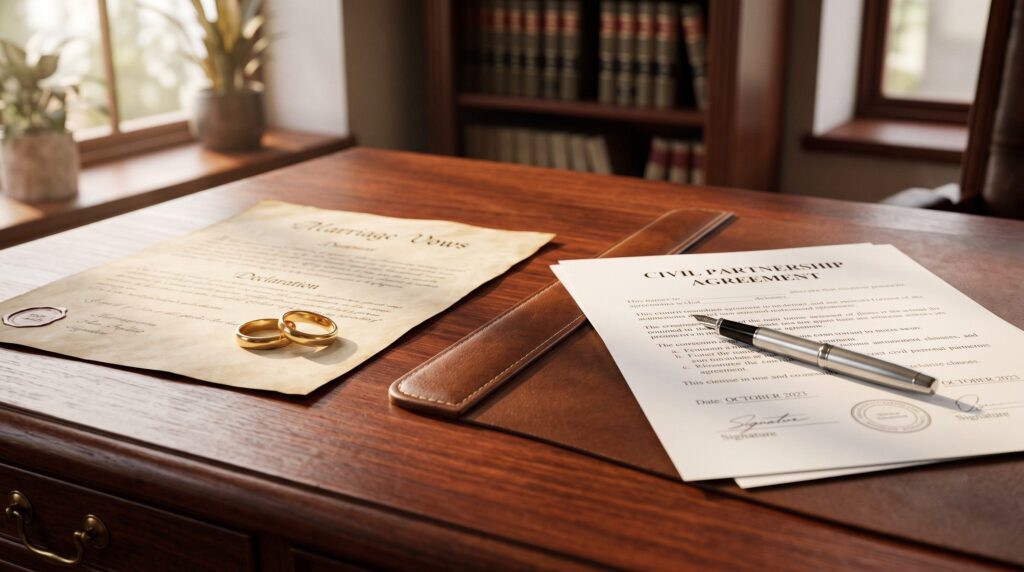
Two of my closest friends spent almost a year going back and forth on this. Not on whether to commit to each other — that part was never in doubt — but on whether to get married or enter a civil partnership. One of them assumed a civil partnership was just “marriage with a different name.” The other had read somewhere it wasn’t fully recognised abroad and got nervous about future travel plans.
I ended up sitting through registrar appointments and reading way more government guidance than I expected to, just trying to help them figure it out. So if you’re standing at the same crossroads, here’s the actual breakdown — not the Wikipedia version, the version that matters when you’re planning your actual life together.
Table of Contents
- Is There Really a Difference Between Marriage and Civil Partnership?
- Who Is Eligible for a UK Civil Partnership?
- The Ceremony: Religious vs Secular
- How the Relationship Actually Begins
- The Paperwork Difference Almost Nobody Notices
- Ending Things: Divorce vs Dissolution
- Are You Still “Husband and Wife” in a Civil Partnership?
- International Recognition — The Part That Trips People Up
- What’s Identical Either Way
- Can You Convert a Civil Partnership to Marriage?
- Frequently Asked Questions
- Related Searches
Is There Really a Difference Between Marriage and Civil Partnership?
Short answer: yes, but less than most people assume. In the UK, both options now give you almost identical legal, tax, and financial protections. The real differences sit in the ceremony itself, the wording on the certificate, and how the relationship is treated once you leave the UK. If none of that matters to you, honestly, either choice works fine legally.
Who Is Eligible for a UK Civil Partnership?
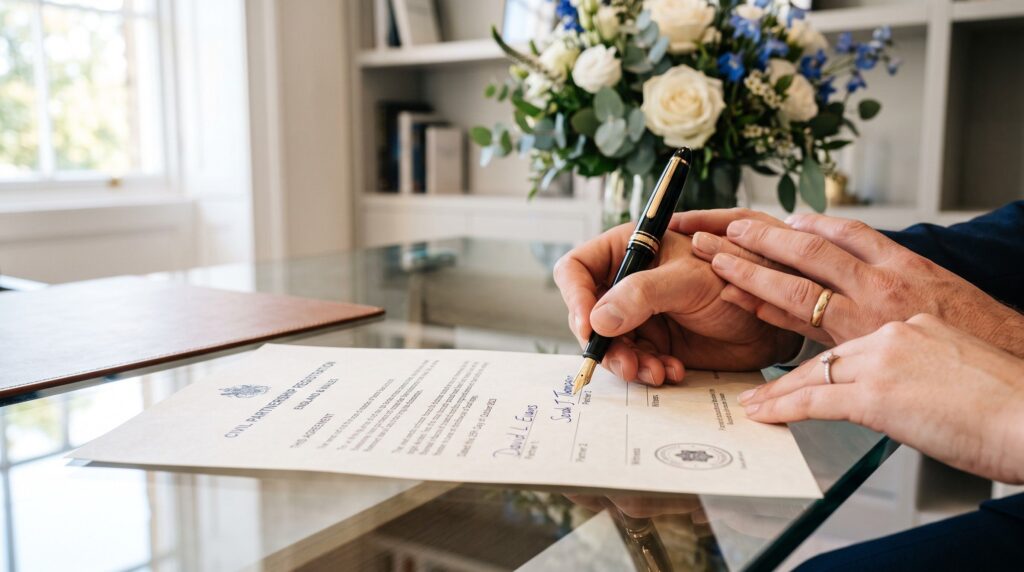
This is the bit that changed most recently, and it still confuses people. It used to only be available to same-sex couples. That’s no longer the case — since the law changed, opposite-sex couples in England and Wales can also enter a civil partnership. So today, eligibility isn’t about sexual orientation at all. Any two people who aren’t already married or in another civil partnership, aren’t closely related, and are both over 18 (with some exceptions for 16–17 year olds with consent) can choose either route.
The Ceremony: Religious vs Secular
This is genuinely the biggest practical fork in the road.
If you want a traditional church wedding — hymns, religious readings, a vicar or officiant leading a religious service — marriage is your only option. A civil partnership ceremony is strictly secular. The venue can be gorgeous, the day can feel just as special, but legally there can’t be any religious content built into the formation itself.
How the Relationship Actually Begins
Here’s a detail almost nobody mentions until it’s relevant. A marriage legally begins the moment you exchange specific spoken vows in front of witnesses and a registrar. Say the words, you’re married.
A civil partnership works differently. It’s formed by signing the Civil Partnership Document. There’s no legal requirement to say any vows out loud at all — although plenty of couples add their own words anyway, purely as part of the celebration, not because the law demands it.
The Paperwork Difference Almost Nobody Notices
Marriage certificates in the UK historically only listed the fathers’ names. That’s since been updated, but it’s a fairly recent fix rooted in old-fashioned custom. Civil partnership certificates, on the other hand, were built from the start to include both parents — mothers and fathers — reflecting a more modern approach to how families are recorded.
Ending Things: Divorce vs Dissolution
If a marriage ends, it’s called a divorce. If a civil partnership ends, it’s a dissolution. Different name, mostly similar process.
Neither can legally end within the first year. Both currently run on the no-fault principle, meaning nobody has to prove the other person did something wrong to justify ending it. One quirk worth knowing: adultery is a specific legal term that only applies to marriage. It can’t be used as a standalone ground for dissolving a civil partnership, even if it’s effectively what happened.
Are You Still “Husband and Wife” in a Civil Partnership?
Technically, no — and this trips a lot of people up. Civil partners are legally referred to as “civil partners,” not husband and wife. Practically speaking, most couples just use whatever terms feel right to them in daily life, and nobody’s stopping you from calling each other whatever you want socially. But on official documents and in legal contexts, the terminology stays distinct from marriage.
International Recognition — The Part That Trips People Up
If travel, work abroad, or dual citizenship is anywhere in your future plans, this is the section to actually pay attention to.
Marriage is recognised almost everywhere in the world. A UK marriage certificate opens doors in nearly every country’s legal system.
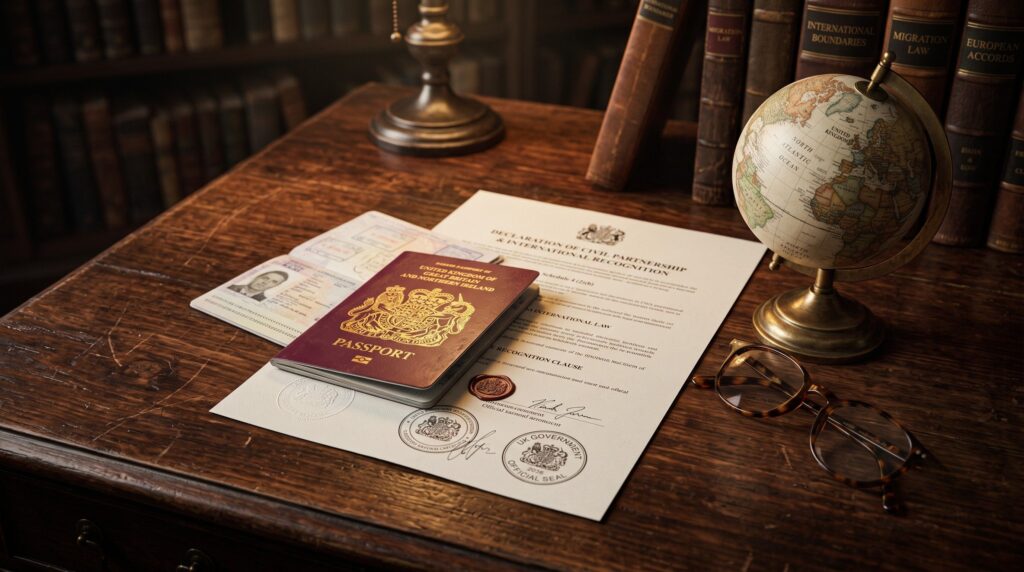
A civil partnership is a different story. It’s well recognised across the UK and much of Europe, but plenty of countries simply don’t have an equivalent legal category. In some of those places, you could be treated as legally single for tax, inheritance, or visa purposes — even though back home you’re fully partnered under UK law. If you think you might relocate or work overseas, this is worth raising directly with a solicitor before you decide.
What’s Identical Either Way
Whichever route you pick, you get the same:
- Tax benefits, including the Marriage Allowance and inheritance tax exemptions
- Pension rights, including a survivor’s pension claim
- Parental responsibility for children born within the union
- Automatic inheritance rights under the Rules of Intestacy if your partner dies without a will
Can You Convert a Civil Partnership to Marriage?
Yes, and this is one of the more couple-friendly parts of UK law. If you started out in a civil partnership and later decide you’d rather be married, you can convert it. In England and Wales, this process is fairly straightforward, and — this is the nice bit — you get to keep your original partnership date instead of your “anniversary” resetting to the conversion date.
Frequently Asked Questions
Is there any difference between marriage and civil partnership?
Yes, though it’s smaller than most people expect. The legal, financial, and tax protections are nearly identical. The real differences are in the ceremony (religious vs secular), how the relationship legally begins (vows vs signature), the terminology used, and how well the union is recognised outside the UK.
Are you still husband and wife in a civil partnership?
Not legally. Civil partners are officially termed “civil partners” rather than husband and wife, even though many couples use whatever language feels natural to them personally.
Can you convert a civil partnership to marriage?
Yes. In England and Wales, couples can convert an existing civil partnership into a marriage through a straightforward process, and they keep their original partnership date rather than starting a new one.
Who is eligible for a UK civil partnership?
Any two people over 18 (with limited exceptions for 16–17 year olds with parental consent), regardless of gender, as long as neither is already married or in another civil partnership and they aren’t closely related.
Why would a straight couple want a civil partnership?
Some opposite-sex couples prefer a civil partnership because it feels more like a modern legal contract than a traditional institution, avoids religious associations some couples want to steer clear of, or simply matches their personal values better than a conventional wedding.
What are the disadvantages of a civil partnership?
The main drawback is international recognition — some countries don’t legally recognise civil partnerships, which can complicate tax, inheritance, or visa situations abroad. There’s also less flexibility around religious ceremony content.
How do you get a civil partnership in the UK?
You give notice at your local register office, meet residency and eligibility requirements, then sign the Civil Partnership Document in front of witnesses and a registrar, usually alongside a small ceremony of your choosing.
Do you still need a will if you’re married or in a civil partnership?
Yes. Both give you automatic inheritance rights, but a will lets you decide exactly how your assets are split and who looks after any children, rather than leaving it to default intestacy rules.
Related Searches
- Why would a straight couple want a civil partnership
- Civil partnership vs marriage pros and cons
- Marriage and civil partnership difference
- Disadvantages of civil partnership
- Civil partnership vs common law
- How to get a civil partnership
- If you are in a civil partnership can you get married
- Marriage vs civil partnership UK reddit
Further reading: GOV.UK – Civil partnerships | GOV.UK – Registering a civil partnership
Disclaimer: This article is for general information only and isn’t legal advice. If you have assets abroad, plan to work overseas, or have specific pension or tax concerns, speak with a legal professional before deciding between marriage and a civil partnership.

David Hargreaves is a legal content writer specialising in wills, inheritance, and cohabitation rights. He is passionate about helping UK residents understand what happens to their assets and loved ones, and writes in-depth guides to make the law easy to understand for everyone.