Let’s start with the blunt version: if you’re not married and something goes wrong—a breakup, a death, a dispute over the house—the law will not step in to sort it out fairly for you. It’ll look at whose name is on what, full stop. A cohabitation agreement is the one document that changes that equation. Here’s exactly what it does, why you need one, and what’s actually shifting in UK law this year.
Cohabitation Meaning: A Quick Grounding
Cohabitation simply means two people living together as a couple without being married or in a civil partnership. That’s it—no minimum time period, no formal registration required to “become” cohabitants. You’re cohabiting from the point you move in together as a couple, whether that’s obvious to everyone around you or not.
Are Unmarried Couples Allowed to Live Together?
Yes, unconditionally—there’s no legal restriction on unmarried couples living together in the UK, and no requirement to register or declare the arrangement anywhere (aside from practical things like updating your address for tax, benefits, or the electoral roll). The legal question was never whether you’re allowed to cohabit—it’s what protections exist if the relationship changes.
What Are the Rules of Cohabitation?
Here’s the honest answer: there aren’t formal “rules” in the way there’s a rulebook for marriage. There’s no ceremony, no minimum duration, and no register. What actually matters legally comes down to a handful of practical things:
- Who owns the property, and how (sole name, joint tenants, or tenants in common)
- Whose name is on the tenancy, if you rent
- What financial agreements exist between you, written or otherwise
- Whether you have children together, which brings in separate obligations regardless of your relationship status
- Whether you’ve made a will, since intestacy rules don’t recognize unmarried partners
None of these are “rules of cohabitation” exactly—they’re just the practical realities that end up mattering enormously if things go wrong.
What Happens If You Don’t Have a Cohabitation Agreement?
This is really the heart of the matter. Without one, here’s what you’re relying on if the relationship ends:
- Property splits strictly by legal ownership. If your name isn’t on the deeds and you can’t prove a financial contribution or clear agreement, you may walk away with nothing from a home you’ve lived in for years.
- No automatic entitlement to savings or assets held solely in your partner’s name, no matter how the household finances were actually run day to day.
- No spousal-style maintenance claim if one partner earned significantly less or gave up work to raise children.
- Disputes get resolved through trust law, if at all—a slower, costlier, and far less predictable route than the financial remedies available to divorcing couples.
- If your partner dies without a will, you inherit nothing automatically, regardless of how long you lived together.
Put simply: without an agreement, you’re relying entirely on informal goodwill and whatever paperwork happens to already exist in your favor. For a lot of separating couples, that turns out to be very little.
What Proof Is Needed for Cohabitation?
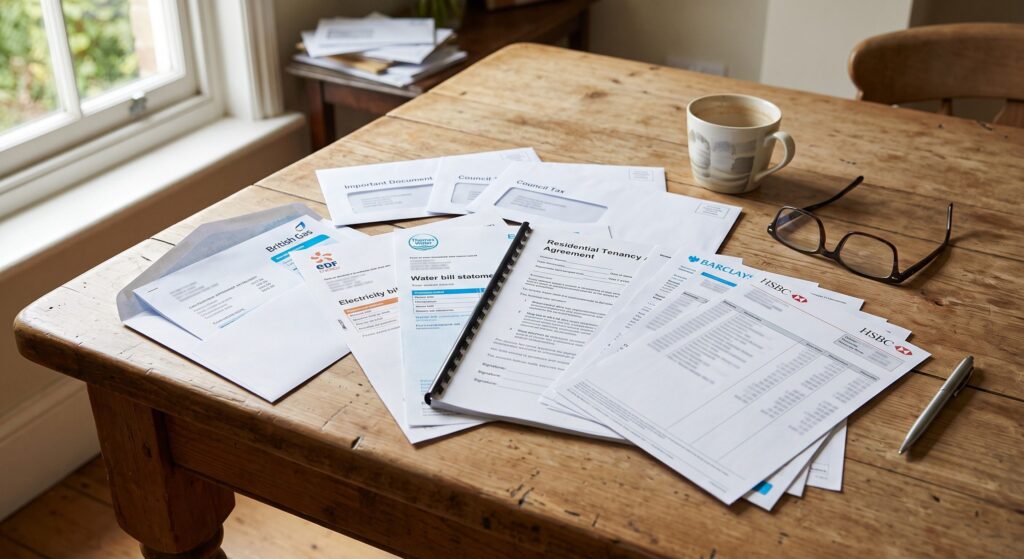
This comes up whenever cohabitation needs to be formally established—for a benefits claim, a visa application, a court dispute, or a Scottish cohabitant claim under time-limited rules. Typical evidence includes:
- Joint tenancy agreement or mortgage documents in both names
- Joint bank account statements, or accounts showing regular financial overlap
- Utility bills or council tax records addressed to both partners at the same address
- Both partners registered with the same GP practice
- Correspondence—insurance documents, official letters—showing both names at one address
- A written cohabitation agreement itself, if one exists
No single document usually settles it alone; whoever’s assessing the claim (a court, a benefits office, or HMRC) typically looks at the overall pattern rather than one piece of paper.
What Actually Goes Into a Cohabitation Agreement
This is the practical core of this whole guide, so let’s lay it out as an actual checklist. A solid cohabitation agreement typically covers:
- Property ownership and contributions—who owns what percentage, and how contributions to a mortgage, deposit, or renovations are recorded
- What happens to the home if you separate—sale, buyout, or one partner staying with compensation to the other
- Bank accounts and savings—how joint accounts are split and confirmation that sole accounts stay sole
- Debts—who’s responsible for what, particularly joint credit or loans
- Household bills and contributions during the relationship—not usually enforced strictly, but useful for clarity
- Arrangements for children, though this typically works alongside—not instead of—the CMS and Children Act processes
- A review clause—a point to revisit the agreement (having a child, buying a new property, a big income change)
To be legally robust, both partners should get independent legal advice before signing, and there should be full financial disclosure from both sides—agreements signed without this can be more vulnerable to challenge later.
Unmarried Couples’ Rights: The Short Recap
Since this underpins why the agreement matters so much: unmarried partners in England and Wales have no automatic right to a partner’s property, pension, or estate, and no automatic maintenance obligation between them if they separate—child maintenance is the one major exception, applying regardless of marital status. A cohabitation agreement doesn’t create rights the law doesn’t already allow—but it does let you both agree, in writing, exactly how you want things to work, rather than leaving it to whatever the default legal position happens to produce.
Cohabitation Law: What’s Actually Changing

There are genuinely two separate things moving through the system right now, and mixing them up causes a lot of confusion online.
1. The Cohabitation Rights Bill [HL]. This is a private member’s bill introduced by Lord Marks of Henley-on-Thames, with its second reading scheduled for 17 July 2026. It would create a framework of rights for cohabiting couples on separation or death—but only for those who either have a dependent child together or have lived together for a minimum of three years. As a private member’s bill, its odds of becoming law depend heavily on government support, which isn’t guaranteed.
2. The government’s own consultation, “A Fairer End to Relationships.” Opened 5 June 2026, closing 14 August 2026, this is the Ministry of Justice’s own process for considering cohabitation reform, running alongside divorce law reform. Government responses to written parliamentary questions have confirmed cohabitation reform is being treated as “a matter of utmost importance,” while also stressing that any reform will “firmly uphold marriage as one of our most important institutions”—signalling any changes are likely to stay well short of marriage-equivalent rights.
One more genuinely notable development: from September 2026, updated relationships education guidance for schools will require teaching that “common-law marriage” is a myth by the end of secondary school—a direct government attempt to tackle the persistent misconception at its root.
Unmarried Couples Living Together: Is There a “New Tax Law” in 2026?
Worth clarifying directly, since this phrasing circulates a lot: there isn’t a new tax law specifically targeting unmarried cohabiting couples in 2026. What’s moving is family law reform—the Cohabitation Rights Bill and the government consultation—not a change to how cohabiting couples are taxed. If you’ve heard “new tax law” mentioned, it’s almost certainly this family law reform activity being described imprecisely.
Common Mistakes to Avoid
- Assuming cohabitation alone creates legal rights over time. It never has and currently doesn’t, regardless of the number of years.
- Signing a cohabitation agreement without independent legal advice on both sides. This weakens its enforceability if it’s ever challenged.
- Leaving property contributions undocumented. Verbal understandings rarely hold up if a dispute later goes to court.
- Confusing the Cohabitation Rights Bill with the government’s consultation. They’re two separate processes with different timelines and different odds of becoming law.
- Assuming any of this is already in force. As of now, current legal rules still apply—nothing proposed has taken effect yet.
- Not revisiting the agreement after a major life change. Buying a new property, having a child, or a big income shift are all good reasons to update it.
Final Thoughts
A cohabitation agreement won’t feel romantic to draw up, and that’s exactly the point—it’s a document for the version of your relationship that isn’t going perfectly, sitting quietly in a drawer in case you ever need it. Most couples who have one never look at it again. The ones who need it are enormously glad it exists. Given how slowly reform is actually moving through Parliament, it remains, for the foreseeable future, the single most reliable tool available to unmarried couples who want real protection rather than a comforting myth.
FAQ
What proof is needed for cohabitation?
Joint tenancy or mortgage documents, shared bills, matching addresses on official records, and a written cohabitation agreement if one exists are assessed together rather than relying on a single document.
What happens if you don’t have a cohabitation agreement?
Property and finances are governed by strict legal ownership and, in disputes, complex trust law—with no automatic entitlement for a non-owning partner regardless of relationship length.
What are the rules of cohabitation?
There’s no formal rulebook—what matters legally is property ownership, tenancy names, financial agreements, children’s arrangements, and whether a will exists.
Are unmarried couples allowed to live together?
Yes, without restriction—there’s no legal requirement to marry or register the relationship in any way.
Is there a new tax law for unmarried couples living together in 2026?
No—the 2026 developments are family law reforms (a private member’s bill and a government consultation), not a new tax regime.
What is the Cohabitation Rights Bill?
A private member’s bill from Lord Marks of Henley-on-Thames, with its second reading set for 17 July 2026, proposing rights for cohabitants with children or 3+ years together.
What is cohabitation law in the UK right now?
Currently very limited compared to marriage—cohabitants have no automatic property, pension, or inheritance rights, though reform is under active discussion in 2026.
What rights do cohabiting couples have?
Mainly what they legally or jointly own, plus obligations tied to children—not the broader automatic rights married couples or civil partners hold.
What does cohabitation mean?
Living together as a couple without being married or in a civil partnership, with no minimum time period required for the term to apply.
Is there a new law for unmarried couples living together in January 2026?
Not specifically in January—the major developments (the Bill’s second reading and the government consultation) fall later in 2026, in the summer.
What are unmarried couples’ rights generally?
Limited automatic legal protection—property and inheritance depend on legal ownership and paperwork, while child maintenance obligations apply regardless of marital status.

Sarah Mitchell is a family law specialist with a strong background in child arrangements, custody disputes, and family mediation. She joined LegalFacts.uk to help parents across the UK understand their legal rights and make informed decisions for their children’s future.