
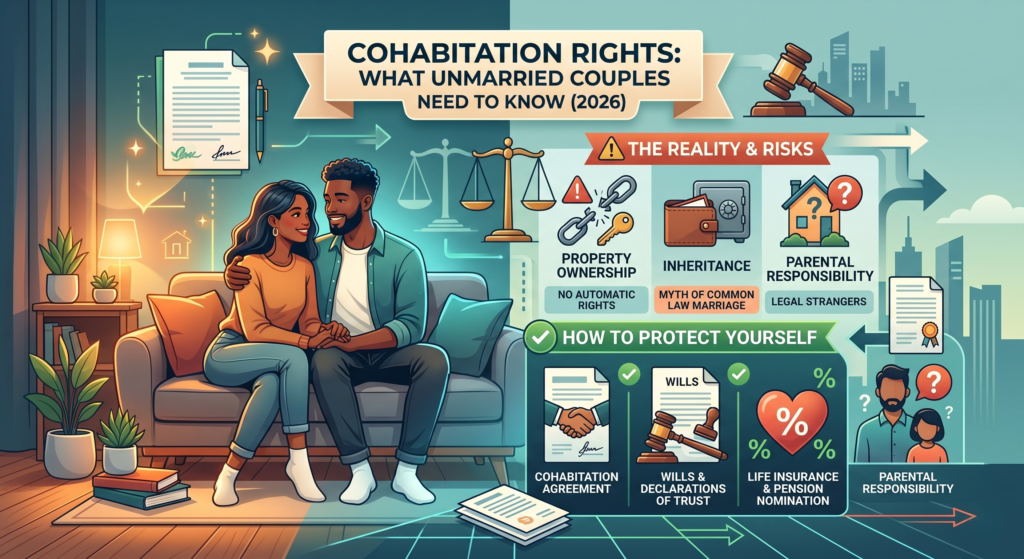
In the UK, the number of couples choosing to live together without getting married has reached record highs. However, a dangerous myth persists: the idea of “Common Law Marriage.” Many couples believe that after living together for a few years, or having children, they automatically acquire the same legal rights as married couples.
Before diving into the legalities, a common question asked is: Are you allowed to live with your partner in 2026? The simple answer is yes. In the UK, living together as an unmarried couple is perfectly legal and socially embraced. But while society has moved forward, the legal framework has not. As of 2026, the reality is starkly different from what many assume. Under current UK law, unmarried couples—often referred to as cohabitants—have very few automatic rights. If the relationship ends or one partner passes away, the legal fallout can be devastating if you haven’t prepared in advance.
The True Meaning of Cohabitation
At its core, the cohabitation meaning refers to two individuals living together in a domestic, romantic relationship without being legally married or in a civil partnership. Sociologists generally categorize this modern living arrangement into the 4 types of cohabitation:
- Prelude to Marriage: Couples testing their compatibility before tying the knot.
- Alternative to Singlehood: Living together primarily for convenience, companionship, or to save on living expenses without a long-term commitment.
- Alternative to Marriage: Couples who are deeply committed to one another for the long haul but ideologically oppose or simply do not want a formal wedding.
- Indistinguishable from Marriage: Couples who function exactly like a married couple, often sharing finances and children, and usually operating under the false assumption that they have legal rights.
The Myth of Common Law Marriage
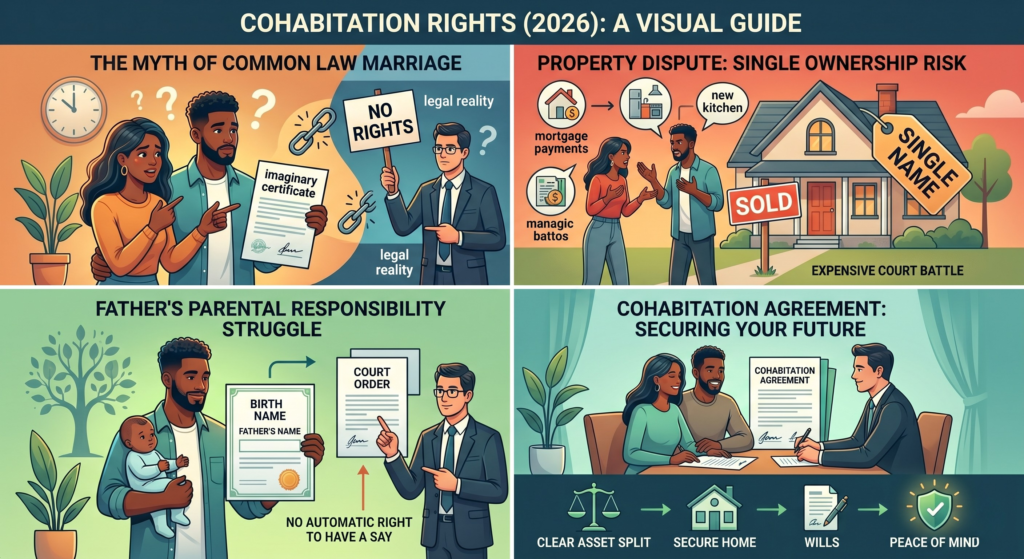
Let’s be clear: “Common law marriage” does not exist in England and Wales. It doesn’t matter if you have lived together for two years or twenty years. It doesn’t matter if you have five children together. The law does not recognize your relationship as a “marriage” unless you have had a civil or religious ceremony. This means you do not have an automatic right to your partner’s property, pension, or even their inheritance if things go wrong.
Romance vs. Legal Reality
When it comes to sustaining a relationship, married couples are often advised to follow the 2 2 2 2 rule in marriage. This is a popular romantic framework suggesting couples should have a date night every 2 weeks, go away for a weekend every 2 months, and take a week-long vacation every 2 years to keep the spark alive.
While unmarried couples can easily adopt these wonderful habits to maintain their emotional bond, they cannot simply adopt the legal protections of marriage. A strong emotional connection does not equal legal security in the eyes of the state.
Property Rights: Who Owns the Home?
One of the biggest risks for cohabiting couples is housing.
If the house is in one name: If you live in a property owned solely by your partner, you have no automatic right to stay there if you split up. Even if you have contributed to the mortgage, paid the bills, or financed a new kitchen, you may have to go to court to prove you have a “beneficial interest” in the home—a process that is notoriously expensive, stressful, and far from guaranteed.
If you rent together: If only one person’s name is on the tenancy agreement, the other partner has no legal right to remain in the property if the relationship ends, regardless of who was paying the rent.
Children and Parental Responsibility
For unmarried parents, the law handles “Parental Responsibility” (PR) differently than for married ones.
- Mothers: Always have PR from birth.
- Fathers: In 2026, a father only has automatic PR if he is married to the mother or if his name is explicitly on the birth certificate (for births registered after December 2003).
- If the father isn’t on the certificate: He has no legal right to have a say in the child’s education, health, or religion unless the mother agrees or he obtains a court order.
What Happens if a Partner Dies?
If a married person dies without a Will, their spouse usually inherits most, if not all, of the estate automatically. For unmarried couples, the rules of inheritance (intestacy rules) do not apply in the same way.
If your partner dies without leaving a Will:
- You have no automatic right to inherit their money, savings, or property.
- The estate will automatically go to their children, parents, or siblings instead.
- You may be forced to make a formal legal claim for financial provision just to stay in the home you shared, which is a long and painful legal battle during a time of grief.
How to Protect Yourself: The 2026 Roadmap
While the law remains behind the times, you can take proactive steps today to protect your future together:
- Cohabitation Agreement: A cohabitation agreement is a legally binding contract that sets out exactly who owns what and how assets, bills, and property should be divided if you separate. In 2026, drawing up a cohabitation agreement with a solicitor is highly recommended as the most effective way to protect both parties and avoid court.
- Declarations of Trust: If you are buying a home together, this legal document specifies exactly what percentage of the property each person owns, ensuring fair distribution if the property is ever sold.
- Make a Will: This is the absolute only way to guarantee your partner is financially looked after and inherits your assets if you pass away.
- Life Insurance: Ensure your partner is explicitly named as the beneficiary on your policy.
Frequently Asked Questions (FAQs)
1. Are there new laws for cohabiting couples in 2026? Despite many headlines regarding “unmarried couples living together January 2026” and searches for an “unmarried couples living together new law,” there has been no sweeping legislative change that instantly grants cohabitants marriage-like rights. While there is a major public consultation expected in Spring 2026 regarding cohabitation reform, any actual, binding changes in the law are still likely several years away.
2. Can an unmarried couple live together in Pakistan? While cohabitation is normal and legal in the UK, international laws vary wildly. If you are travelling or considering relocating, it is important to know local customs. In Pakistan, for example, it is generally illegal for unmarried couples to live together due to strict legal and religious frameworks. This highlights how heavily your cohabitation rights depend on your specific jurisdiction.
3. Can I claim my partner’s pension if they die? Only if they have specifically named you as the “nominated beneficiary” with their pension provider. Unlike married couples, you have no automatic legal right to a widow’s or widower’s pension.
4. Are we considered “next of kin” for medical emergencies? Legally, there is no formal “next of kin” status in the UK. However, hospitals usually look to blood relatives first. Having a cohabitation agreement or drafting a Health and Welfare Lasting Power of Attorney can ensure you have the strict legal right to make medical decisions for your partner.
Conclusion
Living together is a standard modern way of life, but the UK legal system is unfortunately still catching up to society. As an unmarried couple, you are effectively “legal strangers” in many aspects of the law. By understanding these inherent risks, drafting a cohabitation agreement, and putting your wishes in writing, you can enjoy your life together with the absolute peace of mind that both you and your partner are legally protected if the unexpected ever happens.
Important Disclaimer: This article provides general information and is not a substitute for professional legal advice. Cohabitation laws are complex and subject to change. We strongly recommend consulting a family law specialist to discuss your specific situation.