

Ending a marriage is never a decision made lightly. It is a journey often fraught with emotional exhaustion, uncertainty about the future, and a daunting amount of legal paperwork. For decades, the UK’s divorce system was criticized for making this difficult time even worse by forcing couples to blame one another to “prove” their marriage had failed.
However, the legal landscape underwent a historic transformation in April 2022. The introduction of No-Fault Divorce marked the end of the “blame game,” shifting the focus from past mistakes to future solutions. If you are navigating a separation in 2026, understanding the current rules is essential to protecting your rights and your peace of mind.
In this guide, curated by LegalFacts.uk, we break down every aspect of the modern UK divorce process, from costs and timelines to the critical financial steps most people overlook.
What Exactly is the No-Fault Divorce Law in the UK?
To understand where we are, we must look at where we were. Before the law changed, the UK operated under the “five facts” system. Unless you had lived apart for years, one person had to officially “blame” the other for the breakdown of the marriage. This usually meant alleging adultery or “unreasonable behavior.” This adversarial approach often poisoned the relationship between ex-spouses before the divorce even began.
The Divorce, Dissolution and Separation Act 2020 (which came into force in 2022) swept this away. Now, the law recognizes a simple, singular ground for divorce: the irretrievable breakdown of the marriage.
Key Features of the New Law:
- No More Allegations: You do not need to provide “evidence” of why the marriage failed. A simple statement that it is over is enough.
- Joint Applications: For the first time in history, couples can apply together as “Joint Applicants,” signaling a mutual decision to part ways.
- Removal of the Right to Contest: In the past, a spouse could “contest” (fight) the divorce to keep the other person trapped in the marriage. Under the no-fault rules, this is no longer possible except in extremely rare cases involving court jurisdiction or legal validity.
Why Was No-Fault Divorce Introduced?
The catalyst for this change was the high-profile case of Owens v Owens in 2018. Mrs. Owens wanted to divorce her husband, but he refused. The Supreme Court eventually ruled that because she couldn’t prove “unreasonable behavior” to a high enough standard, she was legally forced to remain married until they had lived apart for five years.
The public and legal outcry was immense. It became clear that the law was trapping people in “loveless” or even “toxic” marriages. The government introduced no-fault divorce to modernize the system, reduce the trauma for children caught in the middle, and ensure that the legal process reflects the reality of modern relationships.
How Long Does a No-Fault Divorce Take in the UK?
One of the biggest myths is that no-fault divorce is a “quickie divorce.” While the process is simpler, it is not necessarily faster. The government intentionally built in “reflection periods” to ensure the decision is final and to give couples time to sort out their finances.
On average, a divorce in the UK takes 6 to 8 months from the initial application to the Final Order. Here is the mandatory timeline:
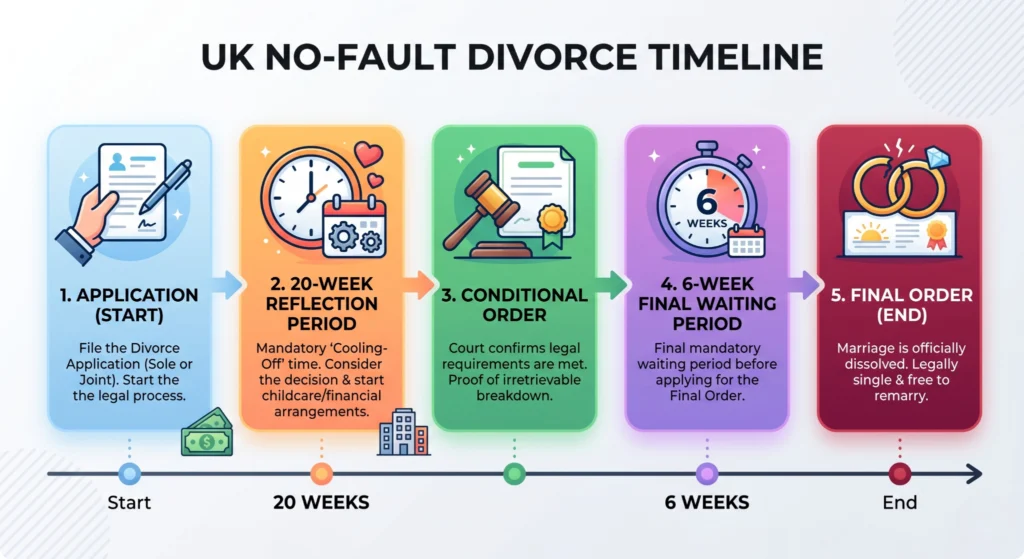
1. The Initial Application (Week 1)
Whether you apply as a sole applicant or jointly with your spouse, the process starts by submitting an application via the government’s digital portal.
2. The 20-Week Reflection Period (The “Cooling Off” Phase)
Once the court “issues” the application, a 20-week waiting period begins. This is the most significant chunk of time in the process. You cannot move forward until this period is over. The law intends for this time to be used constructively—not just to wait, but to negotiate child arrangements and financial settlements.
3. The Conditional Order (The Midway Point)
After the 20 weeks are up, you can apply for a Conditional Order (previously known as the Decree Nisi). This is a document from the court stating that they see no legal reason why you cannot divorce.
4. The 6-Week Waiting Period
Once the Conditional Order is granted, you must wait a further 6 weeks and 1 day before you can apply for the final legal step.
5. The Final Order (The Finish Line)
Once the court grants the Final Order (formerly the Decree Absolute), your marriage is legally dissolved. You are now a single person and free to remarry.
How Much is a No-Fault Divorce in the UK? (2026 Costs)
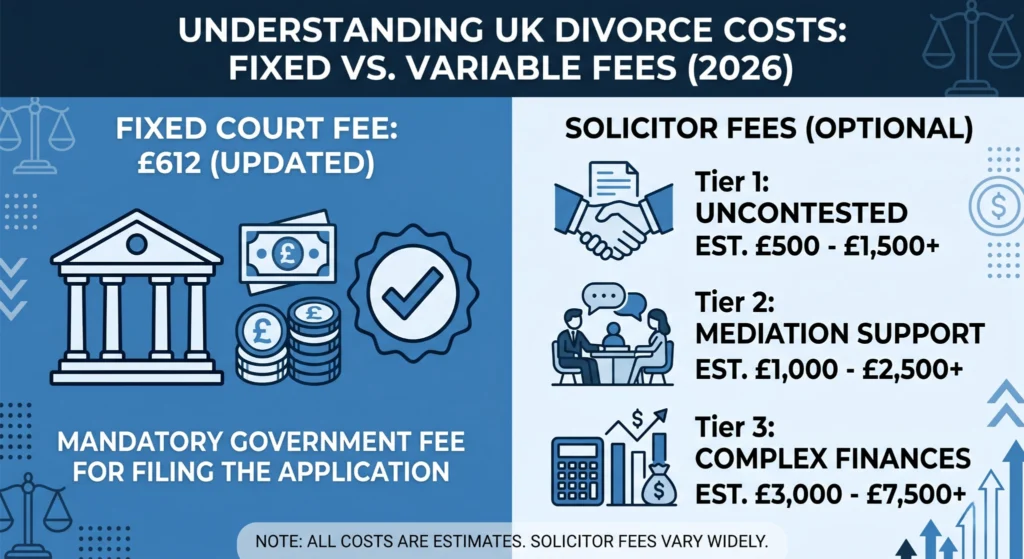
Financial planning is a huge part of the divorce journey. At LegalFacts.uk, we always advise people to separate the “Divorce Fee” from the “Financial Settlement Fee.”
1. The Court Application Fee
As of 2026, the mandatory court fee for filing a divorce application is £612. This is paid to Her Majesty’s Courts and Tribunals Service (HMCTS).
- Note: If you are on a low income, have little in savings, or receive certain benefits, you may qualify for the “Help with Fees” scheme, which can reduce this fee significantly.
2. Solicitor Fees (The Process)
If you hire a solicitor to manage the paperwork, you can expect to pay between £500 and £1,200 plus VAT. Many firms now offer “fixed-fee” packages for no-fault divorces because the process is predictable.
3. The “Hidden” Cost: The Financial Consent Order
This is where many people get caught out. The £612 court fee only ends the marriage; it does not end your financial ties. To legally split your assets, you need a Financial Consent Order. Solicitors typically charge between £800 and £3,000 for this, depending on the complexity of your assets (homes, pensions, businesses).
Who Loses Most in a Divorce?
This is a complex question often discussed on platforms like Reddit. While everyone experiences loss, the “loss” is usually categorized into financial and social-emotional categories.

The Financial Loser
Statistically, in the UK, women (especially those who have been the primary caregivers) often see a larger hit to their long-term financial stability. This is frequently due to the “Pension Gap.” Many women agree to keep the family home in exchange for letting the husband keep his pension. Years later, they realize that a pension pot can often be worth much more than the equity in a house.
The Social-Emotional Loser
Research often points to men struggling more with the social transition. Men are statistically less likely to have a robust emotional support network outside of their marriage, which can lead to higher rates of isolation following a split.
The Real Losers: Those Without a Consent Order
The biggest loser, regardless of gender, is anyone who finishes their divorce without a legally binding financial order. In the UK, a divorce does not stop your ex-spouse from coming back 10 or 20 years later to claim a share of your future earnings, inheritance, or lottery wins. The only way to stop this is a Consent Order.
No-Fault Divorce: Common Myths and Search Queries
When you search for terms like “No fault divorce UK timeline” or “No more divorce in UK,” you might find confusing information. Let’s clear up the most common “People Also Search For” queries:
“No More Divorce in the UK?”
There was a period of confusion online where people thought the “No-Fault” rule meant divorce was being abolished. This is incorrect. Divorce is very much alive; it is the requirement to prove fault that has been abolished.
“No-Fault Divorce UK Reddit”
Reddit threads are full of people asking if they can get a “quickie divorce.” As explained in our timeline, there is no such thing as a 6-week divorce anymore. Every case must respect the 20-week reflection period. If a website promises you a 4-week divorce, it is likely a scam or outdated information.
“Why was no-fault divorce introduced?”
As mentioned, it was introduced to stop “trapping” people in marriages and to lower the temperature of legal battles, especially for the sake of the children.
The Critical Importance of Financial Settlements
At LegalFacts.uk, we cannot stress this enough: The divorce ends the marriage, but it does not split the money.

In the UK, there is no automatic 50/50 split. The court uses “fairness” as its guiding principle. They look at:
- The needs of children: They always come first.
- Earning capacity: Can both parties support themselves?
- Standard of living: The goal is to avoid one person falling into poverty while the other remains wealthy.
- Pensions: These are legally sharable assets. Do not ignore them.
To make your financial agreement “official,” you must have a solicitor draft a Consent Order and have it approved by a judge. Without this, your financial future remains “open” to claims forever.
Frequently Asked Questions (FAQs)
1. Can I get a divorce if my spouse doesn’t want one? Yes. Under the no-fault law, your spouse cannot contest the divorce. If you say the marriage is over, the court will eventually grant the divorce regardless of their wishes.
2. How do I start a no-fault divorce application? You can start via the government’s official portal (gov.uk). You will need your marriage certificate and the £612 fee.
3. Does the “No-Fault” rule apply to financial settlements too? No. While the reason for the divorce doesn’t matter for the paperwork, “bad behavior” can (in very rare, extreme cases) still be considered during financial splits, though the court generally prefers to keep the two issues separate.
4. What happens during the 20-week reflection period? This is the time to negotiate. Most couples use these 5 months to work with mediators or solicitors to agree on how to split the house, the savings, and the time spent with children.
5. Is the UK divorce process entirely digital now? Yes, almost entirely. Unless there is a significant dispute over children or high-value assets that requires a hearing, you will likely never have to step foot inside a courtroom.
Conclusion: Moving Forward with Clarity
The transition to a no-fault divorce system in the UK is a welcome change for those facing the end of a chapter. It allows for a more dignified, less aggressive path toward a new beginning. By removing the need to assign blame, LegalFacts.uk believes that couples are better positioned to co-parent effectively and reach fair financial conclusions.
However, because the “paperwork” has become easier, many people fall into the trap of thinking the “legal protection” isn’t necessary. Always ensure that you secure a Financial Consent Order to protect your future.
Divorce is a marathon, not a sprint. Take your time, understand your rights, and ensure that when you cross the finish line, you are standing on solid ground.
Important Disclaimer: LegalFacts.uk is an informational platform. We provide general information and do not offer legal advice. Laws, court fees, and procedures can change. We strongly recommend that you consult with a qualified UK solicitor to discuss the specifics of your individual case before making any legal decisions.