
Who Owns the Property if an Unmarried Couple Splits Up?
When a married couple divorces, the court has wide-reaching powers to redistribute property to ensure a fair outcome for both parties. However, for unmarried couples in the UK, the legal framework is significantly different and much more rigid. There is no “automatic” right to a share of your partner’s home, regardless of how long you have lived together or how many household bills you have paid.
In 2026, the question of “who gets the house” is decided by land law and trusts, not family law. Here is a breakdown of how property ownership is determined after a split.
Understanding the Legal Reality of Separation
When couples separate outside of marriage, many individuals are surprised to learn that their legal standing is quite different from what they anticipated. A common concern is whether a partner has any claim to a home held solely in the other’s name, or what rights exist if the relationship ends unexpectedly.
It is critical to understand that without the protections offered by marriage, assets are treated more akin to a business partnership. Entitlements are rarely based on the emotional duration of the relationship, but rather on the formal legal documentation and financial evidence established at the time of purchase.
1. Property in One Partner’s Name
If the property is registered in only one person’s name, the law begins with the presumption that they hold 100% of the ownership. Consequently, the non-owning partner possesses no automatic right to reside in the property or receive a portion of the proceeds upon sale.
Establishing a Beneficial Interest
To claim a share of a house owned by an ex-partner, one must demonstrate a “Beneficial Interest.” This is typically achieved through one of two legal pathways:
- Resulting Trust: You provide evidence of direct financial contributions to the initial purchase price or mortgage deposits.
- Constructive Trust: You provide evidence of a “common intention” that you would own a share of the property (such as verbal agreements like “this is our house”), coupled with actions taken to your detriment based on that promise, such as funding major renovations or home extensions.
2. Property in Joint Names
If you purchased the home together, your rights are dictated by how the property was registered at the time of purchase.
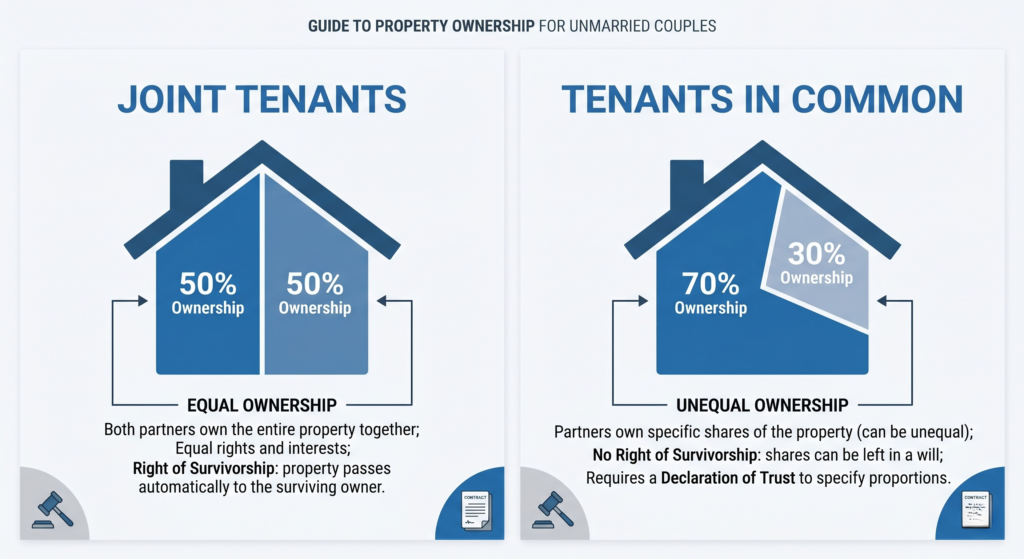
Joint Tenants
If you are registered as “Joint Tenants,” you both own the entire property as a whole. Upon separation, the standard legal starting point is a 50/50 split of the sale proceeds, regardless of who contributed more to the mortgage or initial deposit.
Tenants in Common
If you are registered as “Tenants in Common,” you own specific, defined shares of the property (e.g., 70% and 30%). This is generally recorded in a Declaration of Trust. When a separation occurs, the equity is divided precisely according to these predetermined percentages. As of 2026, this is the most highly recommended approach for unmarried couples purchasing property where financial contributions are unequal.
3. Can I Be Forced to Leave?
If you are not the legal owner and have no formal rights to the property, your ex-partner can technically request that you vacate the premises, provided they give “reasonable notice.”
However, if you have dependent children together, you may be eligible to apply for a court order under Schedule 1 of the Children Act 1989. The court may grant the non-owning parent and children the right to remain in the property until the youngest child reaches 18, ensuring domestic stability. Once the children reach adulthood, the property typically reverts to the legal owner.
The Importance of a Declaration of Trust

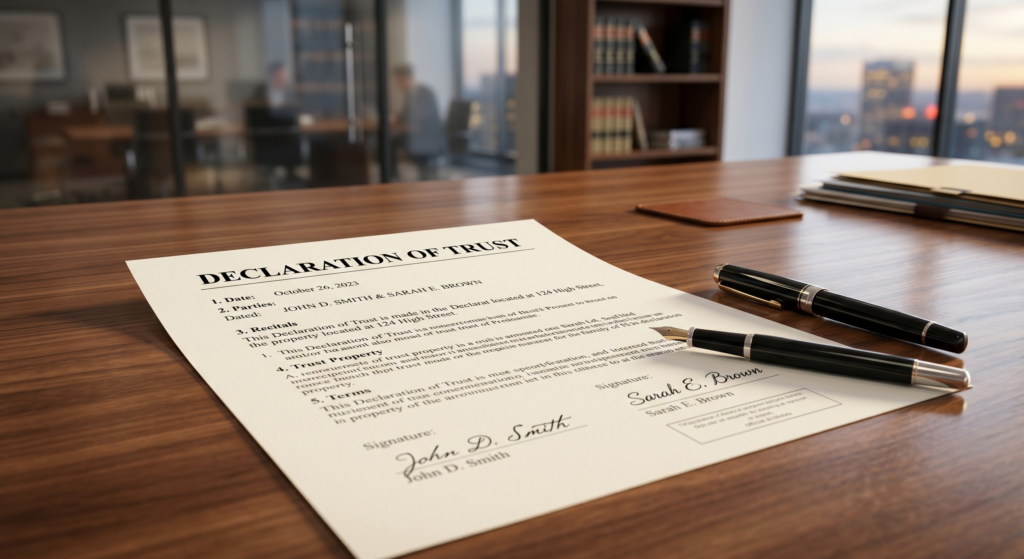
Because the law regarding unmarried couples is so strict, a Declaration of Trust is the most vital document you can possess. This is a legally binding statement made during the purchase that outlines:
- The exact amount of the deposit contributed by each party.
- The division of equity if the property is sold.
- The agreed-upon sharing of mortgage payments and maintenance costs.
Without this document, you risk entering a prolonged and costly legal battle in the County Court to prove your entitlement to a share of the property.
Frequently Asked Questions (FAQs)
- I paid for a new kitchen; do I get that money back? Not necessarily. Unless you can prove that paying for the renovations was part of a clear agreement to grant you a share of the property’s value, the court may view it as a gift or a contribution to living expenses rather than an investment in ownership.
- Does “Common Law Marriage” help me? No. Common law marriage is a legal myth. The court will not grant property rights based solely on the duration of your cohabitation.
- What if we cannot agree on selling the house? If one partner wishes to sell and the other does not, you may need to apply for a court order under the Trusts of Land and Appointment of Trustees Act (TOLATA). The court will then determine whether the property should be sold based on the original purpose of the purchase.
Additional Legal Considerations
- What is the “2 2 2” rule for married couples? While often discussed in the context of marriage maintenance (a date night every two weeks, a getaway every two months, and a holiday every two years), it serves as a reminder for all couples to maintain clear communication regarding their shared future and financial planning to prevent future disputes.
- What assets cannot be touched in a separation? Because divorce laws do not apply to unmarried couples, assets held solely in your name or purchased with your private funds generally remain your exclusive property, provided there is no formal joint agreement stating otherwise.
- What am I entitled to if we split up? If your name is not on the title deed and no formal cohabitation agreement exists, you generally do not have an automatic legal claim to your partner’s assets.
Conclusion
For unmarried couples, property ownership is a matter of clear, documented law rather than emotional fairness. If your name is not on the title, your position is inherently vulnerable. In 2026, the most effective way to protect your home and your financial investment is to ensure your name is on the legal title or to have a formal Declaration of Trust and a Cohabitation Agreement in place from the outset.
Important Disclaimer: This article is for informational purposes only. Property law for cohabiting couples is highly technical. If you are facing a separation, we strongly recommend consulting a qualified property litigation solicitor to discuss your specific rights and options.
Topics Frequently Searched by Our Readers
- Legal issues when an unmarried couple breaks up
- Joint ownership vs. Tenants in Common explained
- Cohabitation property rights for unmarried couples
- Rights of a partner when the other owns the home
- Essential legal overview of property rights for cohabiting couples