My cousin called me on a Tuesday afternoon, completely confused. She’d just received a letter from her solicitor saying her Decree Nisi had been granted — and she genuinely thought that meant her divorce was done. She was already planning to tell her family, maybe even look at dating apps, and had mentally moved on.
She was not divorced. Not yet.
That phone call is actually what made me dive deep into understanding these two terms — because honestly, even after reading through the paperwork myself, the language felt like it was designed to confuse people. Latin phrases, bureaucratic delays, and zero clear explanation from anyone in the process. So let me break this down in a way that actually makes sense.
First, a Bit of Context: Why Do These Terms Even Exist?
Both “Decree Nisi” and “Decree Absolute” are (or were) part of the English and Welsh divorce process. They stem from old court language — Latin, to be precise — and they represent two separate legal stages that a marriage has to pass through before it officially ends.
Think of it like this: getting a Decree Nisi is like getting pre-approval on a mortgage. You’re almost there, but the money isn’t in your account yet. The Decree Absolute is when the funds actually land. Two steps. Same goal. Very different legal status.
Now, it’s worth noting — the UK’s Divorce, Dissolution and Separation Act 2020 replaced much of this old language in April 2022. The new terms are Conditional Order (replacing Decree Nisi) and Final Order (replacing Decree Absolute). But because so many people still search for the old terms, and because documents from older cases still use them, it’s absolutely worth understanding what they mean.
What is a Decree Nisi?
“Nisi” is Latin for “unless” — so a Decree Nisi literally means a court order that will take effect unless something happens to prevent it. In plain terms, it’s the court saying:
“We’ve looked at this. The marriage appears broken down irretrievably. We’re prepared to end it — but we’re not doing it just yet.”
When a Decree Nisi is granted, it means:
- The court has reviewed your divorce petition and found it valid
- A judge has confirmed the grounds for divorce are satisfied
- You are not yet divorced — this is a provisional step
The waiting period after the Decree Nisi is typically six weeks and one day before you can apply for the Decree Absolute. That gap exists historically so that the court — or anyone else — has a chance to raise objections. In practice, for most straightforward divorces, nothing happens during that window. But it’s legally required.
Does a Decree Nisi mean you are divorced?
No. Absolutely not. This is probably the most common mistake people make, and it has real consequences. My cousin was about to post about her “divorce” on social media before I caught her. If you remarry before your Decree Absolute comes through, your new marriage is void. That’s not a technicality you want to deal with.
What Does the Decree Nisi Certificate Look Like?
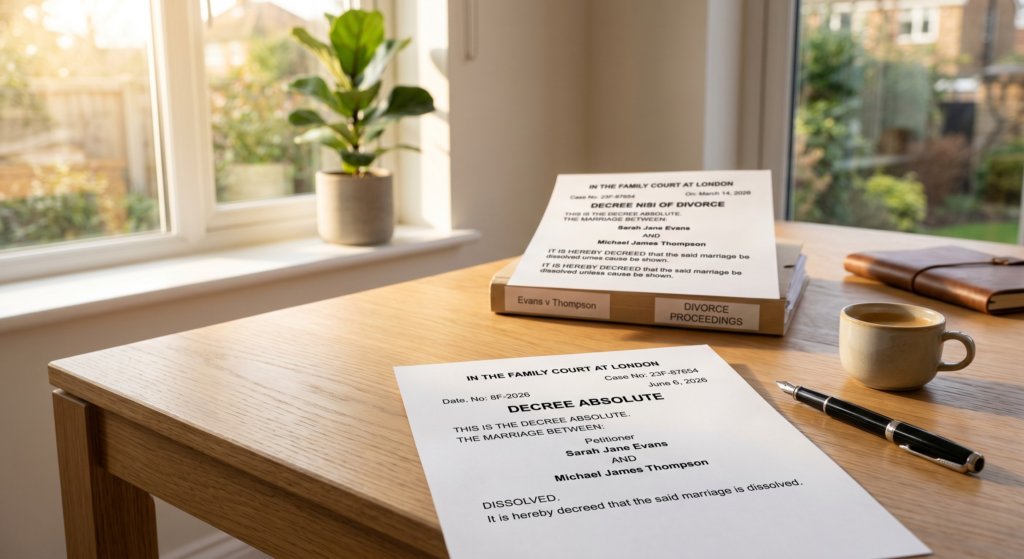
The Decree Nisi comes as a formal court document — usually a single A4 page with the court’s official header, the names of both parties (referred to as “petitioner” and “respondent”), the case number, and a statement confirming the court is satisfied the marriage has broken down.
It’s surprisingly understated for something so significant. No pomp, no ceremony. Just a piece of paper that says, essentially, “we’re nearly done here.”
What is a Decree Absolute?
This is the one that actually matters. The Decree Absolute is the final legal document that formally ends your marriage. The moment this lands in your hands (or your solicitor’s inbox), you are legally divorced.
To get it, you (or your solicitor) must apply to the court after the six-week-and-one-day waiting period. It doesn’t happen automatically — you have to actually request it.
Once the Decree Absolute is issued:
- Your marriage is legally over
- You are free to remarry
- Inheritance rights and pension entitlements can change significantly
- Both parties should update wills, insurance policies, and financial accounts
What does a Decree Absolute look like?
Similar format to the Nisi — a formal court document with both parties’ names, case number, and a clear statement that the marriage is dissolved. Some people describe it as anticlimactic for something so final. One friend said she expected some kind of official stamp or seal and instead got what looked like a standard legal letter.
The Difference Between Decree Nisi and Decree Absolute (Side by Side)
Here’s the simplest way to understand it:
| Decree Nisi | Decree Absolute | |
|---|---|---|
| Meaning | Marriage may be dissolved | Marriage is dissolved |
| Latin meaning | “Unless” | “Absolute / Final” |
| Legal status | Provisional | Final |
| Are you divorced? | No | Yes |
| Can you remarry? | No | Yes |
| When it happens | After court reviews petition | 6 weeks + 1 day after Nisi |
| New equivalent (UK, 2022) | Conditional Order | Final Order |
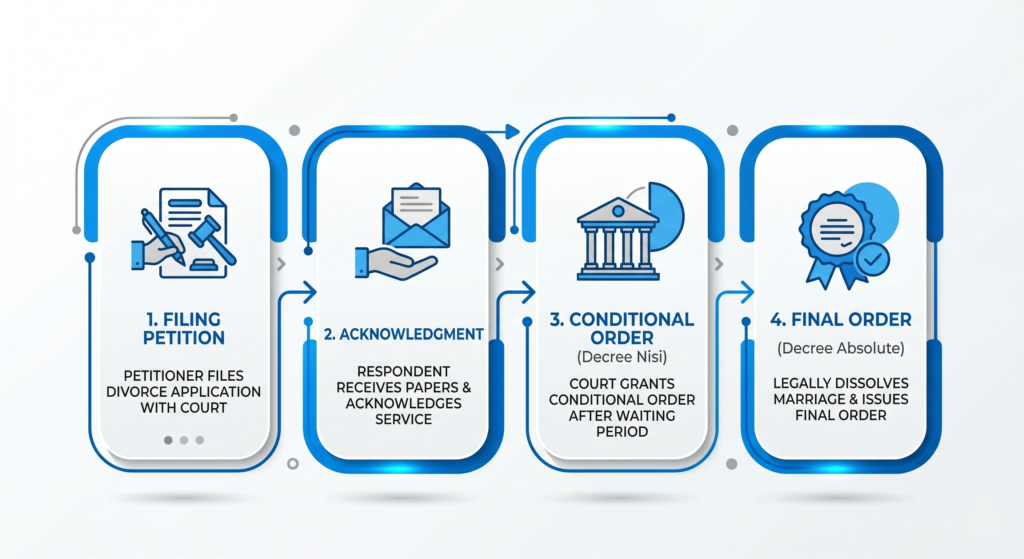
The Four Stages of Divorce (How It All Fits Together)
People often ask about the stages of divorce in England and Wales. While procedures vary depending on when the divorce was filed, the general flow for cases under the old system looked like this:
Stage 1: Filing the Petition One spouse (the petitioner) submits the divorce petition to the court, stating grounds for divorce — most commonly “irretrievable breakdown of marriage.”
Stage 2: Acknowledgement of Service The other spouse (the respondent) receives the papers and formally acknowledges them.
Stage 3: Decree Nisi The court reviews the case, and if satisfied, grants the Decree Nisi. You’re in the waiting room now.
Stage 4: Decree Absolute You apply for this after the waiting period. Once issued, the marriage is legally over.
Under the new no-fault divorce system introduced in 2022, the process is broadly similar but uses the updated terminology (Conditional Order / Final Order) and removes the need to assign blame.
What Are the 3 C’s of Divorce?

This comes up a lot in searches, and it’s more of a practical framework than a legal one. The “3 C’s” most commonly referred to in divorce contexts are:
Communication — or the lack of it — is usually at the heart of marital breakdown.
Children — if there are kids involved, their welfare becomes the court’s primary concern. Custody, access, and financial support all get handled separately from the divorce itself (these are “ancillary matters”).
Cash — the financial settlement. Splitting assets, pensions, property, and debts. This is often where divorces get complicated and contentious.
These three areas require their own negotiations and agreements, separate from the Decree Nisi/Absolute process. Getting your Decree Absolute doesn’t mean everything is sorted — it just means the marriage is legally over.
Common Mistakes People Make (Learned the Hard Way)
Mistake 1: Assuming Decree Nisi = Divorce
We’ve covered this, but it bears repeating. You are not divorced when you receive the Nisi. Do not act like you are. Do not remarry. Do not update your relationship status assuming the legal process is complete.
Mistake 2: Waiting Too Long to Apply for the Absolute
There’s a minimum wait (six weeks and one day) but there’s also a practical concern at the other end — if you wait more than a year after your Decree Nisi to apply for the Absolute, the court may require you to explain the delay. I’ve seen people put it off because of property disputes or financial proceedings and then find themselves in administrative headaches.
Mistake 3: Not Sorting Financial Matters Before the Absolute
Once your Decree Absolute is issued, you lose certain automatic inheritance rights. If you die without updating your will, your estate might not go where you intend. A lot of people focus so hard on the emotional side of divorce that they forget to handle the paperwork for pensions, joint accounts, life insurance beneficiaries, and property titles.
Mistake 4: Getting a Copy Later and Struggling to Find It
You will need your Decree Absolute — or Conditional Order — as official proof of divorce. It comes up when you remarry, apply for a mortgage, update your name, or handle pension claims. Keep a certified copy somewhere safe. If you lose it, you can apply to the court for a replacement, but it takes time and costs a small fee.
Getting a Copy of Your Decree Nisi or Absolute
If you’ve misplaced your original documents, you can apply to the court where your divorce was processed for a certified copy. You’ll need to know which court handled it and your case reference number. In the UK, you can also search the government’s online divorce records if the divorce was registered relatively recently.
Solicitors usually hold copies for a set period — it’s worth calling yours first before going through the court process.
Decree Nisi Translation and Terminology
Since we’re clearing up Latin while we’re at it:
- Nisi = “unless” in Latin. The decree takes effect unless cause is shown to the contrary.
- Absolute = final, unconditional. No more “unless” — it’s done.
In Scotland and Northern Ireland, the divorce process uses different terminology altogether — Scotland has its own system, and Northern Ireland follows similar but distinct rules. The Decree Nisi / Absolute framework specifically applies to England and Wales.
The Emotional Reality Nobody Talks About
Here’s something the legal explainers always skip: getting the Decree Absolute can hit differently than you expect.
My cousin — who initiated the divorce, who had been miserable in the marriage for years — sat quietly for about ten minutes after her Decree Absolute arrived. Not crying. Just… processing. “I thought I’d feel relieved,” she told me. “I do. But it’s strange to have something so big end with just a letter.”
That’s normal. The legal end of a marriage rarely lines up neatly with the emotional end of one. Give yourself grace on both timelines.

Final Thoughts
If you’re going through a divorce, the terminology can feel overwhelming — especially when the stakes are so high and the language feels so cold and archaic. The key things to hold onto:
The Decree Nisi (now Conditional Order) says you’re on your way — but you’re not there yet. The Decree Absolute (now Final Order) is the finish line. Don’t act on the first as though it’s the second.
And please — sort your financial paperwork before or immediately after the Absolute. Future you will be grateful.
Note: This article reflects general information about divorce law in England and Wales. Laws and procedures can change — always consult a qualified family law solicitor for advice specific to your situation.

James Whitfield is a senior legal researcher with over a decade of experience in UK family law and civil rights. He founded LegalFacts.uk to make complex legal information simple and accessible for everyday people across the United Kingdom.