
Ending a marriage is hard enough emotionally. The last thing most people want is to feel trapped in a complicated, expensive legal process on top of it. The good news is that in 2026, getting a divorce without a solicitor in the UK is genuinely possible — and for many couples, it is the most sensible route. But it is not always the right one.
This guide will walk you through exactly when you can handle it yourself, where the real risks lie, and how to stay protected — without necessarily spending thousands on professional fees.
So, do you actually need a solicitor to get divorced?
The short answer is no. There is no legal requirement in England and Wales for either party to use a solicitor. Since the Divorce, Dissolution and Separation Act 2020 came into full effect, the process has become far more straightforward. There is now just one ground for divorce — that the marriage has broken down irretrievably — and you do not need to blame your spouse or prove anything dramatic in court.
The government’s online portal on GOV.UK handles the entire paperwork process. If your situation is relatively clean, you can apply, pay the court fee, and complete each stage yourself without ever setting foot in a solicitor’s office.
Worth knowingThe removal of fault-based divorce has made DIY divorce considerably more realistic for ordinary couples. You are no longer in a position where one person must make allegations against the other, which used to make tensions — and legal costs — far worse.
When going without a solicitor makes sense
There are situations where handling your own divorce is perfectly reasonable. Broadly speaking, you are a good candidate if:
- Both of you agree that the marriage is over, and there is no hostility or dispute about that
- You do not own property together and have no significant shared debts
- Neither of you has a pension worth a significant amount, or you have already agreed informally how things will be split
- You do not have children together, or arrangements for the children are already settled and working smoothly
- The marriage was relatively short, and there are few joint assets to speak of
If most of those boxes are ticked, the process is far less daunting than it might sound. Thousands of people in the UK complete their own divorce applications each year without any professional involvement at all.
How the DIY divorce process works in 2026
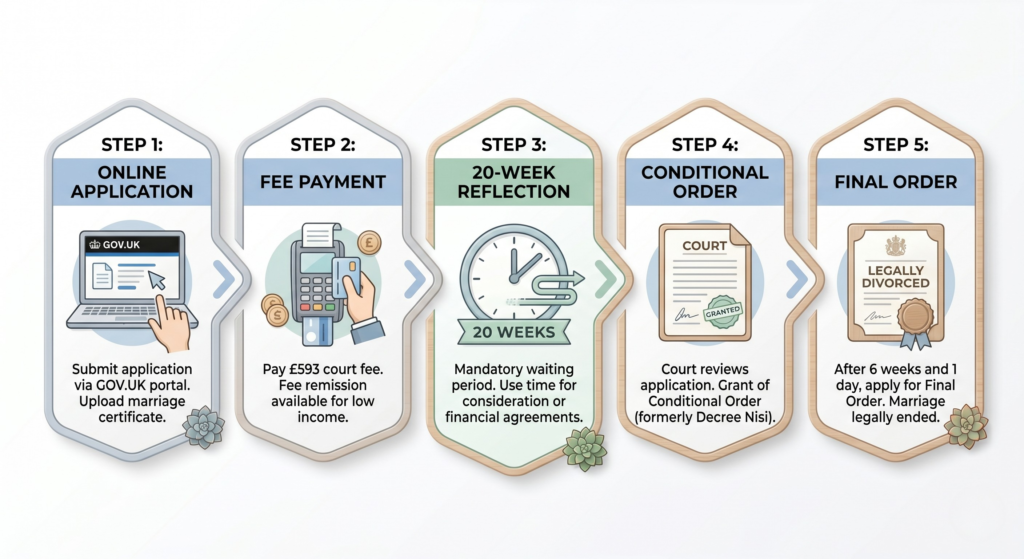
If you decide to proceed without a solicitor, the journey looks like this:
- 1Submit your application onlineYou fill in your details through the GOV.UK divorce portal and upload a photo of your marriage certificate. You can apply as a sole applicant or jointly with your spouse.
- 2Pay the court feeThe current fee is £593 (correct as of 2026, though you should always verify on GOV.UK as this can change). If you are on a low income or Universal Credit, you may be eligible to apply for a fee remission.
- 3The 20-week reflection periodOnce the court has issued your application, a mandatory 20-week waiting period begins. This is built into the law and cannot be shortened. It is not about bureaucracy — it is designed to give couples time to consider reconciliation or reach financial agreements.
- 4Apply for the Conditional OrderAfter the 20 weeks, you apply online for what used to be called the Decree Nisi. The court reviews the application and, if satisfied, grants it.
- 5Apply for the Final OrderSix weeks and one day after the Conditional Order is granted, you can apply for the Final Order (formerly Decree Absolute). Once granted, you are legally divorced.
Practical tipDo not rush to apply for the Final Order the moment you are eligible, especially if you have finances to sort out. Becoming legally divorced before a financial settlement is in place can actually affect certain financial rights, particularly around pension death benefits.
Where people go wrong — and where a solicitor still matters
The divorce application itself is genuinely manageable on your own. But the moment finances or children enter the picture, the risk of making a costly mistake rises sharply. Here is where most DIY divorces run into trouble.
Major risk
Not getting a Financial Consent Order
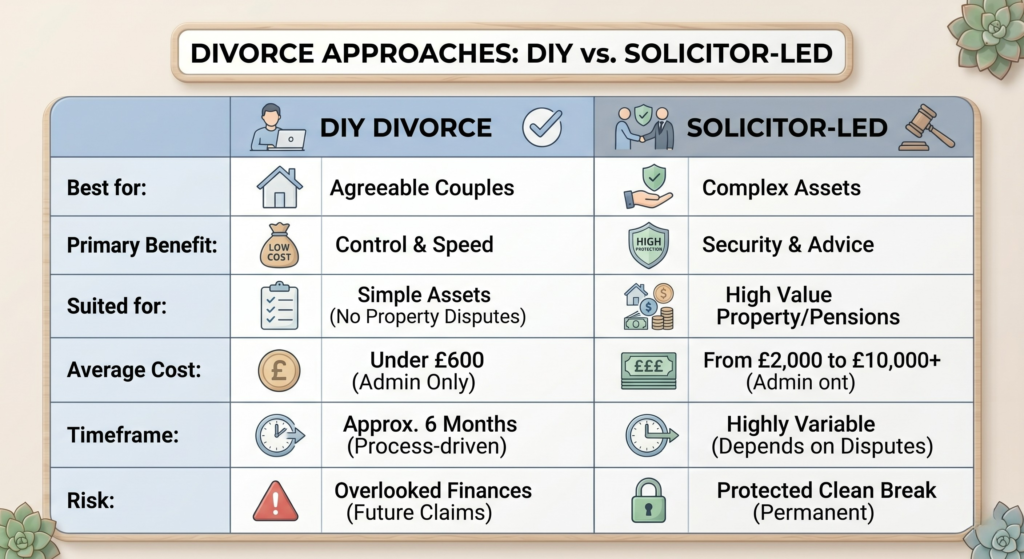
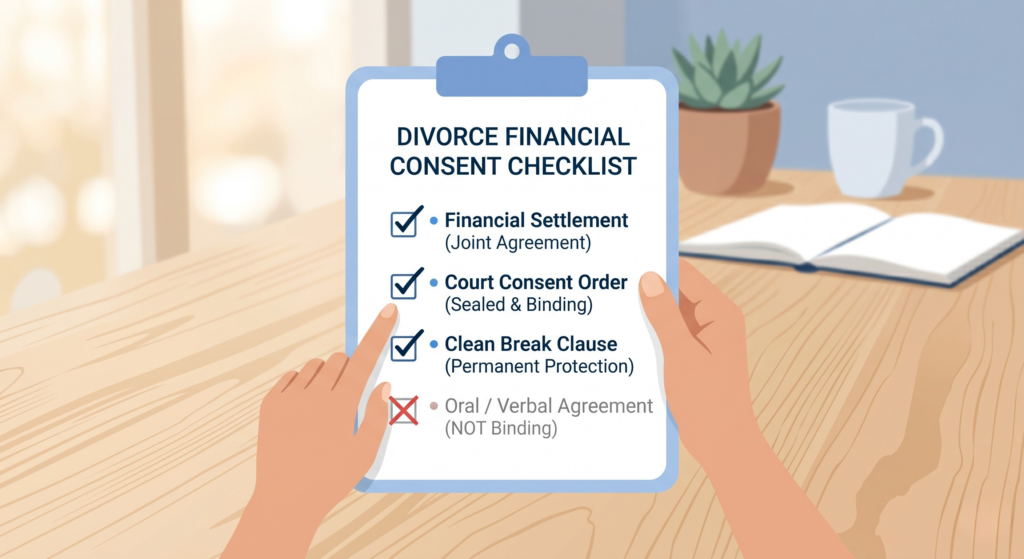
This is the single most common — and most expensive — mistake. If you and your spouse simply agree verbally on how to split things and then get divorced, that agreement has no legal standing. Your ex could make a financial claim against you years down the line, even after you have both moved on and rebuilt your lives. A solicitor will always advise you to get your financial agreement turned into a court-sealed Consent Order. It is the only way to achieve a genuine clean break.
Commonly overlooked
Ignoring pensions
Pensions are often the largest asset in a divorce, particularly for couples who have been married for a long time, yet they are routinely ignored in DIY divorces. Without a solicitor or pension specialist to request a Cash Equivalent Transfer Value (CETV) and advise on pension sharing orders, one person can walk away having left tens of thousands of pounds on the table — without even knowing it.
Practical risk
Errors on the application
The online portal is user-friendly, but the court is not forgiving of mistakes. Even a small discrepancy — a name that does not exactly match the marriage certificate, for instance — can result in your application being rejected. Court staff cannot offer legal guidance on how to correct it, which means delays and, in some cases, additional fees. A solicitor checking your paperwork before submission can prevent weeks of frustration.
The middle ground — unbundled legal services
One of the most sensible developments in family law over the past few years is the growth of what are called “unbundled” legal services. Rather than paying a solicitor to handle every aspect of your divorce from start to finish, you can now pay for specific, defined pieces of help.
This might look like:
- Doing the divorce application entirely yourself, then hiring a solicitor purely to draft your Financial Consent Order
- Paying for a one-off, fixed-fee consultation to go through your financial situation and get professional advice on whether you are missing anything
- Having a solicitor review and sense-check your completed application before you submit it
This approach is increasingly popular because it gives people real legal protection without the cost of full representation. For most straightforward divorces, it is probably the wisest path.
What about divorcing with no money?
If cost is a genuine barrier, there are options. As mentioned above, the court fee remission scheme (Help with Fees) allows those on Universal Credit, means-tested benefits, or a low income to have the £593 court fee reduced or waived entirely. You can check your eligibility and apply through the GOV.UK website at the same time as your divorce application.
Legal aid for divorce is very limited in England and Wales. It was largely withdrawn in 2013 under the Legal Aid, Sentencing and Punishment of Offenders Act. However, it may still be available where there is evidence of domestic abuse, or in cases involving the risk of child abduction. If you believe you might qualify, you can use the government’s legal aid checker at GOV.UK or contact organisations such as Citizens Advice.
Frequently asked questions
What is the cheapest way to get a divorce in the UK?
The cheapest route is a joint DIY application through GOV.UK, splitting the £593 court fee between you. If your finances are genuinely simple and both parties agree on everything, this can be the only cost you face. However, adding a basic Consent Order — which is strongly advisable — will typically cost between £300 and £500 if drafted by a solicitor or a specialist online legal service.
What is a “silent divorce” and is it relevant in the UK?
A “silent divorce” is not a formal legal term in the UK. It is a phrase sometimes used to describe couples who gradually drift apart and live increasingly separate lives without formally ending the marriage. From a legal standpoint, you are still married until a Final Order is granted — and that has real implications for things like inheritance, next-of-kin rights, and pension entitlements.
What is the biggest mistake people make in a divorce?
Without question, it is failing to formalise the financial settlement with a court order. Many couples reach a mutual agreement and then simply get divorced, assuming that agreement is binding. It is not. Years later, if one person’s circumstances improve significantly, the other can make a claim. Getting a solicitor to draft a Financial Consent Order removes this risk permanently.
My spouse has a solicitor. Do I need one too?
If your spouse is represented and you are not, you are at a disadvantage — particularly when it comes to financial negotiations. Their solicitor’s job is to protect your spouse’s interests, not yours. You do not necessarily need full representation, but having a solicitor review any documents you are asked to sign is strongly advisable.
Can I use an online divorce kit?
Be careful. Many kits sold online are outdated, use American legal terminology, or are not tailored to English and Welsh law. The only reliable starting point is the official GOV.UK divorce service. If you want additional guidance, use a regulated UK legal service rather than a generic online pack.
The bottom line
Divorce without a solicitor is entirely achievable in the UK in 2026, and for couples with uncomplicated lives and genuine mutual agreement, it is a perfectly sensible option. The online process is accessible, the law has been simplified, and you can complete the paperwork without any legal background.
But the paperwork is only part of it. If you have a house, a pension, savings, or children, the financial and practical stakes are high enough that cutting corners on professional advice can cost far more than the fees you save. The smartest approach for most people is to handle the divorce application themselves while bringing in a solicitor — even just for a single consultation or to draft a Consent Order — at the stages that matter most.
Know what you can do yourself. Know where professional guidance is worth every penny.
Important disclaimer: Legalfacts.uk is an informational blog. We are not solicitors or regulated legal professionals. Nothing on this website constitutes legal advice. While it is possible to proceed with a divorce without professional help, we strongly recommend seeking independent legal advice before making decisions about financial settlements, pension sharing, or child arrangements. For help finding a regulated solicitor, visit the Law Society’s Find a Solicitor tool at solicitors.lawsociety.org.uk.

James Whitfield is a senior legal researcher with over a decade of experience in UK family law and civil rights. He founded LegalFacts.uk to make complex legal information simple and accessible for everyday people across the United Kingdom.