
My uncle passed away in late 2022. He had a house, a few savings accounts, some premium bonds, and a Will he’d written with a solicitor about ten years earlier. We thought — naively — that because there was a Will, everything would be sorted out within a few weeks. Hand over the document, get the keys, done.If someone has told you to ‘sort out probate’ and you’re wondering how long does probate take — and what it even means — you’re in the right place.
Eighteen months later, we were still dealing with it.
Not because anything went dramatically wrong. There was no dispute, no hidden debt, no complicated foreign assets. It was just… slow. Bureaucratic. A process nobody in our family had ever been through before, and one that nobody had properly explained to us.
If you’re reading this because someone you love has just died and you’ve been told you need to “sort out probate,” I want to give you the honest version of what that means — not the textbook definition, but what it actually looks like when you’re the one doing it.
So What Actually Is Probate?
At its core, probate is the legal process of proving that a Will is genuine and giving someone the official authority to deal with a dead person’s estate.
Banks won’t let you close an account. The Land Registry won’t let you transfer a property. Pension providers won’t release funds. None of them will act on your word alone, no matter how close you were to the deceased. They need a court-issued document that says: this person has the legal right to handle this estate.
That document is called a Grant of Probate (when there’s a Will) or Letters of Administration (when there isn’t one).
Once you have it, doors start opening. Without it, you’re stuck.
Probate of Will vs. No Will — What’s the Difference?
If there is a Will: The Will names one or more Executors — the people responsible for carrying out the deceased’s wishes. They apply for a Grant of Probate, which confirms the Will is valid and gives them legal authority to act.
If there is NO Will: The person died “intestate.” In that case, there’s no named Executor. Instead, the next of kin (usually a spouse, then adult children) can apply for Letters of Administration. The rules for who inherits are then set by law — the intestacy rules — rather than any personal wishes.
Both processes go through the Probate Registry. Both end up in roughly the same place. The main difference is that dying without a Will almost always makes the process more complicated and occasionally more painful, especially if family members disagree about who should be Administrator.
When Is Probate Required?
This trips people up constantly. Not every death requires probate, and not every estate goes through the full process.
Probate is usually required when:
- The deceased owned property in their sole name
- They had bank or savings accounts above a certain threshold (usually £25,000–£50,000, though each bank sets its own limit)
- They held stocks, shares, or investments in their sole name
- There are significant assets that need to be formally transferred
Probate is usually NOT required when:
- The estate is very small — typically under £5,000–£10,000 (bank-dependent)
- Assets were held in joint names — for example, a joint bank account or a property owned as “Joint Tenants.” In these cases, the asset passes automatically to the surviving joint owner without any court process
- The deceased only had assets that pass by nomination (like some pension death benefits or life insurance policies written in trust)
One thing my family didn’t realise: our uncle had a joint savings account with his wife (who had predeceased him), and because it had defaulted back to sole ownership after her death, it was treated as a sole asset and required probate. We assumed joint history meant joint rules. It doesn’t.
When Is Probate Not Necessary? (And People Get This Wrong)
There’s a widespread belief that having a Will means you can skip probate. That’s not true. The Will tells you what should happen to someone’s estate. Probate is the legal process that actually makes it happen.
You might not need probate if:
- Everything was jointly owned and passes by survivorship
- The total estate value is very low
- All assets were held in trust or passed by beneficiary nomination
If you’re unsure, call the bank directly. Most large UK banks have a bereavement team and will tell you their specific threshold. Some will release modest amounts without a Grant; others won’t budge on a penny.
The 5 Key Steps of the Probate Process
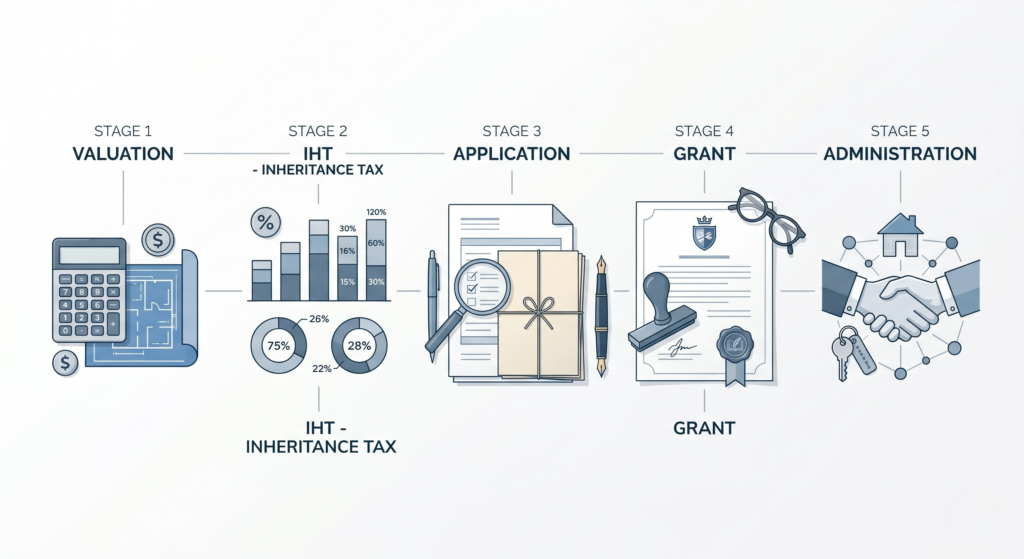
Step 1: Value the Estate
Before you can apply, you need a clear picture of everything the deceased owned and owed. That means:
- Getting up-to-date balances from every bank and savings provider
- Having the property professionally valued (ideally by a RICS surveyor, especially if IHT might be an issue)
- Identifying any debts — mortgages, credit cards, utility bills, loans
- Checking for Premium Bonds, shares, ISAs, pension pots
This stage alone takes longer than most people expect. Banks can take two to four weeks just to send a balance figure. Some institutions are better than others.
Step 2: Deal with Inheritance Tax (IHT)
If the estate exceeds the nil-rate band (currently £325,000, or up to £500,000 if the main residence is left to direct descendants), Inheritance Tax is due at 40% on everything above the threshold.
Here’s the brutal part: you often have to pay IHT before you can get the Grant of Probate — but you can’t access the deceased’s money to pay it without the Grant. It’s a classic catch-22.
The workaround most people use is a “Direct Payment Scheme,” where HMRC arranges for the tax to be paid directly from the deceased’s bank accounts. Not all banks participate, and it requires paperwork, but it’s genuinely the most practical route for most estates.
Even if no IHT is owed, you’ll likely still need to submit an IHT form (IHT205 for simpler estates or IHT400 for more complex ones) confirming that.
Step 3: Submit the Probate Application
Applications now go through the HMCTS online portal. You’ll need:
- The original Will (if there is one)
- The death certificate
- The completed IHT form or confirmation from HMRC
- The application fee
For estates valued over £5,000, the 2026 application fee is £300. Additional official copies of the Grant cost £1.50 each — order more than you think you need, because you’ll be sending them to multiple institutions simultaneously. Trying to get by with one copy and sending it sequentially adds weeks to the process.
Step 4: Wait for the Grant
Once submitted, you’re in the queue. The Probate Registry’s processing time varies. For straightforward online applications, you’re looking at 4 to 8 weeks in normal conditions. Paper-based applications, complex estates, or periods when the Registry is backlogged (which happens more often than you’d think) can push this to 16 weeks or beyond.
There’s essentially no way to speed this up. You can call to check status, but the Registry will tell you very little. It’s one of the most frustrating parts of the process — you’ve done everything right, and you’re just waiting.
Step 5: Administer the Estate
Receiving the Grant is not the finish line. It’s more like getting your race number. Now the actual work begins:
- Closing bank accounts and transferring funds
- Selling or transferring the property
- Clearing the house
- Paying any remaining debts and creditors
- Filing a final tax return for the deceased (if needed)
- Distributing the inheritance to beneficiaries
For a standard estate with a single property, this phase typically takes 3 to 9 months after the Grant arrives.
How Long Does Probate Take in 2026? (Realistic Timeline)
Here’s the honest breakdown, based on a typical UK estate:
| Phase | Realistic Time |
|---|---|
| Valuing the estate | 4–12 weeks |
| Sorting IHT and submitting application | 2–6 weeks |
| Waiting for the Grant | 4–16 weeks |
| Administering the estate (selling property, closing accounts) | 3–9 months |
| Total, start to finish | 6 to 18 months |
Most “average” estates land somewhere between 9 and 12 months. If there’s property to sell in a slow market, a disputed Will, foreign assets, or a backlogged Registry, 18 months is entirely realistic.
The 6-month end of the range usually means a small estate, no property, no IHT complications, and a quick Registry turnaround.
How Long After Probate Is Granted Does It Take to Receive Inheritance?
Once the Grant arrives, most straightforward bank accounts can be closed and funds transferred within 2 to 4 weeks — sometimes faster if you’re organised and have multiple certified copies of the Grant ready to send out simultaneously.
Property takes longer because it depends on the property market, conveyancing solicitors, and buyers. A sale can take 3 to 6 months from instruction to completion.
If you’re a beneficiary waiting on your inheritance, the honest answer is: it’s rarely less than a few weeks after the Grant arrives, and often several months if property is involved. Executors have up to a year (the “Executor’s Year”) to administer the estate before beneficiaries can formally push back.
How Long Does Probate Take for a Bank Account?
Bank accounts are usually the fastest part. Once you have the Grant and certified copies, most high-street banks process closure requests within 2 to 4 weeks. Some are faster — Lloyds and Barclays, for example, have dedicated bereavement teams that are reasonably efficient.
The delay is usually not the bank but the queuing — if you only have one Grant copy and you’re sending it sequentially to multiple banks, you’re adding weeks for no reason. Order at least four or five certified copies from the Probate Registry upfront.
Does Power of Attorney Speed Up Probate?
This is a common misconception worth clearing up. A Lasting Power of Attorney (LPA) ends the moment the donor dies. It has no effect on probate whatsoever.
LPA is useful during someone’s lifetime if they lose capacity. But the moment they die, it becomes worthless paper. The Executor’s authority comes from the Grant of Probate — not from any LPA that may have existed.
If you were acting as someone’s attorney before they died, your role ends there. You then step into the Executor role (if you’re named in the Will) or apply for Letters of Administration.
How Much Does an Estate Have to Be Worth to Go to Probate?
There’s no single national threshold — it varies by institution. The general guidance is:
- Under £5,000: Most banks will release funds without requiring probate
- £5,000–£50,000: Varies by bank — some require probate, others will act on a death certificate and statutory declaration
- Over £50,000 (or any property in sole name): Almost certainly requires a Grant of Probate
The Probate Registry’s own fee kicks in at estates worth over £5,000 — that’s when the £300 application fee applies.
If the estate is borderline, it’s worth calling the specific banks involved before assuming probate is necessary.
How Long Does a Will Take to Make?
Slight tangent, but it comes up a lot — especially after someone dies without one and the family is dealing with the fallout.
A simple Will can be drafted and signed in a single appointment with a solicitor, typically 1 to 2 hours. Cost is usually £150–£300 for a straightforward document. If you use an online Will-writing service, it can be done in under an hour.
The legal requirements are minimal: the Will must be in writing, signed by the testator in the presence of two witnesses, and those witnesses must also sign. Neither witness can be a beneficiary.
The real barrier to making a Will isn’t time or cost — it’s the human tendency to put it off. The number of estates that go through the intestacy process every year because someone simply never got around to it is genuinely staggering.
Common Mistakes People Make (and How to Avoid Them)
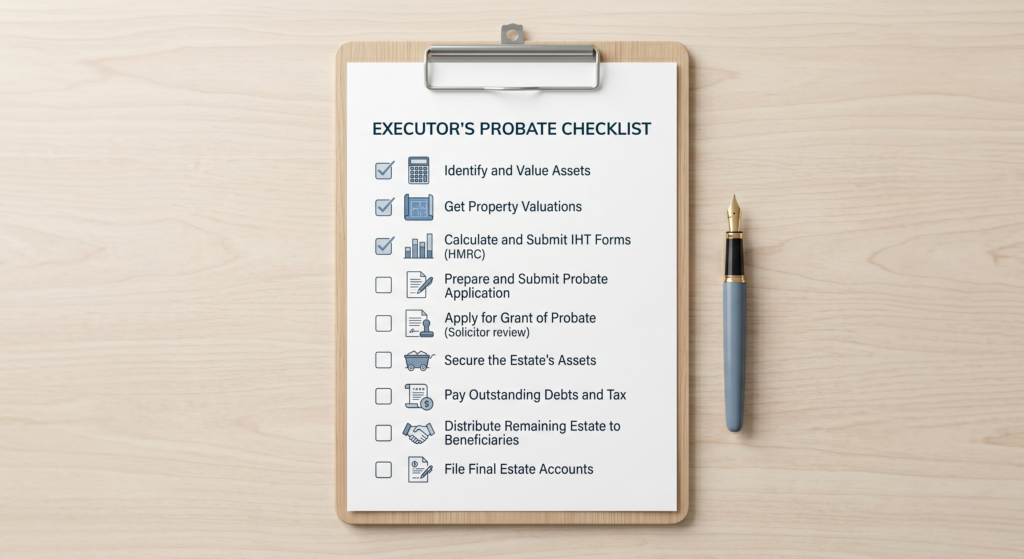
Mistake 1: Assuming a Will means no probate needed.
It doesn’t. A Will tells you the intentions. Probate is what makes those intentions legally enforceable.
Mistake 2: Only ordering one copy of the Grant.
Order at least four. Banks, the Land Registry, share registrars — everyone needs one, and making them wait while you pass a single copy around adds months to the process.
Mistake 3: Touching the estate’s money before the Grant arrives.
Executors sometimes transfer money or pay themselves from the estate before probate is granted. This is legally problematic and can expose you to personal liability. Wait for the Grant.
Mistake 4: Forgetting about the deceased’s final tax return.
HMRC still needs to be notified of the death and a final Self Assessment may be required if the deceased was self-employed or had income from multiple sources. This catches people off guard.
Mistake 5: Ignoring creditors.
Executors are personally liable if they distribute an estate and a creditor turns up later. It’s standard practice to place a statutory advertisement in The Gazette, giving creditors two months to come forward before you distribute. It feels like a formality — but it protects you.
Frequently Asked Questions
Can I sell the house before probate is granted?
You can market the property and accept an offer before the Grant arrives, but you cannot legally complete the sale. Buyers’ solicitors will flag it; most cash buyers and experienced buyers will proceed cautiously, but it can complicate your buyer chain.
Do all estates need probate?
No. Small estates, assets held jointly as Joint Tenants, and assets held in trust or passing by nomination often don’t require probate. Call each institution individually to confirm their threshold.
What if there’s no Will?
You apply for Letters of Administration instead of a Grant of Probate. The process is broadly similar, but the intestacy rules determine who inherits — your spouse and then your children, in a set legal order.
Can an Executor be removed for being too slow?
Yes. Beneficiaries can apply to the court to remove or replace an Executor who is being unreasonably slow or negligent. It’s a legal process in itself, but it is an option if things go badly off track.
What if there are assets abroad?
Foreign assets are one of the most complex probate scenarios. Some countries require their own separate probate process (“re-sealing” the UK Grant, or an entirely fresh local application). This is absolutely a situation where hiring a solicitor pays for itself.
Is probate public?
Yes. Once a Grant of Probate is issued, the Will and the Grant become public documents. Anyone can request a copy from the Probate Registry for a small fee. This surprises some families who assumed their loved one’s wishes would remain private.
A Final Thought
The thing nobody tells you about probate is how emotionally strange it is. You’re grieving, and simultaneously you’re chasing bank statements, deciphering tax forms, and fielding calls from solicitors. It doesn’t feel like honouring someone’s memory. It feels like admin.
But done properly, probate is actually an act of respect — making sure the person’s debts are cleared, their wishes are honoured, and the right people receive what they were left. The paperwork is a means to that end.
If the estate is straightforward, you can often handle it yourself, especially with the HMCTS online portal now in place. If there’s a property, significant assets, or any kind of complication — a disputed Will, foreign assets, a blended family — getting a solicitor involved early is almost always worth the cost. Not because you can’t manage it, but because the mistakes that happen when people manage complex estates alone can be expensive to fix later.
This article is for general information only and does not constitute legal or financial advice. Probate timelines vary depending on estate complexity and Probate Registry workloads. For high-value or disputed estates, we recommend consulting a qualified probate solicitor.

David Hargreaves is a legal content writer specialising in wills, inheritance, and cohabitation rights. He is passionate about helping UK residents understand what happens to their assets and loved ones, and writes in-depth guides to make the law easy to understand for everyone.