
If you’ve ever wondered what does child maintenance covers — really covers — you’re not alone.
I remember sitting across from my sister at her kitchen table, about eight months after her separation, watching her go through a stack of receipts. Football boots. A new school bag. Orthodontist consultation. Swimming lessons. Her ex had just sent his monthly maintenance payment — and she was trying to work out what she was actually “allowed” to ask him to contribute toward.
That conversation ended in tears and a lot of confusion. Because honestly? Nobody tells you upfront what child maintenance is supposed to cover, what it isn’t, and what happens when your child needs something that falls awkwardly in the middle.
If you’re in a similar spot — whether you’re the one paying or the one receiving — this is the honest, practical breakdown you probably needed months ago.
First, Let’s Talk About What the CMS Actually Says
The Child Maintenance Service (CMS) in the UK calculates payments based on the paying parent’s income. It’s a formula — income percentage multiplied by number of children, adjusted for overnight stays and other children in the household. What it’s not is a detailed shopping list.
The official position is that maintenance covers a child’s everyday living costs. That phrase sounds simple until you try to define it in real life.
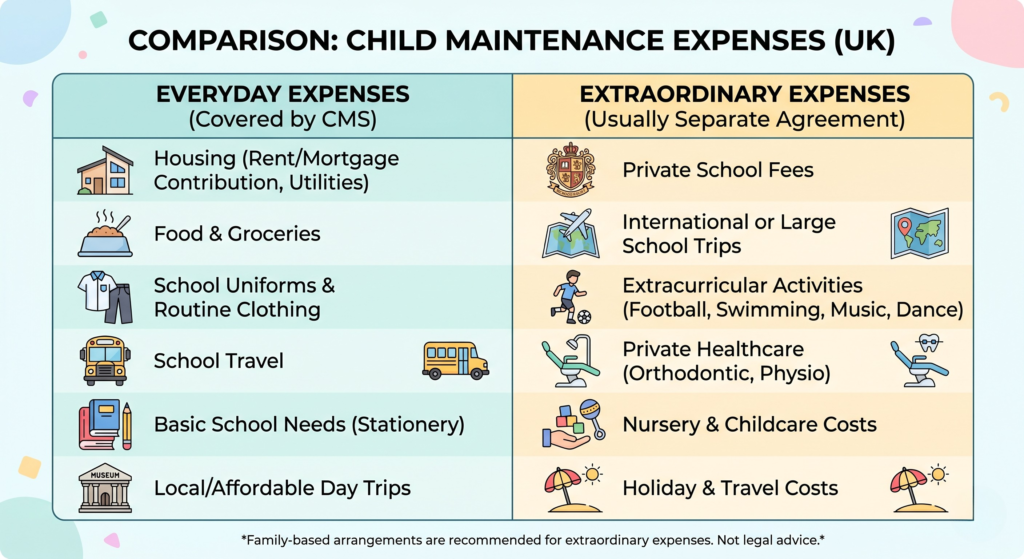
Here’s what’s officially considered part of those everyday costs:
- Housing — a contribution toward the rent or mortgage of the home the child lives in, plus utilities like heating, electricity, and water
- Food — daily meals, school lunches, general groceries
- Clothing — everyday clothes, shoes, coats
- Basic school costs — essential stationery, basic books, school travel
That’s the core of it. And honestly, when you add it up, it doesn’t go very far — especially in a city where rent alone can swallow the entire payment before you’ve bought a single meal.
Does Child Maintenance Cover School Uniforms?
Yes — technically. School uniforms, because they’re a routine cost of a child being in school, fall under “everyday living costs.” The CMS would expect the receiving parent to budget for this from the monthly payment.
But here’s where it gets murky. A standard secondary school uniform — blazer, PE kit, shirts, trousers, shoes — can easily run £200 to £300 when you’re buying it all at once, usually at the start of a new school year. That’s a big hit in a single month.
Most parents who are co-parenting reasonably well tend to approach this practically: the receiving parent covers routine school clothing from the maintenance, but if both parents want to be involved, or if the cost spikes significantly (like a brand-new blazer for a new school), they have a separate conversation about splitting it.
If your co-parenting relationship is more strained and everything goes through the CMS? Then uniform costs are considered covered by the payment. You can’t formally claim extra for them.
What About School Trips?
Local, affordable day trips are generally considered part of normal school life and therefore covered by maintenance. A £12 museum visit? That’s on the receiving parent to budget for.
An international school trip to Rome for £900? That’s a different conversation entirely. These are typically treated as extraordinary expenses — costs that are genuinely outside what a monthly maintenance payment could reasonably account for.
There’s no automatic legal mechanism for splitting these. The most sensible approach — and what many separated parents quietly agree to — is a 50/50 split on anything above a certain threshold, say £100 or £150 per trip. You can document this in a family-based arrangement outside the CMS, which is totally legal and often much simpler than going through a formal process.
Private School Fees: A Completely Separate Thing
This one causes enormous confusion, so let’s be clear: child maintenance does not cover private school fees. Not a penny of it.
The CMS calculation has nothing to do with the school a child attends. It doesn’t matter if the child has been in private education since Reception. The formula is the formula.
If you want private school fees to be covered (or continued) after a separation, you have two options:
- A family-based agreement — both parents voluntarily agree to contribute to fees on top of standard maintenance. This works best when communication is decent.
- A School Fees Order through the courts — you can apply to a court, but they’ll only grant this if the fees are genuinely affordable for both parties and if keeping the child in private school is consistent with their background and best interests. Courts treat this as a high bar.
I’ve seen cases where one parent genuinely couldn’t sustain private school fees alone, the other refused to contribute voluntarily, and the child ended up switching to a state school mid-year. It’s painful, but the CMS won’t fix it for you.

Extracurricular Activities: Football, Swimming, Music, Dance
This is the one that causes the most arguments in my experience.
Weekend football. Saturday swimming lessons. Guitar lessons. Dance classes. Gymnastics. These are not included in the standard CMS calculation. The CMS officially views extracurricular activities as lifestyle choices — extras above and beyond a child’s basic needs.
What that means in practice:
- If the paying parent wants the child to continue a particular activity, they often offer to pay for it separately
- If the receiving parent signs the child up for something new, they generally carry the cost unless both parents agree otherwise
- There’s no mechanism to force a paying parent to contribute to extracurriculars through the CMS
This is genuinely one of the messiest areas. I’ve spoken to parents who feel guilty stopping activities because they can’t afford them alone. And others who feel it’s deeply unfair that their child gets to do all these things at one house but they’re not expected to contribute financially.
The only real solution is a separate, documented agreement between both parents. Write it down, even informally. Something like: “We both agree to split activity costs 50/50 for any activity both of us agree to sign the child up for.” It doesn’t have to be a legal document. It just needs to be clear.
If I Pay Child Maintenance, Should I Pay for Anything Else?
Short answer: legally, through the CMS, no. The payment is meant to be your financial contribution to the child’s upbringing.
Longer, real-world answer: it depends on your relationship with your co-parent and what you’ve agreed.
The CMS figure is genuinely just a floor — a legal minimum. Many families go well beyond it through voluntary agreements because the reality is that a single monthly payment doesn’t cover everything a child needs across an entire year.
If you want a relationship with your child that involves birthday parties, holidays, school trips, sports, and all the rest — most paying parents find it’s in everyone’s interest to have those separate conversations. Not because you’re legally obligated, but because it makes co-parenting smoother and your child’s life fuller.
How Is Child Maintenance Calculated?
The CMS uses the paying parent’s gross weekly income as the starting point. Here’s a simplified version of how the rates break down:
- Nil rate — income below £7/week or certain exempt circumstances
- Flat rate — £8.40/week for those on certain benefits or income below £100/week
- Reduced rate — income between £100–£200/week, with a tapered calculation
- Basic rate — the most common; a percentage of income above £200/week
- 12% for one child
- 16% for two children
- 19% for three or more children
- Basic plus rate — higher percentage on income over £800/week
Overnight stays with the paying parent reduce the amount. So does having other children living with you.
There’s an official child maintenance calculator on the GOV.UK website that gives you an estimate — it’s genuinely useful and free to use before you contact the CMS formally.
What Is the Minimum a Father (or Any Paying Parent) Has to Pay?
The flat rate — currently £8.40 per week — is the legal minimum for paying parents on very low incomes or certain benefits. In practice, for most parents in employment, the basic rate calculation produces a significantly higher figure.
It’s also worth noting: paying the CMS minimum doesn’t mean both parents have contributed equally to a child’s life. It’s a floor, not a ceiling.
Does Child Support Cover Clothing for Both Houses?

No — and this is a common pain point.
If a child spends time at both parents’ homes, the standard position is that the receiving parent uses the maintenance to cover the child’s clothing. The child’s clothes technically go where the child goes.
But in households where there’s genuine shared care, many parents duplicate the basics — a set of everyday clothes at each home — just for practical sanity. That cost at the paying parent’s home is on them; it’s not something the CMS accounts for.
When Does Child Maintenance Stop?
Generally, child maintenance payments stop when the child:
- Turns 16, unless they remain in full-time approved education
- Finishes full-time approved education (A-Levels, equivalent qualifications), typically around age 18-19
- Turns 20 — this is the absolute upper limit, even if they’re still in approved education
If a child goes to university, standard CMS maintenance stops. University support is a separate conversation — many parents agree privately to contribute, but the CMS has no jurisdiction over it.
The NHS vs Private Healthcare Question
Standard NHS healthcare — GP visits, prescriptions (which are free for under-16s), routine dental check-ups — is considered covered by maintenance. No extras needed.
Private medical care is different. If your child needs private orthodontic work (braces not available on the NHS), private physio after a sports injury, or any other private treatment, that’s treated as an extraordinary expense. Most parents handle it case by case, splitting the cost or agreeing on who covers what.
What About Childcare and Nursery Fees?
This is an area where maintenance genuinely falls short. Nursery and childcare costs in the UK — especially in London and other cities — can be astronomical. The standard maintenance payment for a child under school age simply doesn’t cover nursery fees.
Most working parents reach a separate agreement to split childcare costs. If one parent is paying CMS maintenance and splitting nursery fees 50/50, their actual contribution to the child’s costs can be significantly higher than the headline maintenance figure.
A Few Things People Get Wrong
Mistake 1: Assuming the receiving parent has to show receipts.
They don’t. Legally, a receiving parent is not required to account for how maintenance money is spent. As long as the child’s needs are being met, neither the CMS nor a court will demand a breakdown. This frustrates paying parents enormously — but it’s the law.
Mistake 2: Thinking maintenance covers holidays.
If a parent wants to take the child on holiday, they cover that cost entirely — flights, accommodation, spending money. Maintenance covers life at home, not travel.
Mistake 3: Expecting maintenance to adjust seasonally.
Some parents ask for extra in winter to cover higher heating bills. The CMS doesn’t work that way. The calculation is an annual average; the receiving parent is expected to budget accordingly across the year.
Mistake 4: Assuming verbal agreements will hold.
If you and your co-parent agree on something beyond the CMS payment — splitting trips, covering sports clubs, contributing to school fees — write it down. Not because you don’t trust each other right now, but because circumstances change, memories differ, and you’ll thank yourself later.
The Bigger Picture
Child maintenance was never designed to be a complete solution. It was designed to be a baseline — to make sure that after a separation, the child’s most basic needs don’t fall entirely on one parent’s shoulders.
The families who navigate this best are usually the ones who treat the CMS payment as a starting point, not an endpoint. They have separate, practical conversations about the things that actually make up a child’s life: the sports kit, the school trip, the birthday party, the dentist.
It’s not always easy, especially when the relationship between parents is difficult. But the child doesn’t stop having needs just because the adults in their life have stopped talking comfortably. And in the end, most of the awkward conversations are worth having — for the kid’s sake, if nothing else.
This article is intended for general information only and does not constitute legal advice. For guidance specific to your situation, consider speaking to a family solicitor or contacting the Child Maintenance Service directly via GOV.UK.

Sarah Mitchell is a family law specialist with a strong background in child arrangements, custody disputes, and family mediation. She joined LegalFacts.uk to help parents across the UK understand their legal rights and make informed decisions for their children’s future.