
My friend called me at 11pm on a Tuesday, crying. Her husband had smashed her phone, thrown her bags outside the front door, and was refusing to let her back into the house — a house she had lived in for nine years. Her name wasn’t on the mortgage. She had no idea she had any rights at all.
That night, I helped her search for answers. And the one thing that kept coming up — the thing that actually worked for her within 48 hours — was an Occupation Order.
If you’re reading this right now, you’re probably in a similar situation. Maybe you feel trapped in your own home. Maybe you’ve already left but you want to come back. Maybe someone has told you to “just leave” and you’re wondering why you should be the one to go. This article is for you — and I’m going to explain everything as clearly and honestly as I can, including the parts most legal websites leave out.
So, What Actually Is an Occupation Order?
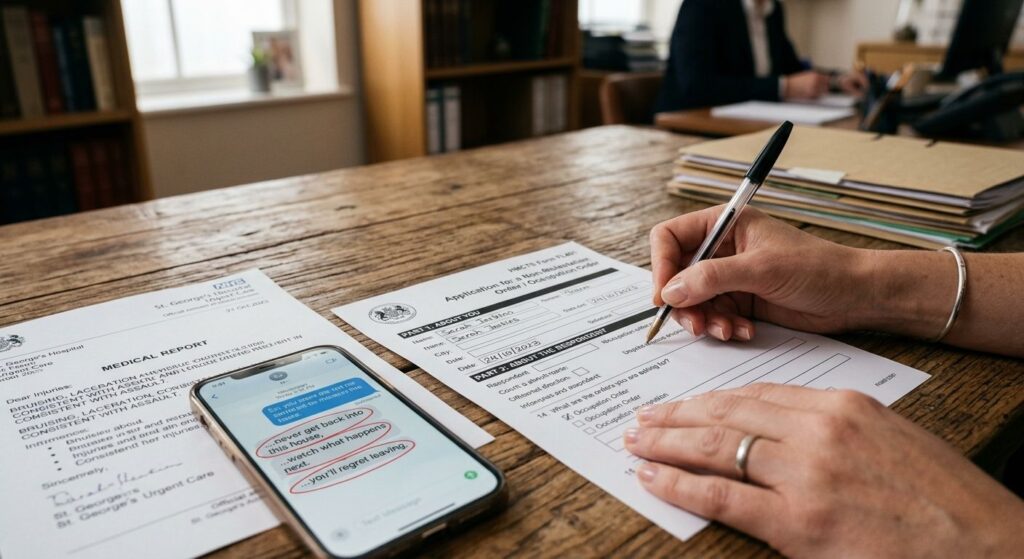
In plain English: it’s a court order that decides who gets to live in the home — and who has to leave. It doesn’t matter whose name is on the mortgage or the tenancy agreement. The court looks at safety, not paperwork.
It’s made under the Family Law Act 1996, and it’s one of the most powerful tools available to someone escaping a dangerous or controlling home situation. It can:
- Force your partner or ex-partner to leave the property entirely
- Stop them from coming within a set distance of the home
- Allow you to return if you’ve been locked out or forced to flee
- Split the property into zones if, for some reason, both parties need to remain temporarily
- Even order the person who leaves to keep paying rent or the mortgage while proceedings continue
But here’s what a lot of people don’t know: it doesn’t change who owns the home. It’s temporary — usually six to twelve months. It’s a safety net, not a final settlement.
How Much Does an Occupation Order Cost in the UK?
This is the question most people search for first, so let’s just get it out of the way.
Court fee: £0. There is no court fee to apply for an Occupation Order in the UK. The application itself is completely free.
Now, the real cost question is about legal representation. You don’t have to use a solicitor, but honestly, in most cases you should. Here’s a rough breakdown:
| Route | Estimated Cost |
|---|---|
| DIY (no solicitor) | £0 — but high risk if contested |
| Legal Aid (if eligible) | Free or very low cost |
| Private solicitor | £1,500 – £5,000+ depending on complexity |
| Emergency without-notice application | Often slightly higher due to urgency |
Legal Aid is still available in 2026 for domestic abuse cases, and this covers Occupation Orders. You’ll need to show evidence of abuse (more on that below), but if you qualify, your solicitor’s fees are covered. Check your eligibility through a family law solicitor or Citizens Advice.
How to Apply for an Occupation Order in the UK

Here’s the actual step-by-step process — not the watered-down version:
Step 1: Fill Out Form FL401
This is the main application form. It covers both Occupation Orders and Non-Molestation Orders, so if you need both (and many people do), you fill out one form. You can download it from the HMCTS website or get it at your local family court.
The form asks for:
- Your details and the respondent’s details
- The property address and ownership information
- The nature of your relationship (married, cohabiting, etc.)
- What you want the court to order
Step 2: Write Your Witness Statement
This is the part most people underestimate. Your witness statement is your evidence. It needs to be detailed, chronological, and specific. Don’t just write “he was abusive.” Write dates, describe incidents, mention witnesses, reference any police callouts, GP visits, or messages.
Courts see a lot of these. Vague statements get vague responses. Specific, documented statements get results.
Step 3: Choose: With Notice or Without Notice?
Without notice (emergency): If there is an immediate risk of harm, you can apply without telling the other person first. The court can hear your case the same day and grant a temporary order. This is what happened in my friend’s situation — she had an order within 48 hours.
With notice: In less urgent situations, the respondent is served with the papers and gets a chance to respond at a hearing. This takes longer but is more thorough.
Step 4: Attend the Hearing
Even for emergency orders, you (or your solicitor) will need to attend court. If the order is granted without notice, there will be a follow-up hearing where the respondent can challenge it.
Step 5: Order Is Served
Once granted, the order must be formally served on the respondent — usually by the court bailiff or a process server. It only becomes legally enforceable from the moment they receive it.
What Evidence Do I Need for an Occupation Order?

This is where people often go wrong — either they bring too little, or they don’t know what counts as evidence.
Here’s what actually helps in court:
Strong evidence:
- Police call logs and crime reference numbers
- Medical records showing injuries (A&E visits, GP notes)
- Text messages, WhatsApp chats, voicemails — screenshot everything
- Emails or letters with threatening content
- Witness statements from neighbours, family members, friends
- Photographs of injuries or damage to property
- Any previous court orders (injunctions, restraining orders)
- Social services or safeguarding records if children are involved
Don’t overlook:
- Your own diary or journal entries with dates (courts do accept these)
- Screenshots of social media posts or messages
- Bank statements showing financial control or coercion
- School or GP letters expressing concern for children
The key legal test is “significant harm” — you need to show that you or your children face serious risk if the order isn’t made. The more specific and documented your evidence, the stronger your case.
How to Win an Occupation Order
“Winning” an Occupation Order comes down to the Balance of Harm test. The judge weighs up:
- The harm to you (and your children) if the order is NOT granted
- The harm to the respondent if they ARE forced to leave
If your harm outweighs theirs, the court is legally required to grant the order. So your job is to make that balance crystal clear.
Here’s what works in practice:
✅ Do this:
- Be specific in your witness statement — not “he was violent” but “on 3rd March 2025, he pushed me into the kitchen counter. I attended A&E the following morning. Reference: [hospital name].”
- Bring evidence of the respondent’s ability to find alternative housing (e.g. they have family nearby, they earn enough to rent)
- If children are involved, show how the current situation is affecting them — school reports, children’s services notes, GP letters
- Apply for a Power of Arrest to be attached — this gives police immediate authority to act if the order is breached
❌ Avoid these mistakes:
- Don’t wait too long hoping the situation improves — courts are more sympathetic when applications are timely
- Don’t discuss the case on social media — the respondent’s solicitor will find it
- Don’t try to negotiate informally after applying — it can undermine your case
- Don’t exaggerate. Courts are experienced. Credibility matters more than drama.
Problems With Occupation Orders (The Honest Part)
I want to be real with you here, because most articles skip this entirely.
1. They don’t always stick. An order is only as good as its enforcement. If the respondent breaches it and you don’t report it, nothing happens. You must call the police every single time there’s a breach — even if it feels minor.
2. Without-notice orders are temporary. An emergency order is usually just a few weeks. There will be a return hearing where the respondent can contest it. If they turn up with a good solicitor and you don’t have strong evidence, the order can be discharged.
3. Housing can become complicated. If the respondent is the sole owner and they’re forced out, they may stop paying the mortgage. The court can order them to keep paying, but enforcing that is another matter.
4. It can escalate tension. Serving an order on someone volatile can sometimes provoke them. Make sure you have a safety plan in place — know where you’ll go, who to call, and save the non-emergency police number.
5. Not everyone qualifies. You must be an “associated person” — which generally means you were in a relationship with the respondent or have children together. If you’re a flatmate or lodger with no relationship, this route isn’t available to you.
Emergency Occupation Order: When You Need Help Today
If you are in immediate danger, you don’t have to wait weeks for a court date. An emergency without-notice Occupation Order can be applied for and granted on the same day in many cases.
Here’s what you do:
- Contact a family law solicitor first thing in the morning — explain it’s urgent
- Or go directly to your local family court — courts have duty judges for urgent applications
- You can also contact National Domestic Abuse Helpline (0808 2000 247) — they can help you access emergency legal support
You do not need to have everything perfectly documented to get emergency help. Courts understand that people in crisis don’t always have time to gather evidence. Your sworn statement alone can be enough for an initial order.
Occupation Order vs Non-Molestation Order: Which Do You Need?
A lot of people confuse these two, and sometimes you actually need both.
| Occupation Order | Non-Molestation Order | |
|---|---|---|
| What it covers | Who lives in the home | Harassment, threats, contact |
| Main use | Excluding someone from the property | Stopping someone from contacting or threatening you |
| Affects ownership? | No | No |
| Emergency application? | Yes | Yes |
| Form | FL401 | FL401 (same form) |
If someone is both threatening you and sharing your home, you can apply for both at the same time on the same form.
Frequently Asked Questions
How long does an Occupation Order last?
Most orders are granted for six months. They can usually be extended by a further six months if legal proceedings are still ongoing.
Can I get an Occupation Order if I’m not married?
Yes — cohabiting couples, ex-partners, and people who have had a child together can all apply, even if they were never married.
What happens if the order is breached?
If there is a Power of Arrest attached, the police can arrest the respondent immediately. Without one, you’d need to apply to the court for a committal hearing (which can result in a fine or imprisonment for contempt of court).
Can the respondent challenge the order?
Yes, at the return hearing (usually 14 days after an emergency order). This is why having solid evidence matters from day one.
Does an Occupation Order affect the divorce settlement?
Not directly — it doesn’t change ownership. But a judge in divorce proceedings will be aware of it, and it can influence decisions about the family home.
Can I apply without a solicitor?
Legally, yes. In practice, it’s risky — especially if the respondent turns up with legal representation. At minimum, speak to Citizens Advice or a legal aid solicitor before you go it alone.
What is Form FL401?
FL401 is the official court application form used to apply for both Occupation Orders and Non-Molestation Orders in England and Wales. It’s available free from the HMCTS website.
Final Thoughts
The law isn’t perfect. Courts are slow sometimes. Evidence is hard to gather when you’re terrified. I know that.
But what I also know — from watching my friend go through this — is that the Occupation Order is one of the few legal tools that can genuinely change your situation quickly. Within days, not months. And the fact that it costs nothing to apply means money isn’t a barrier.
If your home has stopped feeling like a safe place, you shouldn’t be the one sleeping on someone’s sofa. The law gives you the power to make the person causing the danger leave instead. Use it.
This article is written for general informational purposes and does not constitute legal advice. If you are in immediate danger, please call 999. For legal support, contact a qualified family solicitor or the National Domestic Abuse Helpline: 0808 2000 247 (free, 24 hours).

David Hargreaves is a legal content writer specialising in wills, inheritance, and cohabitation rights. He is passionate about helping UK residents understand what happens to their assets and loved ones, and writes in-depth guides to make the law easy to understand for everyone.