
A friend of mine called me in a panic last year. She was separating from her partner, money was tight after moving into a tiny rented flat with the kids, and a solicitor had just quoted her a number that made her laugh out loud — not because it was funny, but because she genuinely didn’t have it. She asked me, half-joking, “so what, do I just have to sort this out myself with no help at all?”
That’s actually the moment I learned how much misinformation is floating around about legal aid and mediation. Most people assume legal aid basically doesn’t exist anymore, because everyone’s heard the headlines about solicitor funding being slashed. What barely anyone realises is that mediation is treated completely differently. The eligibility rules are far more generous, and I’ve now sat with two separate friends through the actual paperwork side of this, so I know exactly where people trip up.
If you’re staring down a separation and dreading the cost of sorting out the kids or the finances, this is the bit nobody explains properly. So let’s go through it properly — what it covers, who actually qualifies, what catches people out, and what to do if you don’t qualify at all.
What Legal Aid Actually Pays For in Mediation
Here’s the first thing that surprised my friend: legal aid for mediation isn’t a discount scheme. If you qualify, it’s free. Not “subsidised,” not “reduced rate” — free. That includes:
- The MIAM (Mediation Information and Assessment Meeting) — the initial one-on-one chat where the mediator figures out if mediation is suitable for your situation.
- Every joint session — the actual sit-downs where you and your ex work through arrangements for the kids or the money.
- The paperwork at the end — the mediator drafting your Memorandum of Understanding (the document that summarises what you agreed).
- A bit of legal advice on the side — some legal aid mediation providers can also give you a small amount of solicitor advice to support what’s happening in mediation.
I’ll be honest, when my friend found this out she assumed there must be a catch. There sort of is, but it’s not really a catch — it’s just that you have to actually qualify, and that’s the part most people get wrong or give up on too early.
The Rule Nobody Tells You: What Happens When Only One Of You Qualifies
This is the bit I think is genuinely underrated, because it changes the whole conversation with an ex-partner who’s reluctant to even try mediation.
If one of you qualifies for legal aid and the other doesn’t:
- The MIAM is free for both of you.
- The first joint session is also free for both of you, even though only one person technically qualifies.
- After that first session, the person without legal aid starts paying the standard rate, but the qualifying person keeps going for free the whole way through.
I’ve seen this work in practice and it’s actually a decent icebreaker. If your ex is dragging their feet because they think mediation is “another solicitor cost,” telling them the first session costs them nothing at all sometimes gets them through the door. Once people are actually sat in the room, they’re usually more willing to keep going.

How Eligibility Is Actually Worked Out
This is where things get a bit number-heavy, but stick with me, because the actual thresholds matter more than the vague “you have to be on a low income” version most articles give you.
The Legal Aid Agency runs what’s called a means test, and as of the current 2026 thresholds (the figures are reviewed and updated every April, so they do shift slightly), here’s roughly where the lines sit:
Gross monthly income Your gross income generally needs to sit under about £2,657 a month (roughly £31,884 a year) before tax. If your gross monthly income is above that figure, you’re automatically ineligible for civil legal aid regardless of your outgoings — there are some exceptions if you’ve got more than four children, where extra allowances kick in.
If you’re on certain benefits, you skip the income test entirely. This is called “passporting,” and it covers things like:
- Income-based Jobseeker’s Allowance
- Income-related Employment and Support Allowance
- Income Support
- Universal Credit
So if you’re already receiving any of those, don’t even bother stressing over the income calculation — you’re automatically through that part.
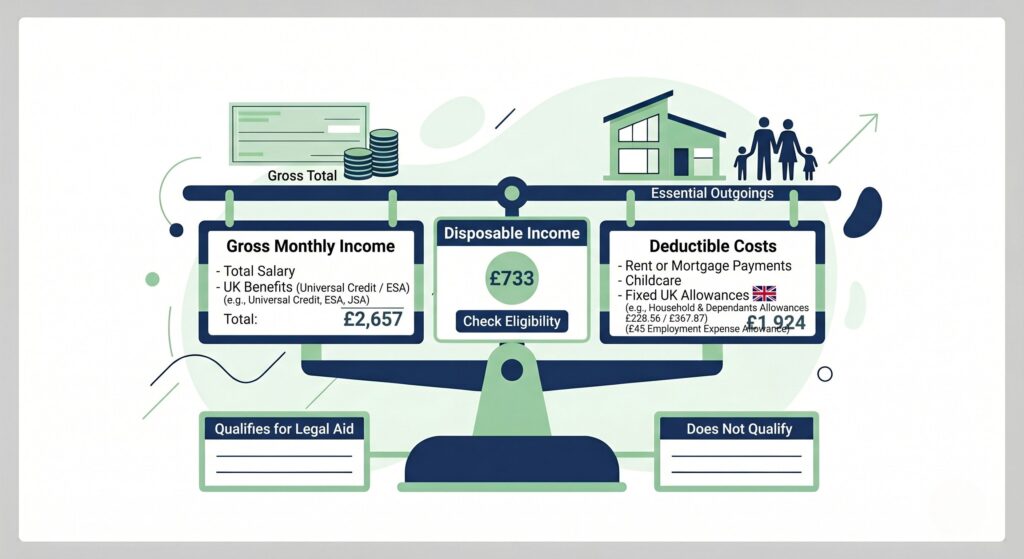
Disposable income This is the bit people genuinely misunderstand. It’s not your total income, it’s what’s left after rent or mortgage, childcare, and other essential costs are taken off. The disposable income limit currently sits around £733 a month. The updated guidance also includes fixed monthly allowances of roughly £228.56 for a partner and around £367.87 for each dependant, plus a £45 employment expense allowance and a housing cost cap in certain cases.
This is exactly why my friend, despite having a “normal” salary on paper, still qualified — once rent and childcare were factored in, her actual disposable income was well below the line. She assumed she’d be rejected before she even applied. Don’t make that mistake. Apply and let the calculation actually run rather than guessing yourself out of it.
Capital and assets Your savings, investments, and home equity get looked at too. The general capital limit is around £8,000, though there are specific allowances if the home you’re living in is part of the actual dispute — more on that below, because it’s one of the most common questions people ask.
What You Actually Need to Bring to the MIAM
Don’t turn up empty-handed. The mediator can’t just take your word for your financial situation — they need actual proof, and if you don’t bring it, you’ll likely need a second appointment, which just delays everything. Bring:
- Bank statements covering the last four weeks
- Your most recent payslip, if you’re employed
- Proof of any benefits (a Universal Credit statement, for example)
- Details of your rent or mortgage payments
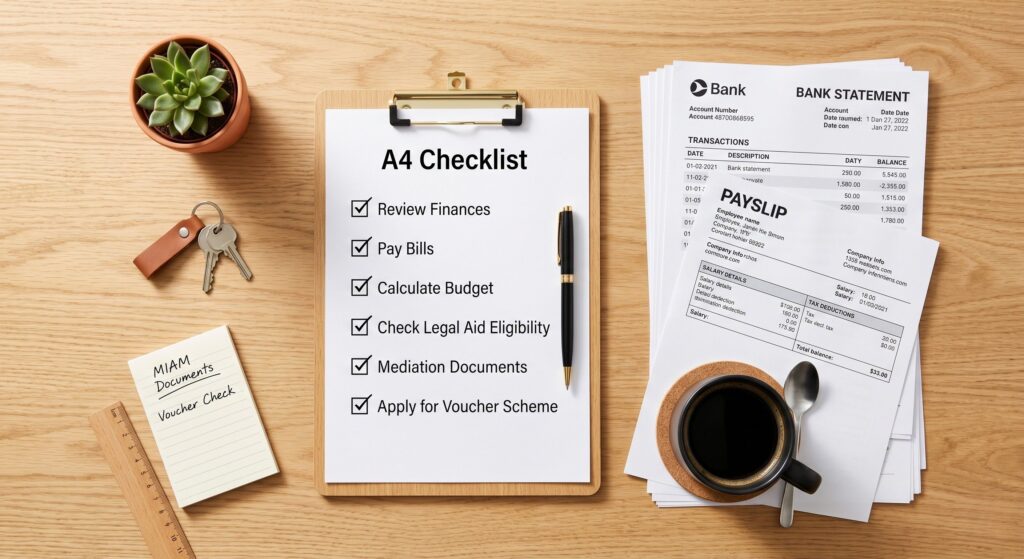
A small lesson from experience here — my friend brought an old payslip from three months earlier because that’s what she had saved on her laptop, and the mediator sent her away to get a current one. It cost her an extra week of waiting. Dig out the most recent one before your appointment, even if it means logging into a payroll portal you’ve forgotten the password to.
If You Don’t Qualify, You’re Not Out of Options
This is the part that gets glossed over constantly. Plenty of people earn just slightly too much to qualify for legal aid but still can’t comfortably afford full mediation fees. If that’s you, look at the Family Mediation Voucher Scheme.
The voucher gives you a one-off contribution of up to £500 towards your mediation costs if there’s a dispute relating to a child, and crucially, it’s available regardless of your income or assets, because it isn’t means-tested at all. You can even apply for the voucher if you’re also eligible for legal aid, although the voucher itself doesn’t cover the MIAM — legal aid is what covers that part.
A couple of practical notes worth knowing: you can only claim one voucher per case, so if your mediation runs over £500 you’ll need to fund the rest privately or look at legal aid instead. As of early 2026, the scheme is still running, though vouchers are subject to availability, so it’s worth double-checking with your mediator that funding is currently accessible before you commit to anything.
Common Mistakes People Make With This Whole Process
After going through this with two different friends, the same handful of mistakes kept popping up:
- Assuming they don’t qualify without actually applying. The disposable income calculation catches a lot of people who assume their salary alone disqualifies them.
- Picking a mediator who doesn’t have a Legal Aid Contract. Not every mediator can offer legal aid — you have to specifically check before booking, otherwise you’ll get to the MIAM and find out it’s not free after all.
- Not realising the voucher and legal aid can sometimes be used together. People often think it’s one or the other, when actually they can overlap depending on the situation.
- Bringing outdated financial documents. As above — it delays everything and means a second trip.
- Giving up after one rejected application. Circumstances change, thresholds get reviewed every April, and a “no” six months ago might be a “yes” now if your income or housing costs have shifted.
Frequently Asked Questions
Can you get a free mediator?
Yes, if you qualify for legal aid through the means test described above, the mediator’s MIAM, joint sessions, and the final agreement document are all provided free of charge. You’ll need a mediator who specifically holds a Legal Aid Contract though — not every mediator offers this.
What is the maximum income to qualify for legal aid?
Your gross monthly income generally needs to be below £2,657 a month, which works out to roughly £31,884 a year, and your disposable income (after housing and childcare costs) needs to be under about £733 a month. These figures are reviewed annually, so it’s worth checking the current threshold rather than relying on last year’s numbers.
What does free mediation mean?
It means the entire cost of the process is covered — the assessment meeting, every joint mediation session, and the paperwork at the end — with no bill landing on your desk afterwards, provided you’ve passed the means test and your mediator is registered to offer legal aid.
Can you get legal aid for criminal cases?
Yes, legal aid for criminal cases works under a separate system with its own means and merits tests, and is generally assessed differently from civil legal aid for mediation. If you’re dealing with a criminal matter, you’d need to check eligibility specifically for criminal legal aid rather than the family mediation route covered here.
Can I get legal aid for divorce?
Solicitor-led legal aid for the divorce process itself was largely removed years ago. However, legal aid is still very much available for mediation, which is why mediation has become the main route for people who want free professional help while separating.
Who can get legal aid for family court?
Eligibility for family court legal aid depends on passing the same kind of means test, although there are some categories — like cases involving domestic abuse — where the rules are more flexible because financial control can be part of the abuse itself.
Can you get legal aid if you own a house?
Possibly, yes. A portion of your home equity is usually disregarded, and if the property itself is the thing being disputed, an even larger amount may be excluded from the capital calculation. Owning a home doesn’t automatically rule you out.
How much legal aid can you get?
For mediation specifically, if you qualify, the cost is fully covered rather than partially funded — there isn’t a capped amount the way there is with the voucher scheme. The voucher route, by contrast, is capped at £500 per case.
A Final Thought
What struck me most after going through this with people I actually know is how much money gets needlessly spent simply because nobody checks. The system genuinely is designed to help people who are already dealing with one of the harder periods of their life — but it only works if you actually go through the MIAM and let someone run the numbers instead of assuming the answer in advance.
If you’re in the middle of this right now, the smartest five minutes you can spend is finding a mediator with a Legal Aid Contract and just asking. Worst case, you find out you don’t qualify and look at the voucher scheme instead. Best case, you’ve just saved yourself thousands of pounds during a time when you really didn’t need another bill.
This article is based on general information and real-world experience and isn’t a substitute for formal advice. Legal aid thresholds are reviewed and can change, so always confirm your specific eligibility with an accredited legal aid mediation provider.
