

Divorce vs. Legal Separation: Which is Right for You?
When a marriage hits a breaking point, the first word that usually comes to mind is “divorce.” However, in the UK, divorce isn’t the only legal path available. For some couples, Legal Separation (officially known as Judicial Separation) offers a middle ground that provides legal protection without actually ending the marriage contract.
As we look at the legal landscape in 2026, choosing between the two depends on your personal values, your financial goals, and your long-term plans. In this guide, we will compare both options side-by-side to help you decide which route is right for your specific situation.
What is the Fundamental Difference?
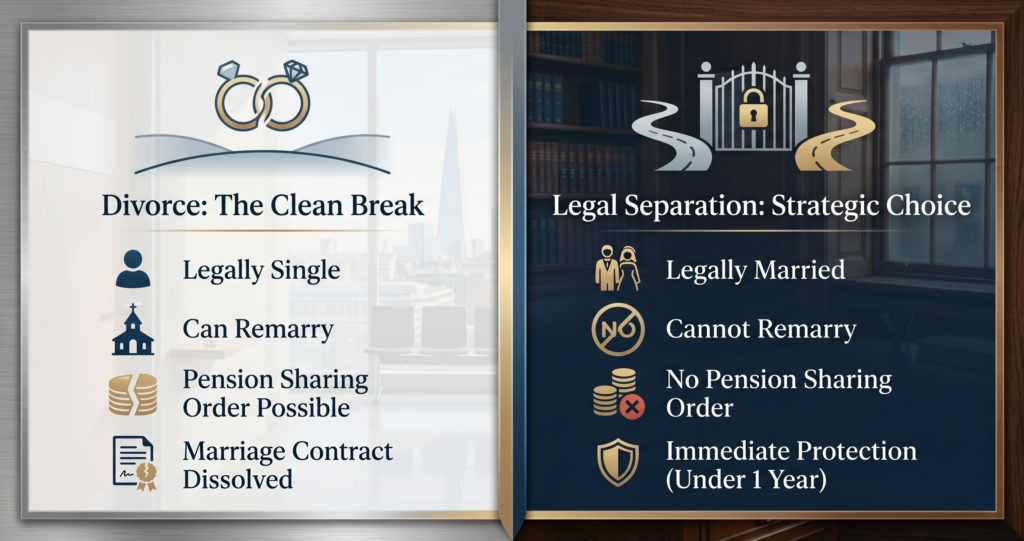
The biggest difference is simple: Divorce ends the marriage; Legal Separation does not.
Divorce: This is a final legal dissolution. Once the Final Order is granted, you are legally single and free to remarry. Your marriage certificate is no longer valid for any legal benefits.
Legal Separation: You remain legally married but are “separated” in the eyes of the court. You cannot remarry because your marriage contract still exists, but you are no longer required to live together or share a life.
Why Choose Legal Separation Over Divorce?
You might wonder why someone would choose to stay legally tied to their partner. There are several strategic and personal reasons for this in 2026:
- Religious or Moral Beliefs: For many, divorce is a social or religious taboo. Judicial separation allows you to live independently and settle finances through the court while respecting your faith.
- The “One-Year” Rule: In the UK, you cannot apply for a divorce until you have been married for at least 12 months. If your marriage breaks down within the first few months, Legal Separation is your only way to get court-ordered protection immediately.
- Preserving Benefits: Since you remain married, you may still be entitled to certain “spousal benefits,” such as health insurance coverage or specific social security rights that would vanish the moment a divorce is finalized.
- Tax and Inheritance: In some cases, staying married allows you to keep specific tax exemptions or inheritance rights that divorcees lose. It can be a pragmatic choice for those managing complex family assets.
Comparing the Costs (2026 Estimates)
Cost is often a deciding factor. In the UK, the court fees differ slightly:
Divorce Fee: Currently 612 pounds. This process requires two orders (Conditional and Final).
Legal Separation Fee: Currently 415 pounds. This is generally a one-step process where the court issues a single Judicial Separation Order.
Note: Solicitor fees for negotiating financial settlements will be similar for both processes, so do not assume that separation is inherently “cheaper” if there are complex financial assets to divide.
The Financial Impact: The “Clean Break”
One major disadvantage of Legal Separation is that it is harder to achieve a “Clean Break.”
In a Divorce, the court can issue a Pension Sharing Order, which splits a pension pot so both parties have their own separate retirement fund. This effectively severs the financial tie.
In a Legal Separation, the court cannot issue a Pension Sharing Order because the parties are still technically married. You can agree on maintenance payments or property division, but your financial futures remain somewhat intertwined. This is why many people view the lack of a “clean break” as the most significant drawback of choosing separation over divorce.
Avoiding Common Mistakes
Many couples rush into a decision without proper guidance. The biggest mistake in a divorce or separation is neglecting to seek early legal advice. People often act out of anger, leading to unfair settlements, or they fail to fully disclose all assets to the court, which can lead to severe legal repercussions later. Always prioritize clear communication and professional counsel over emotional reactions to ensure your future stability.
Frequently Asked Questions (FAQs)

1. Can I change a Legal Separation into a Divorce later?
Yes. Many couples use Legal Separation as a “trial period.” If you later decide that the marriage is truly over, you can apply for a divorce. You will, however, have to pay the divorce court fee at that time.
2. Do I need to prove “fault” for a Legal Separation?
No. Just like the No-Fault Divorce laws of 2022, you do not need to blame your spouse for a Legal Separation. You simply apply to the court stating that you wish to live apart.
3. Does a Legal Separation protect me from my spouse’s new debts?
A Judicial Separation Order formally marks the end of your “marital partnership.” While it helps clarify your separate financial status, it is always best to have a formal Financial Order drafted alongside it to ensure you aren’t held liable for debts your partner incurs after the separation.
4. What happens to my Will if we legally separate?
This is a critical point. In a Divorce, your ex-spouse is automatically “written out” of your Will in most cases. In a Legal Separation, your Will remains exactly as it is. If you want to ensure your spouse doesn’t inherit your estate, you must write a new Will immediately after separating.
5. Can we still live in the same house?
Yes. You can be legally separated while living under the same roof, provided you are leading “separate lives,” which means you are essentially maintaining separate households within the same property.
Conclusion: Which One is Right for You?
If you are certain that there is no hope for reconciliation and you want the freedom to remarry in the future, Divorce is almost always the better option. It provides a clean break and total independence.
However, if you are in your first year of marriage, have strong religious objections to divorce, or need to stay married for specific financial or insurance reasons, Legal Separation provides the legal framework you need to live your life on your own terms.

Important Disclaimer: This content is for informational purposes only. We are not solicitors or legal professionals. The information provided does not constitute legal advice. We strongly recommend consulting a qualified UK solicitor to discuss whether Divorce or Judicial Separation is the best tactical move for your assets and future.