
Let’s be honest — when a marriage breaks down, the last thing anyone wants is a nasty financial surprise on top of everything else. Yet the question of how much does a divorce cost in the UK is one of the most Googled and least clearly answered questions out there. The truth is, there is no single number. Depending on how amicably you and your spouse can separate, you might spend just over a thousand pounds — or, if things turn ugly, you could be looking at tens of thousands.
This guide breaks down every fee you are likely to encounter in 2026 — from the mandatory court application charge to the costs most people never think about until they receive the invoice. Written specifically for people in England and Wales, our aim is simple: no jargon, no waffle, just clear and honest information.
The One Fee Nobody Can Avoid: The HMCTS Court Application Charge
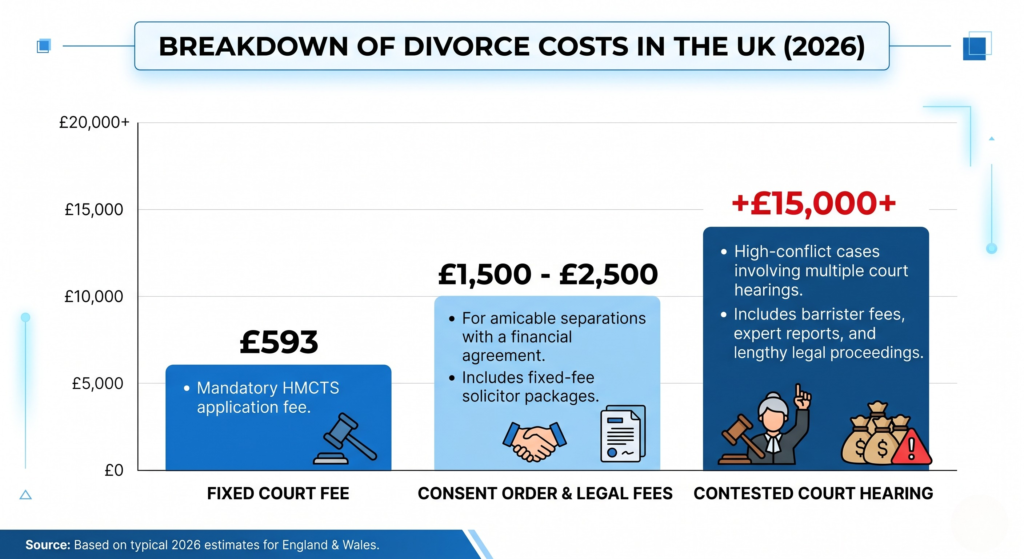
Whatever your situation — whether you are separating by mutual agreement or your spouse has gone completely off the radar — you cannot get divorced in England and Wales without paying the HMCTS application fee.
As of April 2026, that fee stands at £593.
A few things worth knowing:
- If you apply as a sole applicant, you cover the full £593 yourself.
- If you apply jointly with your spouse, you are both free to split it — many couples simply go halves.
- If your income is low, you are on Universal Credit, or your savings are below a certain threshold, you may qualify for Help with Fees (also called Fee Remission). In some cases, the entire fee can be waived.
To check whether you qualify, visit GOV.UK and search for “Help with Fees” — the online application takes about ten minutes.
Do You Need a Solicitor, and If So, What Will It Cost?
This is where costs start to vary considerably. The online divorce portal is genuinely user-friendly for straightforward cases — some people handle the paperwork entirely on their own. However, if you have shared property, children, pensions, or any kind of financial dispute, a solicitor is almost certainly worth the investment.
Fixed-Fee Divorce Packages
For a clean, uncontested divorce where both parties are in agreement, many solicitors now offer fixed-fee packages. In 2026, these typically range from £600 to £1,200 plus VAT. This usually covers all the paperwork from the initial conditional order through to the final order — in other words, the full legal ending of the marriage.
Hourly Rates for Complicated Cases
If there are disputes — over property, money, or the children — solicitors will bill by the hour. Rates in 2026 generally fall between £200 and £400 per hour, though firms in London or other major cities often charge at the higher end of that scale. It is worth getting written quotes from two or three firms before committing.
The Costs That Catch People Off Guard
The £593 court fee ends your marriage on paper. But for most couples, the harder part is dividing everything you have built together — and that process brings its own set of charges.
Financial Consent Order — £60 court fee, plus £800–£2,500 in solicitor fees
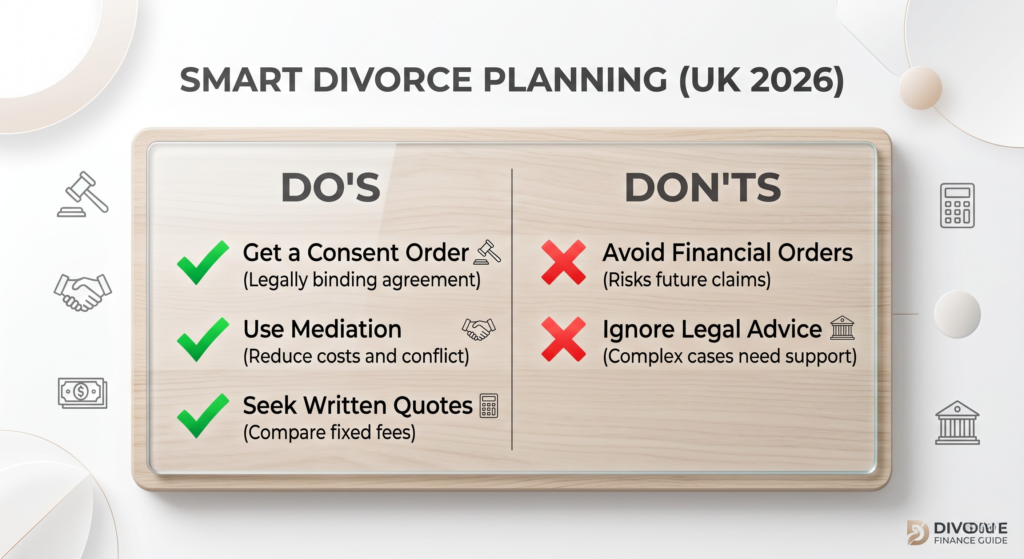
A Consent Order is the document that makes your financial agreement legally binding. Without one, your ex-spouse could — in theory — make financial claims against you years down the line, even after the divorce is finalised. The court fee to submit the order is just £60, but having a solicitor draft it properly typically costs between £800 and £2,500 depending on complexity.
Child Arrangements Order — £263 court fee
If you and your former partner cannot agree on where the children will live or how much time they will spend with each parent, you can apply for a Child Arrangements Order. The application fee is £263. Bear in mind that proceedings over children can also involve solicitor time, which adds to the total.
Mediation — £100–£200 for an initial MIAM, then £200–£400 per session
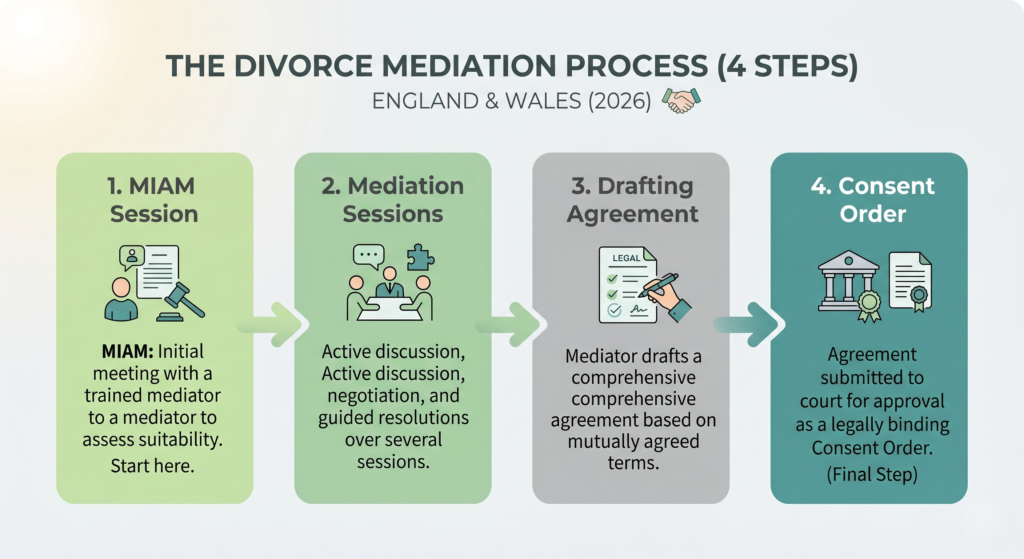
Before most people can apply to court about finances or children, they are legally required to attend a Mediation Information and Assessment Meeting (MIAM). This initial session with a trained mediator costs around £100 to £200. Full mediation sessions that follow typically cost between £200 and £400 each.
Here is an important figure to keep in mind: the average cost of settling finances through mediation is roughly £1,500. Taking the same dispute to a full court hearing can easily run to £15,000 or more. Mediation is not a perfect solution for every couple, but the cost savings can be enormous.
Further Costs You May Not Have Considered
Property and Business Valuations — £300 to £1,000+
If you jointly own a home or a business, the court will generally need an independent professional valuation before any financial order can be finalised. A standard residential survey can cost from £300 upwards, while a business valuation by a specialist accountant may run considerably higher.
Pension Actuary Reports — £1,000 to £2,500
Pensions are often the most valuable asset in a divorce — sometimes worth more than the family home. If either party has a defined benefit pension (such as an NHS, teacher’s, or police pension), an actuarial report may be needed to calculate a fair split. These reports typically cost between £1,000 and £2,500 depending on the scheme’s complexity.
Process Server Fees — Approximately £100 to £200
If your spouse refuses to acknowledge receipt of the divorce papers, you may need to hire a professional process server to hand-deliver the documents in person. This service generally costs between £100 and £200.
Frequently Asked Questions
Is it safe to handle a divorce yourself to save money?
Doing the divorce application yourself — sometimes called a DIY divorce — is perfectly safe when it comes to ending the marriage itself. The online portal is reasonably straightforward, and plenty of people complete it without professional help. Where the risk lies is in the financial settlement. If you skip the Consent Order, your ex-spouse retains the right to make financial claims against you in future, potentially years after the divorce is finalised. The general advice from family law practitioners is this: do the divorce yourself if you are comfortable doing so, but pay a solicitor to handle the financial order.
Can I make my spouse pay for the divorce?
Under the previous fault-based system, it was common for applicants to seek a costs order against the respondent. Under the no-fault divorce rules now in place, courts are far less willing to make such orders. In most cases, both parties simply pay their own legal costs. There are exceptions, but they are unusual.
Does mediation actually save money in practice?
Yes — and often dramatically. A mediated financial settlement typically costs around £1,500 in total. A contested financial hearing in the Family Court can easily cost £15,000 to £30,000 once you factor in both parties’ solicitor fees, barrister costs, and court time. Even in cases where mediation only resolves part of the dispute, it can significantly reduce what needs to be decided by a judge.
What if I simply cannot afford a solicitor?
Legal aid for divorce is now very limited in England and Wales — it is mainly available in cases involving domestic abuse, with strict eligibility criteria. That said, there are alternatives. Law Works clinics offer free legal advice sessions in many areas. Some solicitors also offer unbundled legal services, where you pay only for specific tasks — such as reviewing a draft Consent Order — rather than hiring them to manage the entire case. Citizens Advice can also help with basic guidance at no cost.
How much does a divorce cost if both parties agree?
If you and your spouse are in full agreement — on the divorce itself, the finances, and any arrangements for children — your total costs can be kept quite low. The court application fee of £593, combined with a fixed-fee solicitor package for the Consent Order, means a cooperative divorce can often be concluded for somewhere between £1,500 and £2,500. This assumes no significant disputes and no need for valuations or actuary reports.
Is an online divorce a good option?
The HMCTS online portal is the standard route for most divorces in England and Wales — it is not a separate service but the official digital way to apply. It works well for straightforward cases. Various private online divorce services also exist to guide you through the process for a fixed fee, though these vary in quality. If you choose one, make sure it is staffed by qualified legal professionals, not simply a form-filling service.
A Realistic Summary of Likely Costs in 2026
To give you a clearer picture, here is what different types of divorce might realistically cost in total:
- Uncontested DIY divorce (no financial order): approximately £593 — the court fee alone.
- Uncontested divorce with a Consent Order handled by a solicitor: typically £1,500 to £2,500 in total.
- Divorce involving property, pensions, or business assets (settled without court proceedings): commonly £3,000 to £8,000.
- Fully contested financial proceedings reaching a final hearing: £15,000 to £30,000 or more, and potentially considerably higher in complex cases.
Final Thoughts
A divorce does not have to be financially ruinous, but it does require you to go in with your eyes open. The single most important piece of advice in this guide is this: get a Financial Consent Order. It is the document that protects you once everything is settled, and the cost of getting it right is almost always far less than the cost of not having one.
If you and your spouse can keep communication respectful and make decisions based on practicality rather than emotion, the process can be managed well within a sensible budget. The couples who face the highest bills are almost always those whose cases end up in prolonged court proceedings — and in most cases, that outcome could have been avoided.
Whatever your circumstances, we hope this guide has given you a clearer picture of what to expect financially. The more informed you are at the start of the process, the better placed you will be to make decisions that work for everyone involved.
Important Disclaimer: This article is intended for general informational purposes only and does not constitute legal advice. All fees and cost estimates are based on publicly available information as of 2026 and may vary depending on individual circumstances and future changes to court fee schedules. Always seek a written quote from a qualified solicitor before making decisions about your specific situation.

James Whitfield is a senior legal researcher with over a decade of experience in UK family law and civil rights. He founded LegalFacts.uk to make complex legal information simple and accessible for everyday people across the United Kingdom.