
I still remember the night my sister called me at 11pm, crying about solicitor quotes for her custody arrangement. £250 an hour just for a “consultation.” She hadn’t even started the actual case yet and was already looking at thousands of pounds in fees.
That’s when I told her about the Family Mediation Voucher Scheme. She was sceptical — “free money from the government? Sounds like a scam.” Fair enough, that’s how most of us react to anything that sounds too good. But I’d actually gone through it myself two years before during my own separation, so I knew it was real. I walked her through the whole thing, and honestly, watching her go from panicking about legal bills to having her first session covered for free was satisfying enough that I figured I’d write all of this down properly.
So here’s everything I learned the hard way — the eligibility rules, what the voucher actually covers, the mistakes people make, and the questions everyone ends up googling at 2am when they’re stressed about money and custody at the same time.
What Exactly Is the Family Mediation Voucher?
Let’s get the basics out of the way without making it sound like a government leaflet.
The Family Mediation Voucher is a one-off £500 contribution from the Ministry of Justice that goes straight to your mediator, not into your bank account. It’s there to help separating parents sort out arrangements for their kids without dragging each other through court. Think of it less like a “voucher” you print out and more like a credit note sitting on your mediation file.
The big thing that surprised my sister (and honestly surprised me when I first applied) was this: it doesn’t matter how much you earn. This isn’t Legal Aid. You could be a company director or someone working part-time at Tesco — income and savings genuinely don’t come into it. The only thing that matters is what your case is actually about.
Who Actually Qualifies (Read This Before You Get Excited)
This is where people trip up, so pay attention.
You qualify if your dispute involves:
- Child arrangements — where the kids live, contact schedules, school decisions, that sort of thing
- “All issues” mediation — when you’re sorting out finances AND children together in the same mediation process
What trips people up: if you’re only arguing about the house, savings, or pension splitting with zero children involved, you can’t claim this voucher. I’ve seen people get genuinely upset about this on forums because they assumed “family mediation” automatically meant they qualified. It doesn’t. No kids in the mix, no voucher.
How the Voucher Actually Works (Step by Step)
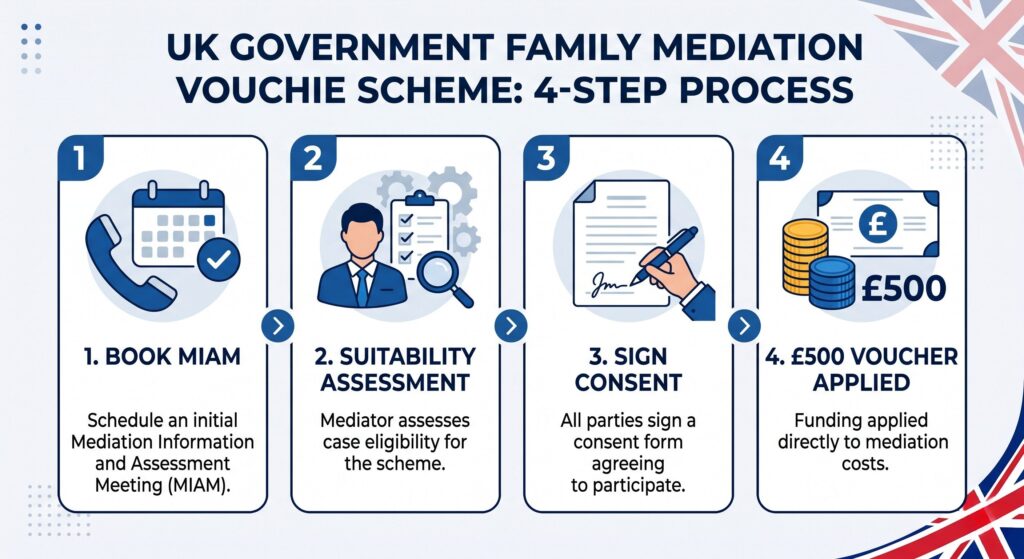
Nobody hands you a physical voucher. There’s no QR code, no email with a coupon attached. It’s all handled between your mediator and the Family Mediation Council behind the scenes. Here’s how it played out for me:
Step 1: Book your MIAM
Both you and your ex need to attend separate Mediation Information and Assessment Meetings. Yes, separate — you’re not in the same room for this part, which honestly made things a lot less tense for me.
Step 2: Get assessed for suitability
During the MIAM, the mediator checks whether mediation is even appropriate for your situation (if there’s been domestic abuse, for example, mediation usually isn’t suitable, and that’s a different process entirely).
Step 3: Sign the consent form
You’ll sign something allowing the mediator to apply for the voucher on your behalf. Takes about two minutes.
Step 4: The credit lands
The £500 gets applied directly against your joint session costs. Your future sessions get discounted or fully covered until that £500 runs dry.
The whole administrative side took less than a week in my case, though I’ve heard it can vary depending on how busy the mediation service is.
What the Voucher Will and Won’t Pay For
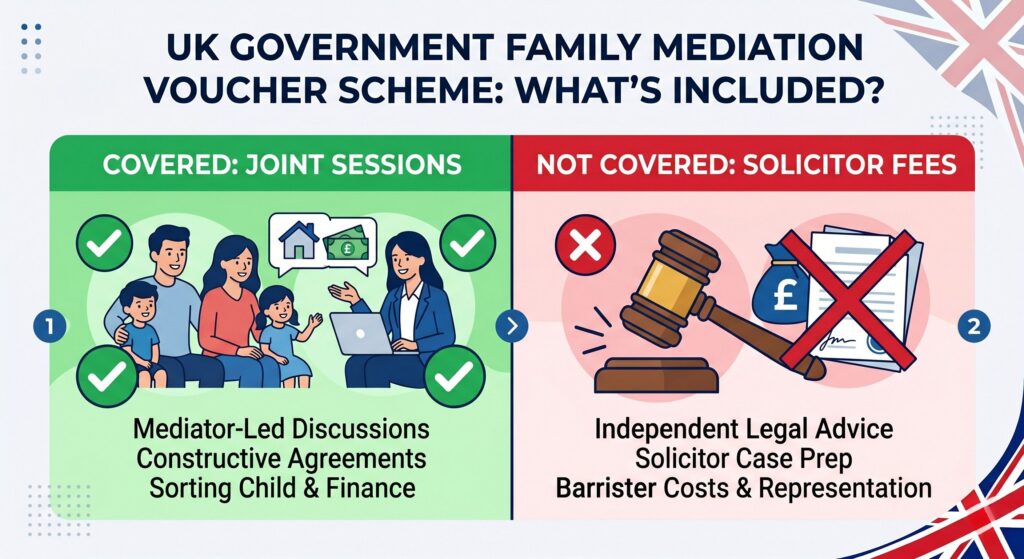
This is the bit nobody explains clearly enough, so let me break it down properly.
It covers:
- Joint mediation sessions (this is the main one)
- Child-Inclusive Mediation, where a trained mediator actually speaks with your children to understand what they want — this was genuinely one of the most useful parts of my process
It does NOT cover:
- Your initial MIAM (you pay for that separately, usually £100–£150 depending on the mediator)
- Solicitor fees of any kind
- A second voucher if you’ve already used one
That last point catches people out constantly. You only get one voucher per family, per case — doesn’t matter if you’ve got four kids or twelve complicated issues to sort through. Once it’s gone, it’s gone, and you’re paying the mediator’s normal hourly rate after that.
Real Costs: How Much Does Family Mediation Actually Cost in the UK?
Since people search for this constantly, let’s talk real numbers.
Mediation sessions typically run between £100 and £200 per person, per session, depending on where you live and how experienced the mediator is. London rates run higher than say, somewhere in the Midlands. Most couples need anywhere from 3 to 6 joint sessions to reach a full agreement, though simpler cases can wrap up in fewer.
So without the voucher, you could be looking at £600–£1,200 total for the mediation process alone. The £500 voucher genuinely takes a massive chunk out of that, sometimes covering the entire thing if your case is straightforward.
Do Both Parents Pay for Mediation?
Generally, yes — both parents split the cost of joint sessions, usually 50/50. But here’s a scenario that actually happens more than you’d think: if one parent qualifies for Legal Aid and the other doesn’t, the Legal Aid parent’s sessions are completely free, while the other parent uses the £500 voucher to cover their half. In a lot of cases, this means mediation ends up costing nothing for either person. My sister’s situation was almost exactly this — her ex qualified for Legal Aid, and the voucher covered her side entirely.
Can I Get Free Mediation?
Short answer: sometimes, yes. Here’s how:
- Legal Aid — if you’re on a low income or receiving certain benefits, you may qualify for fully free mediation, including the MIAM itself
- The voucher stacking with Legal Aid — as mentioned above
- Some local councils and charities run subsidised or free mediation schemes, though availability really depends on your area
If you’re searching for “free mediation services near me,” your first stop should genuinely be the Family Mediation Council’s website, which lists accredited mediators near your postcode along with whether they offer Legal Aid.
How to Apply for Family Mediation (The Actual Process)
People assume there’s some separate “application” for the voucher itself, but there isn’t. Here’s the real sequence:
- Find an FMC-accredited mediator (search by postcode on the official FMC website)
- Book your individual MIAM
- Mention during the MIAM that you’d like to be considered for the voucher scheme — most mediators will bring it up themselves, but don’t assume, ask
- If eligible, sign the consent form
- Your ex-partner attends their own MIAM too
- Joint sessions begin, with the voucher applied automatically against the costs
Common Mistakes I See People Make
After going through this myself and helping my sister through it, here’s what trips people up most:
- Assuming finances-only disputes qualify — they don’t, unless children are involved too
- Forgetting the MIAM isn’t covered — people get annoyed when they’re charged for the initial meeting, not realising the voucher only kicks in afterward
- Waiting too long to apply — funding is first-come, first-served each financial year, and once the annual budget’s used up, the scheme can pause until the next cycle
- Choosing a non-accredited mediator — only FMC-accredited mediators can process the voucher, so always double-check before booking
- Thinking they can get a second voucher for a new dispute later — nope, it’s one per case, period
What Not to Say in Family Mediation

This one matters more than people realise, because mediation isn’t like a normal conversation — the wrong wording can genuinely derail a session. From what I experienced and watched my sister go through, avoid:
- Bringing up the affair, the breakup reasons, or “who’s at fault” — mediation is about arrangements going forward, not relitigating the past
- Ultimatums like “I’m not agreeing to anything unless…” — mediators are trained to spot this and it usually just stalls progress
- Using the kids as leverage (“you’ll never see them if…”) — this is exactly the kind of thing that gets flagged as a red line by mediators
- Legal threats mid-session (“my solicitor says…”) — it shifts the tone from cooperative to adversarial instantly
- Speaking for your children (“they told me they want to live with me”) unless it’s actually true and relevant — kids’ wishes get explored properly through Child-Inclusive Mediation, not hearsay
Basically: stick to facts, stick to the future, and let the mediator manage the emotional landmines. That’s literally their job.
The 2026–2027 Funding Situation
Worth flagging — the Ministry of Justice confirmed funding continues through the 2026–2027 financial year, but the pot isn’t bottomless. Vouchers go on a first-come, first-served basis, and once that year’s budget runs out, new applications can pause until fresh funding kicks in. If you know mediation is coming, don’t sit on it for months — get your MIAM booked early.
Frequently Asked Questions
Can I get free mediation?
Yes, in certain situations. If you qualify for Legal Aid, your sessions (including the MIAM) can be entirely free. If your ex-partner is on Legal Aid and you’re not, you can use the £500 voucher to cover your half, which can make the whole process free for both of you.
How much does family mediation cost in the UK?
Without any funding, expect £100–£200 per session per person, with most cases needing 3–6 joint sessions. That puts total costs around £600–£1,200, though the £500 voucher significantly reduces this for eligible cases.
What not to say in family mediation?
Avoid blame-focused comments about the relationship breakdown, ultimatums, threats involving solicitors, or using your children as bargaining chips. Stick to discussing practical arrangements going forward.
What not to say during mediation?
Same principle applies generally — don’t make accusations, don’t issue conditions or threats, and avoid claiming to speak on your children’s behalf unless it’s been properly explored through the mediator.
Do both parents pay for mediation?
Typically yes, split 50/50 for joint sessions, unless one or both qualify for Legal Aid or the voucher, which can reduce or eliminate that cost.
Is the voucher available for online mediation?
Yes, and honestly most people use it for online sessions now. It’s just as valid as meeting in person, and a lot more convenient if you and your ex live in different areas.
Do I have to pay the money back if we don’t reach an agreement?
No. The voucher is a contribution toward attempting mediation, not a loan. Even if things don’t work out and you end up in court anyway, you keep the £500 — no repayment required.
How to apply for family mediation?
Find an FMC-accredited mediator through the Family Mediation Council’s directory, book your MIAM, and ask about voucher eligibility during that meeting.
Final Thoughts
Going through separation is hard enough without worrying about legal bills piling up on top of everything else. The Family Mediation Voucher isn’t going to solve every problem, and it definitely won’t make the emotional side of things easier — but it does take one massive stressor off the table, and that’s worth something.
If you’re in the position my sister was in a few months back, just go book that MIAM. Ask directly about the voucher. Don’t assume your mediator will automatically bring it up, and don’t wait around hoping things sort themselves out, because the funding genuinely does run out before the financial year ends. The £500 won’t last forever, but while it’s there, it’s one of the few genuinely useful things the system offers separating parents.

Sarah Mitchell is a family law specialist with a strong background in child arrangements, custody disputes, and family mediation. She joined LegalFacts.uk to help parents across the UK understand their legal rights and make informed decisions for their children’s future.